
In Kozhikode, farmer Venu nurtures 70 rare rice varieties, turning his fields into a living library of Kerala’s grain heritage
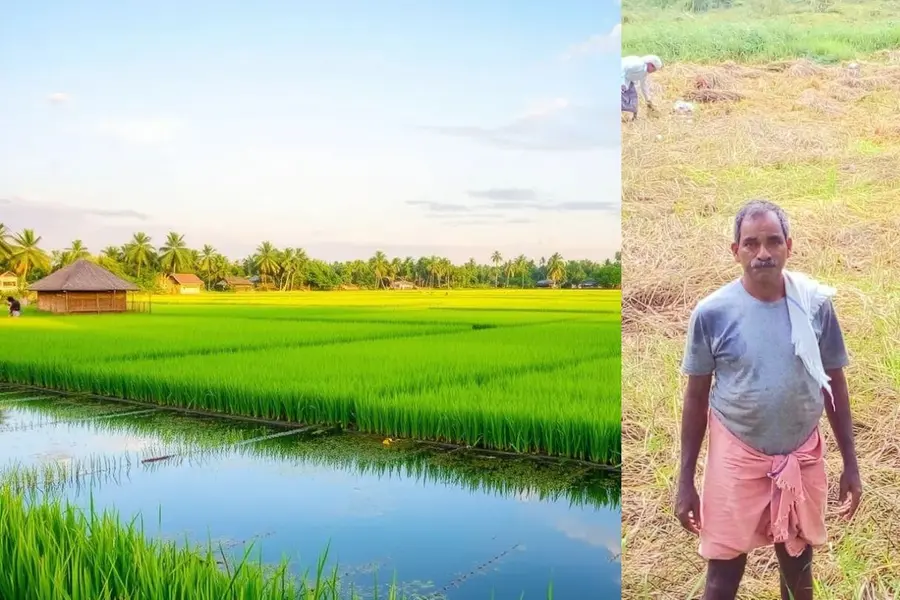
Kozhikode: As the month of Chingam ushers in the Malayalam New Year, paddy fields across Kerala begin to stir with new life. In one such field in Kozhikode, however, something extraordinary is unfolding. Here, farmer Venu of Pallikkara Thazhe Illam is not merely sowing rice—he is sowing heritage, memory, and hope.
Venu tends to a living seed bank of nearly 70 rare and traditional rice varieties, each with a story, a history, and a healing touch. His farm is a patchwork quilt of colors and textures—black, red, golden, violet—representing generations of farming wisdom that modern agriculture often overlooks.
A Keeper of Forgotten Seeds
His collection includes some of Kerala’s most treasured grains: the medicinal Navara, the iron-rich Rakthashali, and the striking Black Jasmine with its jet-black husk. Alongside them thrive varieties like 60-aam Kuruva, Kuthir, Annapoorna, Jyothi, Krishna Kamod, Athira, and Uma. Many of these are heirloom seeds, some sourced painstakingly from other Indian states, others exchanged in a unique farmer-to-farmer barter.
Whenever Venu shares seeds, he requests a new variety in return. Over time, this “seed exchange friendship” has grown into an informal network that sustains biodiversity while weaving bonds between farmers.
Beyond Yield: The Temple Farmer
What makes Venu’s grain even more special is its cultural resonance. Temple authorities regularly seek him out for rice used in Illam Nira rituals, while officials from the Krishi Bhavan turn to him for rare seeds. Unlike commercial rice that is stripped of nutrition in processing, Venu mills his harvest by hand, carefully retaining the rice bran, which he says enhances medicinal properties and adds unmatched flavor.
Rice as Medicine
For Venu, rice is not just food—it is medicine, memory, and faith.
- Navara, with black seeds that yield red rice, is traditionally consumed during Karkidakam for healing.
- Rakthashali is fed to children to improve blood health.
- Black Jasmine is prized for its therapeutic qualities.
- The straw of Dabharshali glows with shades of green and violet.
- Krishna Kamod, once favored by royalty, shimmers with violet hues.
- Varinnellu, known to fight fatigue, even has medicinal roots.
Each grain Venu grows tells a story of resilience and healing, carrying forward Kerala’s indigenous knowledge systems.
An Uphill Journey
The path, however, is not easy. Organic farming yields less than chemical-intensive methods, and leasing land, paying for pumps, and sourcing natural fertilizers stretch Venu’s finances thin. He points out that even schemes like the employment guarantee program rarely provide labor for paddy fields. Yet, despite the hardships, he refuses to compromise on his principles.
For him, rice farming is not a commercial pursuit but a sacred duty—an act of preservation for the generations to come.
A Teacher in the Fields
Recognizing the importance of passing on this legacy, Venu regularly invites schoolchildren into his fields, guiding them through the world of paddy and seeds. He organizes exhibitions where people can see, touch, and learn about forgotten varieties. His work has earned him recognition, including an award from the Thikkodi Krishi Bhavan, but for Venu, the greatest reward lies in keeping alive Kerala’s relationship with its native rice.
More Than a Farmer
Standing in his fields, surrounded by stalks of red, black, and golden rice, Venu is more than just a cultivator. He is a custodian of tradition, a guardian of biodiversity, and a storyteller of seeds.
In a time when modern agriculture often prioritizes yield over diversity, Venu’s fields in Kozhikode whisper an older truth—that farming is not merely about feeding bodies, but about nourishing cultures, communities, and the land itself.
Published: 20 Aug 2025, 10:42 pm IST
Related Topics
Disclaimer: Kindly avoid objectionable, derogatory, unlawful and lewd comments, while responding to reports. Such comments are punishable under cyber laws. Please keep away from personal attacks. The opinions expressed here are the personal opinions of readers and not that of Mathrubhumi.
