
As in Kooriyad, the soil on the Kottiyam highway was unable to bear the load above, causing it to give way and pushing the service road to the side.
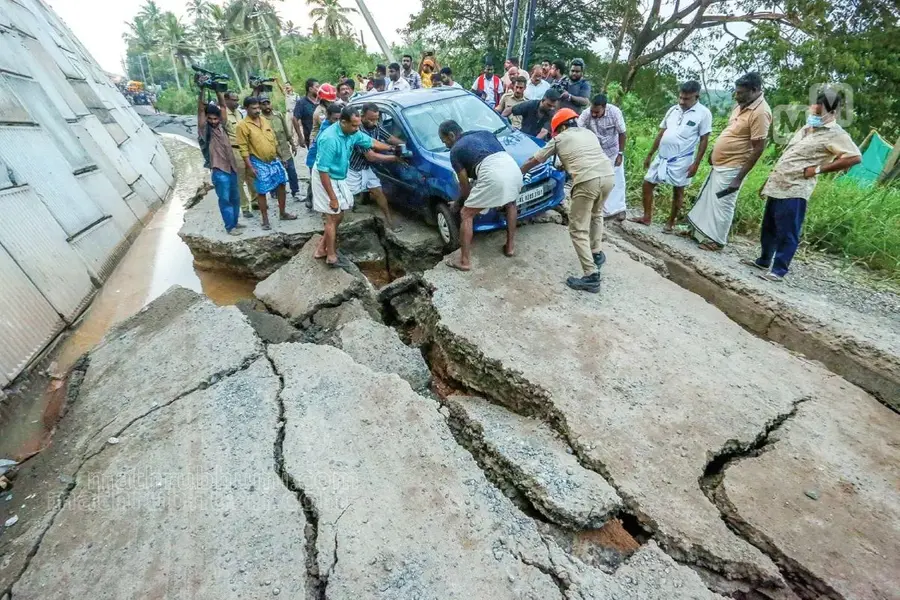
Kollam, Kerala: A landslide at Mylakkad, Kottiyam, has sparked concern, with experts pointing out its resemblance to the National Highway collapse at Kooriyadu, Malappuram, earlier this year.
In this section, the highway traverses paddy fields, where the underlying soil is loose and waterlogged. The newly constructed road was built by raising the level with filled earth, while service roads run beneath it.
Also Read

The soil that had been packed and reinforced between the concrete slabs for months subsided entirely, causing the cracks on the service road to widen. The road, the concreted water drain, and even the protective wall of the adjoining canal all collapsed. Electricity poles along the roadside also leaned dangerously, heightening fears of accidents.
As in Kooriyad, the soil was unable to bear the load above, causing it to give way and pushing the service road to the side. Both sides of the road are flanked by waterlogged fields, and a canal runs beneath to carry drainage. According to National Highways Authority guidelines, elevated roads should be built in such areas. However, based on the Detailed Project Report (DPR) prepared in 2018, the contractor opted to build an embankment using earth fill, a plan approved by National Highway officials.
Constructing an elevated road on pillars requires more time and increased costs. To avoid this, the contractor raised the road using filled earth, a method that can be risky if the soil is unstable. Following the Kooriyad collapse, safety inspections were conducted across ongoing construction sites, but the Mylakkad stretch had not reached an advanced enough stage at the time, and the authorities failed to detect the risk.
Guidelines stringent only on paper
The Ministry of Road Transport and Highways has issued strict guidelines to prevent landslips during construction, but allegations persist that many of these are not being followed in Kerala. Since several projects began before the new rules were introduced, authorities argue that strict enforcement is difficult.
A topographical survey is mandatory to prevent landslips. Soil composition must be tested, and anti-erosion measures implemented. A LiDAR drone survey must be conducted within a 300-metre radius of the construction site to assess landslip risks, and historical satellite imagery must also be analysed. Detailed project reports should be based on studies by the National Remote Sensing Agency (NRSC). Geological and geotechnical studies are compulsory and must be carried out during the monsoon, when the ground is at its weakest.
There are also strict conditions to prevent hazards during work. Adequate drainage must be provided throughout construction. Excavated earth, rocks and debris must be removed without causing environmental damage. Following the accidents at Kooriyad and Karnataka’s Shirur, these guidelines were updated last month.
Frequent accidents during NH construction in Kollam
A series of accidents has occurred during National Highway construction works in Kollam, often attributed to negligence and unscientific practices. Two migrant workers have died in recent incidents, and several major mishaps have been narrowly avoided.
On November 11, a migrant labourer, Mohammed Jubrail (42) from Bihar, died after being buried under soil while it was being levelled with machinery near the Kureepuzha–Kavanad bridge link road.
On July 21, another migrant worker, Vinod Singh (47), a security guard from Bihar, was killed when an iron beam fell on his head during the construction of the new Neendakara bridge.
On July 14, at Kottiyam Junction, a large concrete slab broke off a wall and fell onto a woman riding a scooter during highway works, injuring a woman named Tasleema (28). A more serious accident was avoided because it did not hit her head.
On June 11, the service road of the highway sagged at Palathara while a water drain was being built as part of the six-laning project. The incident occurred near Palathara junction on the Kollam bypass.
On May 8, a private bus collided with a JCB engaged in road work at Paripally, injuring 19 people, including the driver. While a slab was being placed, the loader’s bucket unexpectedly dropped onto the service road, leaving the bus driver no time to brake.
On March 25, three migrant workers were injured when the road caved in near the Palkulangara temple on the Kollam bypass during construction.
On February 7, a landslip occurred near the Kallumthazham railway overbridge, halting traffic. The incident happened while the service road was being built using earthmovers. The same area experienced another landslip in July.
On November 28, 2024, a bridge under construction near Ayathil junction on the bypass collapsed while concrete was being poured. Workers escaped miraculously.
Published: 06 Dec 2025, 01:11 pm IST
Disclaimer: Kindly avoid objectionable, derogatory, unlawful and lewd comments, while responding to reports. Such comments are punishable under cyber laws. Please keep away from personal attacks. The opinions expressed here are the personal opinions of readers and not that of Mathrubhumi.