
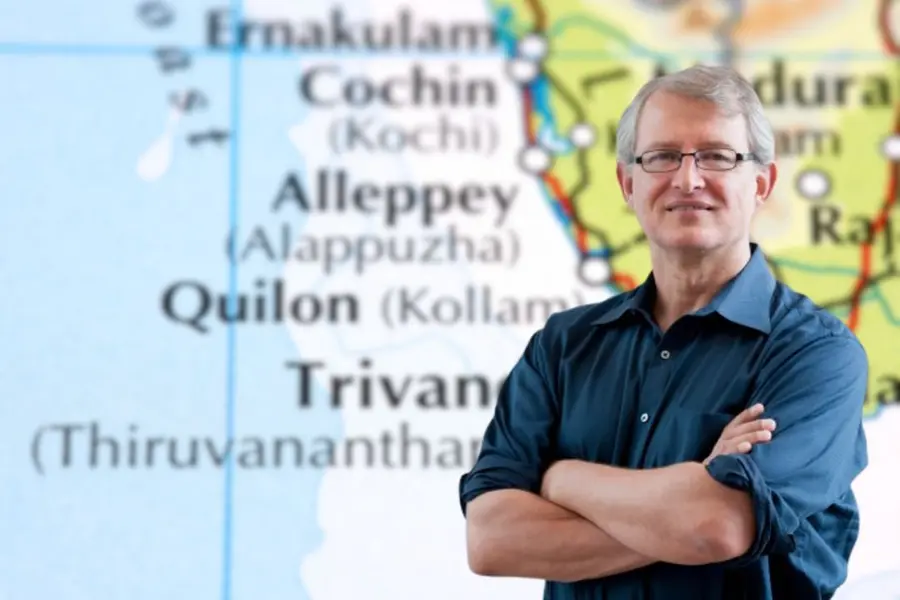
Patrick Heller, a renowned sociologist and professor at Brown University, has a deep connection to Kerala, marked by his extensive research on the state's unique developmental model, social democracy, and participatory governance.
His academic journey began with a Ph.D. dissertation at the University of California, Berkeley, examining the role of the state and class dynamics in Kerala’s redistributive development. His 1999 book, The Labour of Development: Workers and the Transformation of Capitalism in Kerala, India, explores how Kerala’s labour-driven approaches have shaped its development.
Heller has received multiple research grants, enabling in-depth studies on decentralisation and local governance. He has shared insights at prominent conferences and written opinion pieces for major Indian news organisations, including on Kerala’s COVID-19 response.
As Kerala marks its 68th anniversary of state formation on November 1, Mathrubhumi presents an interview with Heller, where he discusses the state's developmental model, social democracy, and the challenges ahead.
Here are some excerpts of the interview:
Do you follow recent socio-political developments in Kerala? Please share your notable observations.
An interesting development from Kerala is that a Bhartiya Janata Party candidate has won as a Member of Parliament (MP). This is surprising, but thankfully, the remaining 19 parliamentary seats out of 20 were won by secular parties. However, Kerala still remains politically distinct from other states.
On the economic front, Kerala has focused on the information and knowledge economy. One unique feature is that in many parts of the world, such policy shifts are pushed by technocrats and businessmen. In Kerala, the public has a voice. It is more inclusive and democratic.
In the case of natural disasters and tragedies, we can observe how people unite in the state. They have strong neighbourhood bonds and a deep concern for fellow citizens. We also see that local governments are more proactive compared to other states. Kerala’s COVID-19 mitigation response resonates with this.
Religious fundamentalism is thriving in a section of Kerala's society. Could you cite any socio-cultural-political reasons?
It is a global phenomenon, whether in Latin America or the US. In the case of Kerala, we can see better representation of women and lower-class individuals on one side. The people are becoming more aspirational. However, with limited resources, feelings of insecurity may affect some individuals. Thus, it is natural that some find comfort in religious fundamentalism and the act of othering. One can be deeply religious and conservative, but not at the cost of denying the rights of people who believe in other religions.
Kerala sees a large number of students going abroad for studies and jobs. As someone familiar with the socio-cultural context of Kerala, what might be the reasons?
Here again, it is a global phenomenon. I work at a US university, and we have more Chinese students migrating here than Indians. China has a better economy and more opportunities than India. Still, they are coming to the US for higher studies, which is natural. People in Kerala are more likely to go abroad than those from Bihar because Keralites have better primary education, are aware of global institutions, and have aspirations for greater exposure. Nonetheless, a pertinent question arises: do they return to Kerala? In the past, many returned to Kerala, established businesses in the state, and contributed positively to its economy. They also brought remittances. However, Kerala needs to focus on high-quality higher education institutions.
What positive and negative changes have been observed in Kerala?
Kerala has a track record of not having a promising economy as its focus was on social development and resource distribution. However, if we look at the last 30 years, we can see that the economy is also catching up. Growth in the IT and tourism sectors and a burgeoning entrepreneurial spirit have turned favourable for the state. The state also has a robust informal sector. However, like any other part of the world, inequality is widening. Being a delicate ecology poses threats of environmental issues, making the state vulnerable.
As we celebrate Kerala Piravi Day, what message would you like to convey to the people of Kerala?
Politically, we must choose whether to invest in democracy or autocracy. We face complicated scenarios, especially in the age of identity politics. We should be more open, find solutions, deliberate, and maintain the notion that Kerala is the most democratic place in India.
Published: 01 Nov 2024, 08:01 am IST
ABOUT THE AUTHOR

Related Topics
Disclaimer: Kindly avoid objectionable, derogatory, unlawful and lewd comments, while responding to reports. Such comments are punishable under cyber laws. Please keep away from personal attacks. The opinions expressed here are the personal opinions of readers and not that of Mathrubhumi.