

The 2025 local body verdict has unsettled Kerala’s political equations. With the LDF losing ground, the UDF regaining momentum, and the BJP making strategic urban gains, the results offer early clues to how the 2026 Assembly battle could unfold.
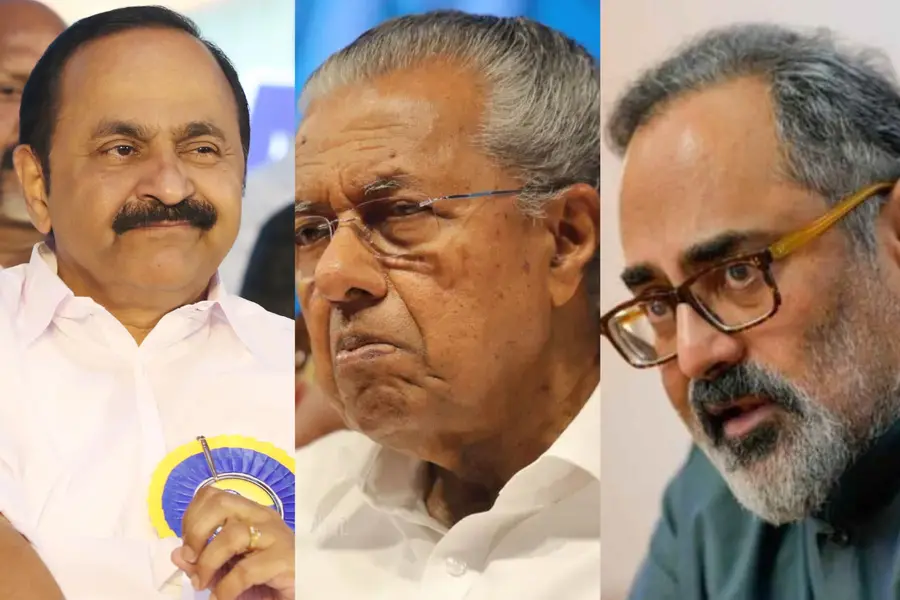
As vote counting kicked off on Saturday morning in the Kerala Local Body Elections 2025, television screens were flooded with images of CPM’s Chief Minister Pinarayi Vijayan, BJP’s Rajeev Chandrasekar, and Congress leaders, including VD Satheesan, KPCC president Sunny Joseph, and veteran Ramesh Chennithala. Curiously, flashes of Shashi Tharoor also made brief appearances, underscoring the ongoing uncertainty over who might emerge as the face of the Congress-led UDF ahead of the 2026 Assembly elections.
Despite speculation over who might lead the UDF in 2026, the local body results made it clear that voter decisions were influenced less by individual leaders and more by broader political and local issues. Internal Congress rifts, including repeated interventions by the AICC over the Palakkad MLA Rahul Mamkootathil controversy, seemed to have minimal direct impact on voting behaviour. Kerala’s electorate, historically unpredictable, once again confounded expectations, with Saturday’s trends painting a difficult scenario for the CPM-led LDF. The controversy surrounding Mamkootathil had little effect on voter confidence, while BJP’s surprising wins, especially in Tripunithura Municipality, underscored emerging political shifts. Meanwhile, the Sabarimala gold theft row, expected to benefit BJP in Pathanamthitta, backfired as the LDF unexpectedly took control of Pandalam Municipality.
Anti-incumbency hits LDF hard
The results reflect pronounced anti-incumbency against the LDF government, which has been in power for nearly a decade under Pinarayi Vijayan. Voter fatigue, governance dissatisfaction, and eroding goodwill have overshadowed the Left’s welfare politics. The government, just before the announcement of the local body polls, had announced a hike in the social security and welfare pensions, higher honorariums for ASHA workers, and a new women's security scheme, among many other financial packages, with an apparent eye on the polls. However, across Kerala’s three-tier panchayat system, municipalities, and corporations, the UDF surged ahead, reclaiming areas once dominated by the LDF. Public frustration over price rises, service charges, and governance issues played a decisive role, outweighing the LDF’s narrative focused on pensions and social security.
UDF shakes hands in Panchayat
The most striking shift occurred in the panchayats, where the LDF’s tally plunged from 580 in 2020 to 340, while the UDF soared past 500 for the first time. The BJP also increased its presence significantly, winning 66 panchayats compared to just 12 five years ago. This shift underlines the LDF’s weakened hold, with both the UDF and BJP capitalising on voter discontent to make substantial gains.
Leadership dilemma in UDF
For the UDF, the local body verdict is a morale booster and a political lifeline. After years of internal churn and electoral disappointment, the Congress-led alliance has reasserted itself as the principal challenger to the Left.
Yet, the results also sharpen unresolved leadership questions within the Congress. While Leader of Opposition VD Satheesan has gained renewed relevance, the elections have simultaneously exposed the diminishing space for Shashi Tharoor within the party’s Kerala unit.
Tharoor’s long-standing ambition for a larger role in the state now appears increasingly distant. Once seen as the UDF’s most saleable chief ministerial face, cutting across caste, religion and class, Tharoor has gradually alienated key sections of his own party through repeated praise of Prime Minister Narendra Modi and public divergence from the Congress line.
Meanwhile, veteran leader Ramesh Chennithala has reasserted himself as a key figure in recent months. He openly confronted MLA Rahul Mamkootathil, demanding his expulsion from the party. While the Congress leadership tried to handle the matter delicately, Chennithala told the media that he had instructed the party to take immediate action against Mamkootathil once the issue came to light. Interestingly, Satheesan had repeatedly dismissed any forms of indecision on the part of Congress, stating that KPCC was immediately to suspend Mamkootathil from the party after a sexual assault complaint surfaced against him.
With the UDF now showing renewed electoral strength, the Congress high command may feel less compelled to accommodate a leader perceived as politically unpredictable. Ironically, the very revival that strengthens the UDF also weakens Tharoor’s bargaining power within it.
Congress MP Shashi Tharoor’s political trajectory now intersects uncomfortably with the BJP’s expanding footprint in Thiruvananthapuram. While Tharoor insists he will never join the BJP, his consistent praise of Modi-led governance and visible comfort with cross-party engagement have blurred political lines.
For the BJP, this ambiguity is strategically useful. It allows the party to project itself as inclusive and aspirational in an urban, cosmopolitan constituency, without making any immediate commitments. For Tharoor, however, it has resulted in a political limbo, distrusted within Congress, yet not fully embraced by the BJP.
As things stand, Tharoor’s path to becoming the UDF’s chief ministerial candidate appears nearly closed. Yet Kerala politics has a habit of producing late twists. If the UDF falters again before 2026 or internal leadership paralysis deepens, Congress may still be forced to revisit uncomfortable choices.
BJP’s saffron surge
The BJP’s performance reflects a tale of two Keralas. In Thiruvananthapuram Corporation, the BJP achieved a historic breakthrough, emerging as the largest party with 50 of 101 wards, overshadowing the LDF’s 29 and UDF’s 19 seats. The urban surge marks a major political realignment in the state capital, long a challenge for the saffron party. The defeat comes despite prior confidence from LDF leaders, including CPM state secretary MV Govindan, who had praised Mayor Arya Rajendran’s leadership, an inspiration even for New York’s recently elected Mayor Zohran Mamdani. The BJP’s win represents a watershed moment, reshaping the political landscape in Kerala’s urban heart.
Surprisingly, the BJP came to power in the Tripunithura Municipality in Ernakulam. The NDA won the municipality with a narrow majority of just one seat. In the election, the NDA secured 21 seats, while the Left Democratic Front (LDF) won 20 seats. UDF was reduced to 16 seats.
Tripunithura Municipality had traditionally alternated between LDF and UDF rule for decades. This time, the contest turned into a close fight between the NDA and the LDF, with the NDA wresting control from the LDF through what is being described as a dramatic turnaround. Classified as an A-grade municipality, Tripunithura witnessed an intensive campaign by the BJP, which appears to have paid off.
However, the BJP’s inability to capitalise on its lone Lok Sabha seat victory in Thrissur, despite intense campaigning by MP Suresh Gopi, highlights limitations in personality-driven strategies and the importance of grassroots engagement. The BJP’s overall rural presence remains modest compared to the dominance of the Left and Congress in district panchayats.
Meanwhile, Palakkad’s results highlight the BJP’s failure to translate political controversies into electoral gains. Despite the explosive sexual assault allegations against expelled Congress MLA Rahul Mamkootathil, expected to weaken the Congress, the BJP won only three seats across Palakkad’s local bodies, one municipality seat and two panchayat seats, falling short of expectations. The UDF’s focus on the Sabarimala gold theft issue resonated strongly with voters, while the LDF’s attempts to exploit the Mamkootathil scandal barely dented UDF prospects.
Published: 13 Dec 2025, 05:29 pm IST
ABOUT THE AUTHOR
Disclaimer: Kindly avoid objectionable, derogatory, unlawful and lewd comments, while responding to reports. Such comments are punishable under cyber laws. Please keep away from personal attacks. The opinions expressed here are the personal opinions of readers and not that of Mathrubhumi.