
Opposition leader V D Satheesan says the LDF’s communal politics and public resentment against the Pinarayi government contributed to its heavy defeat
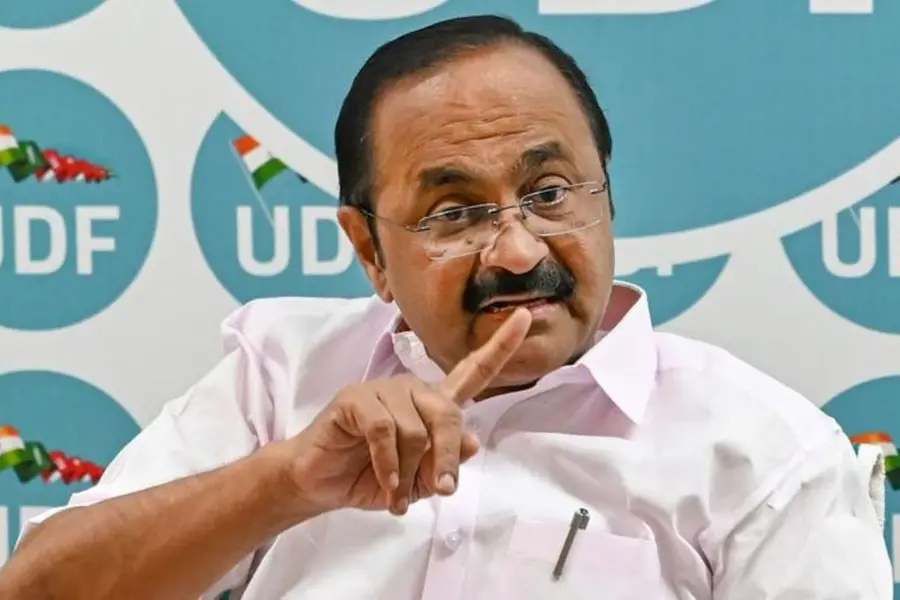
Thiruvananthapuram: Leader of the Opposition in the Kerala Assembly, V D Satheesan, said on Saturday that the Left Democratic Front's (LDF) “communal politics” led to its defeat, while the United Democratic Front (UDF) convinced people with the agenda it placed before them.
In a press conference, Satheesan expressed gratitude to the voters, saying that the UDF was indebted to the public for the mandate. “We placed a charge sheet against the present government before the people. At the same time, we clearly stated what the UDF would do if it comes to power,” he said.
How badly did the LDF perform?
Satheesan said the LDF had suffered a heavy defeat in the elections.
“In the 2020 civic polls, the LDF had won 580 grama panchayats. That has come down to 345 now, while the UDF has grown from 340 to around 500,” he said.
He also detailed changes in block and district panchayats, as well as municipalities:
- LDF’s tally in block panchayats fell from 111 to 68, while the UDF rose from 40 to 77.
- In district panchayats, the LDF declined from 11 to seven, while the UDF increased from three to seven or eight.
- In municipalities, the LDF dropped from 42 to 28, while the UDF increased from 42 to 54.
According to Satheesan, the LDF had five corporations in 2020, which fell to one in 2025, while the UDF increased its count from one to four.
“We see this as a major victory and it is the result of the work of Team UDF. I had said after the Nilambur by-election that we should work together as a team,” he said.
What makes the UDF a strong political force?
Satheesan emphasised that the UDF is not merely a confederation of parties, but a political force representing various social sections.
“This is the reason for the change and for the victories in the recent by-elections,” he said.
What factors contributed to the LDF's defeat?
He said the defeat reflected public resentment against the Pinarayi Vijayan government.
“The second factor is their communal politics. They followed minority communalism till the parliamentary elections and later shifted to majority communalism,” he alleged.
Satheesan claimed that people close to Chief Minister Pinarayi Vijayan had attempted to promote communal politics.
“They adopted the same communal path as the BJP, which thrives on divisive politics. If the BJP has made any gains, including in Thiruvananthapuram, it is due to the CPI(M)'s majority communal appeasement politics,” he alleged.
He further remarked on historical appeasement tactics, saying, “Today, such tactics will only benefit communal fascist forces like the BJP.”
How does Satheesan view government welfare measures?
Satheesan highlighted that welfare activities were carried out using public funds and were not unique to the present government.
“This is not the first government to introduce welfare measures in Kerala. In fact, the LDF government scrapped several welfare schemes,” he alleged.
He further claimed that the current LDF government had harmed the state’s economy.
What is the UDF’s approach following the victory?
Responding to CPI(M) MLA M M Mani's remark that people voted against the LDF despite receiving welfare benefits, Satheesan said it reflected the Left party's disrespect towards voters.
“When we win an election, we should be humble and try to rise to the expectations of the people. The UDF will be at the forefront of Kerala's growth and will exceed public expectations,” he said.
He described the local body election as fuel for the “bigger battle” in next year’s Assembly elections. Satheesan said preparations had already begun, adding, “Discussions on preparations and candidates have started. A united leadership is handling the process.”
Where did the UDF make major gains?
Satheesan noted that UDF had achieved significant gains in areas considered CPI(M) strongholds, such as Kollam and Kozhikode.
“We are going to govern the Kollam Corporation, where the CPI(M), which ruled it throughout history, has slipped to third place. In the Kozhikode Corporation too, the CPI(M) has failed to secure a majority,” he said.
He concluded by highlighting the scale of the UDF's comeback: “We have made major gains across Kerala, in the north, central and southern regions.”
Published: 13 Dec 2025, 05:12 pm IST
Related Topics
Disclaimer: Kindly avoid objectionable, derogatory, unlawful and lewd comments, while responding to reports. Such comments are punishable under cyber laws. Please keep away from personal attacks. The opinions expressed here are the personal opinions of readers and not that of Mathrubhumi.
