
Fatal quarry accidents in Kerala highlight dangerous vertical rock blasting. Experts urge safer, sloped methods to prevent future tragedies
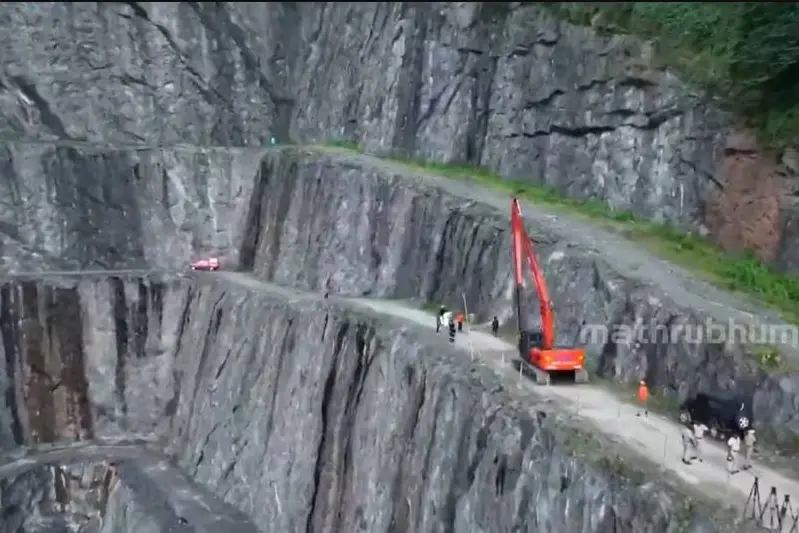
Pathanamthitta: The fatal quarry accident at Payyanaman in Konni has once again raised serious concerns over unscientific rock blasting practices in Kerala. Experts say that the disaster could have been prevented if the rock pile had been broken at a tilted angle rather than at a dangerous 90-degree vertical cut.
The quarry at Chengulam, where two workers lost their lives, was reportedly operating with vertical rock cuts, a method widely criticised by geologists for its instability. According to sources, nearly 90 per cent of rock quarries across Kerala follow similar vertical blasting techniques, despite repeated warnings from scientific bodies.
The National Centre for Earth Science Studies (NCESS) had earlier submitted a detailed report to the state government, recommending scientifically approved methods for rock excavation. Quarry licenses are issued by the state based on the condition that these guidelines are followed. However, once operations begin, there is little enforcement.
A maximum slope of 30 degrees is required
According to safety guidelines, rocks must be excavated at a maximum slope of 30 degrees from ground level. For every five metres of vertical excavation, a bench, five metres wide must be created. These benches serve as access pathways for drilling machinery, lorries, and other equipment.
However, the quarry in Konni, where the recent fatal accident occurred, was operating on a dangerously steep gradient.
Exploding steeply for high profit
If blasting is done at a steep 90-degree angle instead of adhering to the recommended 30-degree slope, the rock collapses easily with minimal effort. This unsafe method is often chosen to maximise profit by reducing the time and cost involved in proper excavation. As a result, rocks fall from significant heights during blasting, posing serious safety hazards. Reports indicate that this steep blasting technique is widely used in many quarries across the state.
High water seepage
The rock formations in the Western Ghats often contain natural cracks, which allow rainwater to seep through, especially during the monsoon season. These cracks become more pronounced in areas where blasting has taken place. As water infiltrates the weakened rock, it increases the likelihood of fractures and breakage. When rocks are cut vertically instead of at a safer slope, the chances of sudden collapse become significantly higher.
-Dr D Padmalal, former Head, Department of Hydrology, National Centre for Earth Science Studies, Thiruvananthapuram, Kerala
Published: 09 Jul 2025, 10:01 am IST
Related Topics
Disclaimer: Kindly avoid objectionable, derogatory, unlawful and lewd comments, while responding to reports. Such comments are punishable under cyber laws. Please keep away from personal attacks. The opinions expressed here are the personal opinions of readers and not that of Mathrubhumi.
