

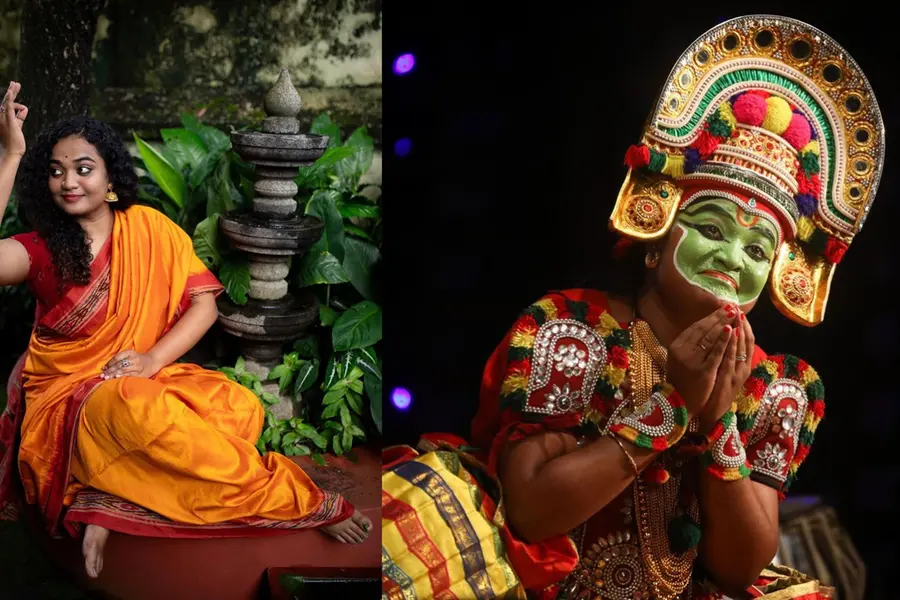
Thiruvananthapuram: Drishya Gopinath, a 30-year-old artist from Punalur, is making waves in the world of Ottanthullal, a traditional art form that combines dance and recitation and is historically dominated by men. Starting her journey in semi-classical folk art at the age of seven, Drishya has performed on over 500 stages across India. She began training students when she was just 17, marking the start of a career that has been as inspiring as it is transformative.
Reflecting on her journey, Drishya said, “Ottanthullal, as a whole, is a male-dominated art form. It requires immense physical fitness since it involves both singing and dancing simultaneously. While many women learn the art, only a few turn up as performing artist. I hope this changes in the future.” Apart from Ottanthullal, Drishya is also trained in Kathakali and Nangyar Koothu.
Drishya’s dedication to breaking stereotypes is evident in her accomplishments. She trained under legendary artists like Kalamandalam Janardhanan and Kalamandalam Prabhakaran and holds a PhD in Ottanthullal. Her research, titled “Adhikaravimarshanam Kunjan Nambiarude Thullal Kalayil” (A Critique of Authority in Kunjan Nambiar’s Thullal), explores how the art form challenges societal hierarchies, including patriarchy.
In 2018, Drishya staged a groundbreaking five-hour performance called Thullal Panchamam, where she narrated five stories from Sreekrishna Charitham. The feat demanded immense stamina and determination, further dispelling myths about women’s ability to sustain the physical rigor required for Ottanthullal.
“There are many misconceptions about women lacking the stamina for this art form,” Drishya remarked. “I felt it was important to bust this myth. Women, with their background in classical dance and inherent flexibility, are equally capable of excelling in this field.”
Drishya’s passion for Ottanthullal goes beyond performance. She has been training students for youth festivals since her 12th grade, with her first mentee competing at a high school division in Thrissur in 2012, where she herself competed in the higher secondary category. This year, she has trained four students—three girls and one boy—for the 63rd Kerala School Kalolsavam.
She also acknowledges the unique challenges women face in pursuing this art form. “There are several reasons why women leave the field—family responsibilities, uncomfortable work environments, and societal pressures. However, I believe the future belongs to women. If I can do this, any woman can. Women are natural multitaskers, capable of mastering this art form with ease. They can efficiently handle the art, makeup, dressing, and everything else related to it,” she said.
As it is known, there is a notable distinction between male and female trainers, with many students traditionally preferring male instructors, known as ashaan. This bias exists not only in Ottanthullal but across various fields. Female trainers, referred to as ashaatti, face additional challenges in gaining acceptance and respect, as the art form is predominantly male-dominated.
Drishya’s mission is clear: to empower women through Ottanthullal and ensure that this culturally rich art form transcends gender barriers. “The next era will be one of womanhood. I look forward to that,” she concluded.
Published: 05 Jan 2025, 03:43 pm IST
ABOUT THE AUTHOR
Disclaimer: Kindly avoid objectionable, derogatory, unlawful and lewd comments, while responding to reports. Such comments are punishable under cyber laws. Please keep away from personal attacks. The opinions expressed here are the personal opinions of readers and not that of Mathrubhumi.