
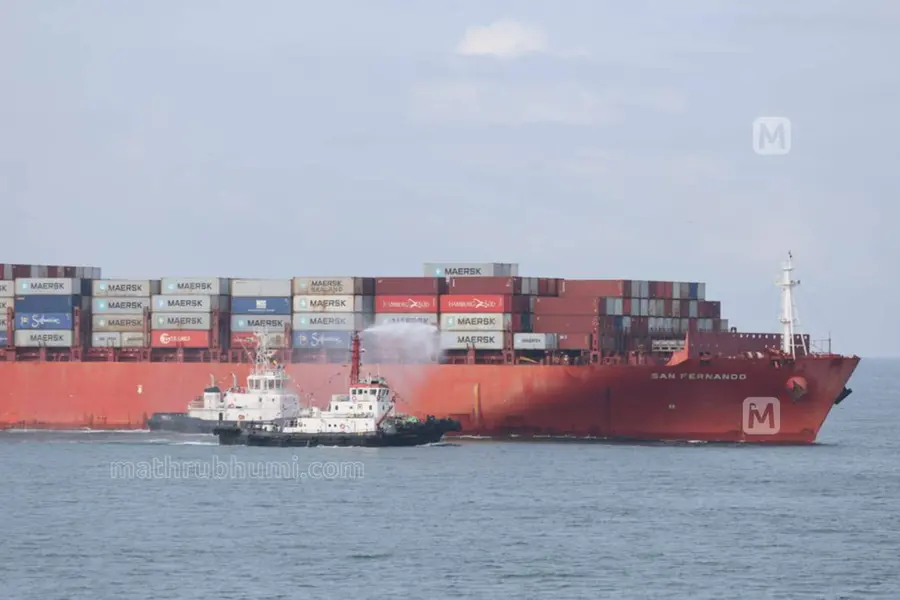
Thiruvananthapuram: Marking a historic occasion, the container ship from China has finally arrived at the Vizhinjam Port.
'San Fernando' which set sail from Xiamen Port in China, was welcomed with a water salute.
The ship will unload 2,000 containers at Vizhinjam. It has a capacity of 8,000 to 9,000 TEUs.
The arrival of the ship marks the beginning of the trial operations at the port.
In an official programme scheduled at the port at 10 AM on Friday, Kerala Chief Minister Pinarayi Vijayan will welcome the ship. The ceremony will be graced by the presence of Union Shipping Minister Sarbananda Sonowal, central and state ministers, dignitaries, officials, and representatives of the public.
The trial operation will continue for 2-3 months. During this period, the port will witness the arrival of large vessels.
Thousands of people are expected to witness the historic event.
Equipped with modern equipment and advanced automation and IT systems, Vizhinjam will become India's first semi-automated port, expected to be fully commissioned in September/October 2024.
In the near future, leading shipping companies worldwide are expected to make their entry into the port.
Vizhinjam Port, boasts of being the first-ever transshipment port in the country. The public-private partnership (PPP) venture is worth Rs 7,700 crores.

Key Characteristics
Vizhinjam port, located approximately 14 km from Kerala's capital Thiruvananthapuram, stands out as India's first Deep Water Transshipment Terminal, designed to evolve through three distinctive phases.
The port's natural depth of 20 metres is a significant allure. Remarkably, the port welcomed a ship bearing the largest crane ever seen in Indian ports without necessitating any dredging activities. Vizhinjam is fully equipped to accommodate colossal vessels, including the ULCS container ship MSC Irina and luxurious cruise liners like Wonder of the Seas, effortlessly.
Strategically positioned just 10 nautical miles (19 kilometres) from the international east-west shipping route, Vizhinjam boasts seamless connectivity to Western Asia, Europe, Africa, and the far eastern regions. Travelling from the primary route to the port merely takes an hour, emphasising its unparalleled accessibility.
It stands out as India's pioneer automated seaport, incorporating advanced facilities that significantly reduce vessel turnaround time. This all-weather port maintains consistent operational efficiency, unaffected by tidal variations, making it a reliable hub for maritime activities.
Upon completion of its initial phase, Vizhinjam port is set to accommodate 1 million TEUs (20-foot equivalent container units). Subsequent phases will expand this capacity to 6.2 million TEUs, representing over 70% of India's transshipment volume.
The port features two breakwaters, a harbour basin, and multiple berths, including 30 capable of accommodating mother ships. Additionally, the Vizhinjam Cruise Terminal boasts two 500-metre-long cruise berths.
This seaport serves as a vital point for vessels navigating the Indian Ocean region, especially for crew change requirements. Its strategic proximity to Trivandrum International Airport, a mere 16 km away, further streamlines crew change operations. Notably, during the challenging times of the COVID-19 pandemic in 2020 and 2021, the port facilitated the embarkation of 2,807 crew members into service, along with the disembarkation of 2,737 individuals as part of these essential crew change operations.
History
Archaeological findings at Vizhinjam reveal intriguing glimpses into its past. Remnants of a fort, potentially dating back to the 8th or 9th century CE, were discovered by a team from the Department of Archaeology, University of Kerala. These ruins were believed to be linked to the Ay dynasty who ruled the region. Historical records indicate that between 788 AD and 920 AD, several kings served as Ay chiefs in Vizhinjam. Sangam literature references also suggest the existence of this fort, which sadly met its demise during the 12th-century invasion by Kolothunga Chola.
The concept of a new port in Vizhinjam was first introduced by Travancore Diwan Ramaswami Iyer. In the 1940s, British engineers conducted a survey regarding this idea. However, these initiatives remained stagnant and did not progress further during that era.
LDF vs UDF
The initiation of the port construction had sparked disputes between the major political coalitions in Kerala- the UDF and LDF. The Congress leaders had urged to name the port after Oommen Chandy, who signed the agreement with the current builder, Adani Ports, in 2015. However, CPM state secretary MV Govindan countered this claim, asserting that the groundwork was laid by EK Nayanar during the period of 1996-2001. In contrast, Congress argues that the first step was taken in 1991 and that CPM initially opposed the idea.
Congress also contends that the LDF government between 1996-2001 failed to progress on the MoU signed with the Hyderabad-based Kumar Group of companies. According to them, the proposal gained momentum when the UDF assumed power in 2001.
On the other hand, CPM maintains that little progress was made during the 2001-06 government, emphasising that the pivotal steps were taken during the tenure of VS Achuthanandan from 2006-11.
Initially, the VS government proposed a Public Private Partnership (PPP) model. However, this approach faced setbacks as two rounds of bidding and tenders failed under this model. The first round was awarded to a Chinese company, which failed to obtain security clearance from the union government. In the second round, Lanco Kondapalli Power Private Ltd., Hyderabad, was chosen, but Zoom Developers contested their disqualification, leading to legal hurdles. Congress accused corruption in the bidding process. Due to uncertainties and challenges, Lanco Group withdrew in 2009. Moreover, a new environmental study mandated by the union environment ministry's updated policy. It was only cleared in 2011.
Subsequent attempts to invite private sector participation yielded poor responses, prompting massive protests by CPM demanding project implementation. The National Green Tribunal and the environment ministry also scrutinised the state government over alleged violations. In 2015, despite opposition from the LDF, Oommen Chandy signed an agreement with Adani Port, which drew objections from CPM, stating that the government was providing unnecessary support to the Adani Group. The construction officially commenced during Oommen Chandy's tenure in 2016. It faced another significant roadblock in 2022. Fishermen protested against the project, demanding a halt to construction and fresh environmental impact studies. The opposition Congress party supported these protests.
Published: 11 Jul 2024, 07:05 am IST
Related Topics
Disclaimer: Kindly avoid objectionable, derogatory, unlawful and lewd comments, while responding to reports. Such comments are punishable under cyber laws. Please keep away from personal attacks. The opinions expressed here are the personal opinions of readers and not that of Mathrubhumi.