
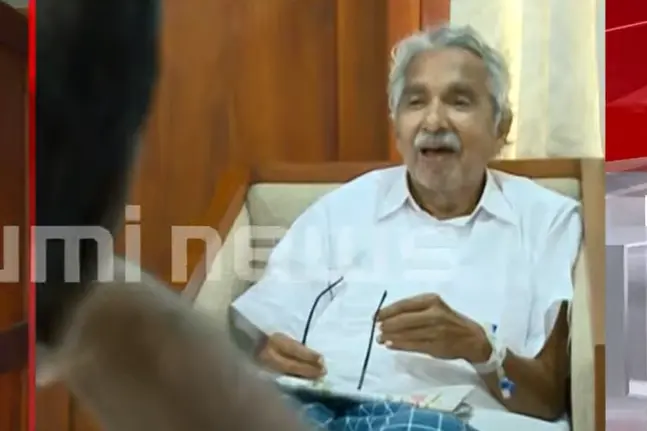
Oommen Chandy, one of the most prominent political figures from Kerala, had a long and illustrious career in politics.
Chandy was one of the members who served Kerala Legislative Assembly for the longest period. He represented Puthuppally constituency 12 times, since 1970.
A leader of the Indian National Congress, Chandy served as the Chief Minister of Kerala on two separate occasions.
Here is the political life of Oommen Chandy
Chandy's political journey began as an activist of the Kerala Students Union (KSU), the student wing of the Congress party. He was the unit president of KSU at St. George High School, Puthupally, and later ascended to the position of state president from 1967 to 1969.
In 1958, during the tenure of the EMS Namboodiripad government, a significant issue arose regarding the students' concession for boat fare in the Kuttanad waterways. The government had increased the fare from one anna (six paise) to 10 paise, leading to widespread discontent among students. KSU spearheaded a protest against this decision, which came to be known as the 'Orana Samaram'.
Chandy actively participated in this protest, which eventually laid the foundation for the 'Liberation Struggle' or Vimochana Samaram, the movement ultimately resulted in the dismissal of the Communist Party of India (CPI) government.
During the 'Orana Samaram', Chandy collaborated with prominent leaders Vayalar Ravi and AK Antony. This trio would go on to become influential figures in state politics. While Antony and Ravi later shifted their focus to politics in Delhi, Chandy chose to remain active in the state and continued his political journey there.
He was also the president of All Kerala Balajana Sakhyam for a brief period. He was elected as the president of the State Youth Congress in 1970.
Oommen Chandy has served as a minister in the Government of Kerala on four different occasions. In his initial term, he assumed the role of Minister for Labour in April 1977, during the K Karunakaran ministry. He continued to hold the same portfolio in the subsequent AK Antony ministry until October 1978.
During his tenure, Chandy spearheaded the government's decision to provide unemployment benefits to educated individuals who were without jobs in Kerala.
He stood firmly by Antony's side in state politics, demonstrating his unwavering support. Although he maintained a silence during the Emergency period under Indira Gandhi, it is widely believed that he was opposed to it. Antony, on the other hand, did not align himself with K Karunakaran, who was a supporter of Indira Gandhi. Antony even raised concerns about Sanjay Gandhi's rapid rise to power.
Following the split in the Congress party in 1978, Antony resigned as the Chief Minister of the Congress (U) faction in protest against the party's decision to nominate Indira Gandhi for the Chikmagalur by-election in 1978. Subsequently, Antony formed his own faction known as Congress (A), which later merged with the Indian National Congress in the presence of Indira Gandhi in Kochi in 1982.
Since then, the A and I factions have been engaged in power struggles in Kerala, with Chandy playing a key role in the strategy of the A group.
Chandy's political journey continued as he took on the role of Home Minister in the second K Karunakaran ministry. Later, he assumed the position of Finance Minister in the fourth Karunakaran ministry from 1991 to 1994. However, he resigned from his ministerial post in protest against Karunakaran's refusal to grant a Rajya Sabha ticket to a leader from their faction.
During this period, a significant event unfolded—the infamous ISRO espionage scandal. Chandy, along with other factional leaders, accused Karunakaran of involvement. They alleged that police officer Raman Srivastava misused his position due to his close association with Karunakaran.
As a result, Antony, who had shifted his focus to national politics in Delhi, took charge of another Congress-led government in Kerala.
In August 2004, Chandy assumed the role of Chief Minister of Kerala, following the resignation of Antony due to the Congress party's failure to win any seats in the parliamentary elections held in May 2004.
With Antony's departure to Delhi, Chandy finally had the opportunity to step out of his mentor's shadow. From May 2011 to May 2016, Chandy served a full term as the Chief Minister of Kerala, becoming the second Congress leader to achieve this feat.
Throughout his five-decade-long tenure as a Member of the Legislative Assembly, Chandy occupied ministerial roles for around 12 years. However, it is noteworthy that, apart from his term as Chief Minister from 2011 to 2016, he never completed a full term in any other offices.
As a young leader, Chandy's contribution in strengthening the party's foundation in Kerala during the 1960s and 1970s was instrumental. He served as the Convenor of the UDF on two occasions, from 1982 to 1986 and from 2001 to 2004. In 2017, he was elected as a member of the Congress Working Committee. The following year, he was appointed as the General Secretary of AICC, responsible for overseeing Andhra Pradesh. While he held various prominent positions in state politics, such as being a key member of the party, he did not assume the role of KPCC president, a position that his colleagues Ravi, Antony, CV Padmarajan, and MM Hassan had all held.
Chandy’s political career has not been immune to controversy. He faced allegations of corruption, particularly in relation to the solar project in 2013 and the palmolein import in 1991. However, none of these allegations were substantiated in a court of law.
Chandy was honoured with the 2013 United Nations Public Service Award for the Asia-Pacific region, specifically in the category of "Preventing and Combating Corruption in the Public Service." Furthermore, Chandy's Mass Contact Programme during 2011-16 period is widely regarded as a significant accomplishment during his tenure as chief minister.
Published: 18 Jul 2023, 07:07 am IST
Related Topics
Disclaimer: Kindly avoid objectionable, derogatory, unlawful and lewd comments, while responding to reports. Such comments are punishable under cyber laws. Please keep away from personal attacks. The opinions expressed here are the personal opinions of readers and not that of Mathrubhumi.
