
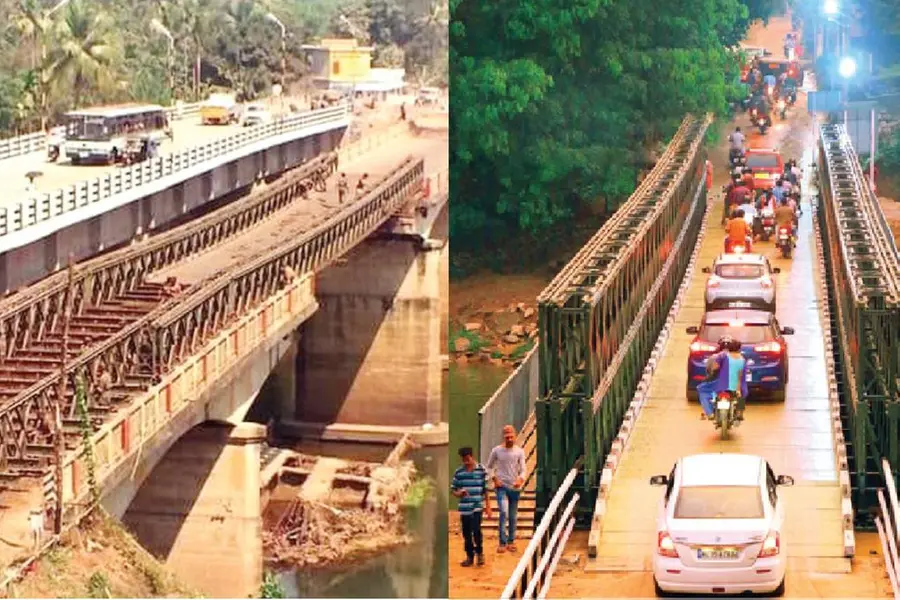
Ranni (Pathanamthitta): The Indian army completed the construction of the Bailey Bridge in the landslide-hit Mundakkai in Wayanad on Thursday. At this juncture, let us examine three Bailey Bridges in Pathanamthitta district at Ranni, Enathu, and Sabarimala.
The First Bailey Bridge
In 1996, the Valiyapalam bridge collapsed, dividing the town of Ranni in Pathanamthitta, which is located on both sides of the Pampa River. For two years, tens of thousands of people were transported across the river using the Bailey Bridge built by the army. This bridge in Ranni was the first Bailey Bridge in Kerala.
The Ranni bridge collapse occurred on July 29, 1996, at 3:30 p.m., when the middle slab of the bridge fell into the river. The incident happened as a bus on the Ranni-Thiruvalla route was crossing the 32-year-old bridge. A major disaster was avoided as the bus successfully reached the other side before the structure collapsed.
Former MLA Raju Abraham mentioned that it was a friend who suggested the idea of building a Bailey Bridge, which led to the demand being made in the state assembly. On November 8, 1996, the then Chief Minister E.K. Nayanar inaugurated the bridge.
Among the items lost in the 2018 flood were photographs of the damaged bridge at Ranni, the Bailey Bridge, and those taken during the construction of the new bridge. These pictures were destroyed when water entered the studios in the town. The only colour photos available now are those kept by Unnikrishnan, the owner of Devi Studio.
Enathu Bailey Bridge
In 2017, a Bailey Bridge was constructed across the Kallada River in Enathu. This bridge was built to replace the Enathu Bridge. The Enathu bridge became unstable on January 10, 2017. In April, 50 soldiers constructed a bridge across the Kallada River in just 36 hours. The bridge was 180 feet long, 10 feet 9 inches wide, and weighed 18 tons. The Bailey Bridge was dismantled in September 2017 when the Enathu Bridge reopened to traffic.
Bridge to nowhere in Sabarimala
The Bailey Bridge at Sabarimala, built in 2011, could not be effectively used due to a planning flaw. It was intended to divert devotees behind the Malikappuram Temple after darshan, guiding them to the Chandranandan Road. However, the bridge was not at the same level as the Malikappuram Temple and Chandranandan Road. As a result, devotees refused to use the route, and the bridge was never used.
Published: 02 Aug 2024, 09:57 am IST
Related Topics
Disclaimer: Kindly avoid objectionable, derogatory, unlawful and lewd comments, while responding to reports. Such comments are punishable under cyber laws. Please keep away from personal attacks. The opinions expressed here are the personal opinions of readers and not that of Mathrubhumi.
