
The state currently has about 2,000 kilometres of solar fencing, with another 100 kilometres to be completed within the next 100 days.
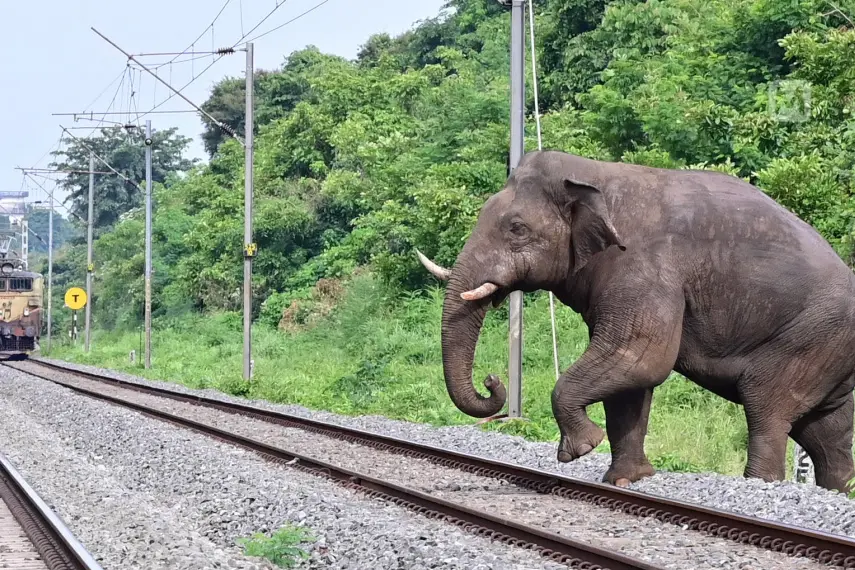
Thiruvananthapuram, Kerala: Facing growing public concern over human-animal conflict, the Kerala government has unveiled an ambitious 100-day action plan aimed at reducing wildlife incursions, strengthening preventive infrastructure and improving compensation mechanisms for victims.
Announcing the measures after a series of meetings with forest officials on Friday, Forest Minister Shibu Baby John said the programme would focus on expanding solar fencing, increasing rapid response capabilities, deploying technology-driven monitoring systems and addressing long-standing concerns raised by farmers and communities living near forest borders.
A centralised solar fencing monitoring system with automatic fault detection will be established with public participation, allowing residents to report damaged sections of fencing along forest boundaries. The state currently has about 2,000 kilometres of solar fencing, with another 100 kilometres to be completed within the next 100 days. The government also plans to extend fencing by an additional 1,900 kilometres over the next five years.
“Another major step is vista clearance-the clearing of trees and dense shrubbery up to 20 metres from the solar fencing-to prevent elephants from pushing trees onto the fences to gain entry,” John said.
He added that shrubs and undergrowth along forest roads would also be cleared with the assistance of local self-government institutions. Funding support from MPs, MLAs, NGOs and CSR initiatives will be explored for the programme. Vista clearance covering 100 kilometres is expected to be completed during the first phase.
More response teams, drones and AI-based monitoring
To strengthen emergency response, the forest department plans to expand its Rapid Response Team (RRT) network.
“At present, we have 28 RRTs, which are inadequate to monitor 6,000 kilometres of forest boundaries. We are planning to create 25 more satellite RRTs that will function out of forest offices,” the minister said.
The department will also establish Metro Rescue Teams on the lines of existing Primary Response Teams (PRTs), which consist of trained volunteers from local communities. In the initial phase, eight Metro Rescue Teams will be launched in Thiruvananthapuram, Kollam, Kottayam, Ernakulam, Thrissur, Palakkad, Kozhikode and Kannur.
Drone squads will be deployed to provide real-time alerts about wildlife entering populated areas and to track stranded animals in farmlands and human settlements.
“We will also ensure AI-aided real-time warning systems and monitoring systems in all forest divisions. Camera traps will also be deployed in areas witnessing severe human-animal conflict for better monitoring of animal movement,” John said.
The department will also undertake measures to improve forest quality by removing invasive plant species such as Senna and Acacia. Authorities are exploring ways to convert invasive species into value-added products, creating livelihood opportunities for tribal communities.
Faster compensation, wild boar census and scientific studies
The action plan proposes significant changes to compensation for victims of wildlife attacks, including a 50 per cent increase in compensation for fatalities and a single-window clearance mechanism to ensure payouts are made within seven days.
Higher compensation for crop losses and injuries caused by wildlife is also under consideration.
“We will form an expert committee to study and create a compensation protocol for crop loss. Many farmer organisations have complained that the criteria for determining compensation are outdated and need revision,” the minister said.
Addressing concerns over the rising wild boar population, the government will conduct a census of boars living outside forest areas. A special drive to eliminate wild boars posing threats to human life and property will begin on June 15, in accordance with existing regulations.
The state will also seek scientific inputs to better understand wildlife populations and forest carrying capacity.
“We will depute the Wildlife Institute of India, Dehradun, to study the carrying capacity of forests in Kerala, understand animal distribution, and determine how they can be managed while avoiding possible conflict with humans,” John said.
The minister said discussions had also been held with the Indian Air Force regarding the transportation of captured wild animals deeper into forests, amid public objections to releasing them near settlements.
As part of the digital push, John launched an online portal for monitoring solar fencing across the state, enabling both officials and the public to report faults and track fence conditions in real time. He also unveiled the Hostile Activity Watch Kernel (HAWK) software, which will allow forest crime cases to be filed online through the District Court Management System (DCMS).
Published: 05 Jun 2026, 06:01 pm IST
Related Topics
Disclaimer: Kindly avoid objectionable, derogatory, unlawful and lewd comments, while responding to reports. Such comments are punishable under cyber laws. Please keep away from personal attacks. The opinions expressed here are the personal opinions of readers and not that of Mathrubhumi.
