
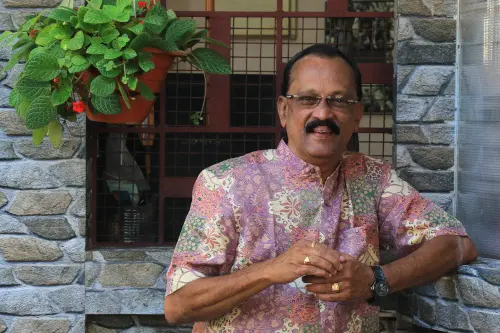
"Rajasooyam," a documentary, unfolds the life and legacy of Rajan Poduval, one of Kerala's most celebrated news photojournalists. Through its intricate storytelling and visually stunning portrayals, the film takes the audience on a journey through Poduval’s life, chronicling his transformation from an unassuming young boy from Ottapalam to a pioneering figure in the world of Indian news photography. The documentary is a reverent exploration of Rajan’s work, capturing his path-breaking contributions and the profound impact he has had on Kerala's media landscape.
Rajan's journey is both humble and extraordinary, starting in the bustling streets of Ernakulam, where he first stumbled into photography. He was initially guided by an academic curiosity that evolved into a passion for documenting the world around him. Recognising his potential, KP Kesava Menon, the revered founding editor of Mathrubhumi, became a mentor to Rajan, setting the young photojournalist on a path that redesigned his professional life.
"Rajasooyam" weaves archival footage with interviews from colleagues, editors, and cultural commentators, creating a multi-layered portrait of Rajan's professional journey. These insights offer a rare glimpse into his life at Mathrubhumi, a period marked by intense fieldwork and a profound dedication. At Mathrubhumi, Rajan honed his unique approach to news photography, mastering the art of capturing the essence of a moment.
Rajan’s career took him across South India, documenting key events that would come to define the political and social histories of the region. "Rajasooyam" highlights Rajan’s work during Tamil Nadu's political upheavals in the 1970s and 1980s, particularly during the influential reign of M.G. Ramachandran (MGR).
Closer to home, Rajan’s photographs of Kerala’s evolving political landscape offer a deeply personal glimpse into the state’s complex social fabric. "Rajasooyam" examines these pivotal works, paying particular attention to his evocative portrayal of Jayalalithaa in the landmark report "Idayakanik Vilak." His images of Jayalalithaa capture the actress-turned-politician in a way that few could, revealing layers of vulnerability and strength, and solidifying Rajan’s reputation as a visual storyteller with an unparalleled eye for nuance.
Perhaps one of the most stirring aspects of "Rajasooyam" is the attention it gives to Rajan’s documentation of Kerala’s sporting icons, including the trailblazing athlete PT Usha. Rajan’s work in capturing these milestones serves as a powerful reminder of how sports have become a symbol of resilience and hope in Kerala, inspiring countless others to pursue their dreams.
His devotion to ensuring his photographs were published first—even when that required putting himself in challenging and sometimes dangerous situations—reveals the depths of his commitment. Rajan’s dedication was never about personal glory but rather about a fundamental belief in the importance of truth.
Beyond his professional contributions, "Rajasooyam" pays homage to Rajan's numerous accolades and honours too. The documentary traces the recognition he received over the years, not only from Kerala but also from broader media circles across India.
In a world where journalism is often criticised for sensationalism, "Rajasooyam" stands as a reminder of the power of authentic storytelling. It celebrates Rajan's unique ability to connect with people and moments, capturing the essence of Kerala's stories with a lens that is both empathetic and uncompromising.
As the closing scenes of "Rajasooyam" fade out, viewers are left with the lasting impression of Rajan Poduval’s legacy—a legacy of courage, dedication, and a belief in the transformative power of visual storytelling.
Published: 25 Oct 2024, 12:02 pm IST
Related Topics
Disclaimer: Kindly avoid objectionable, derogatory, unlawful and lewd comments, while responding to reports. Such comments are punishable under cyber laws. Please keep away from personal attacks. The opinions expressed here are the personal opinions of readers and not that of Mathrubhumi.
