
India's Yuge Yugeen Bharat Museum will have over 1 lakh sq m of display space. Here's how it compares with the Louvre, Hermitage and other major museums.
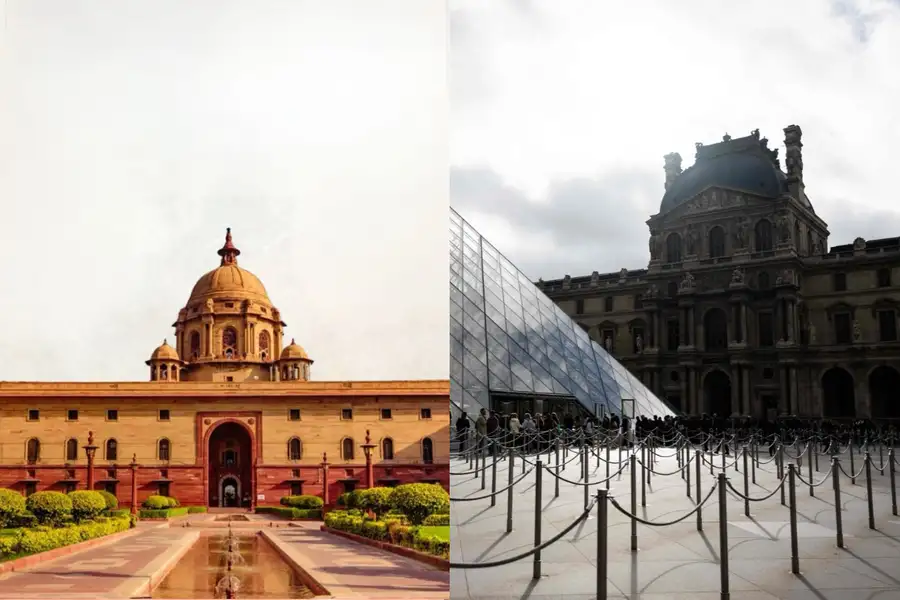
India's upcoming Yuge Yugeen Bharat Museum is being billed as one of the world's largest museums, with a planned display area of over one lakh square metres. The proposed scale would put it ahead of some of the world's best-known museums, including the Louvre in Paris and the British Museum in London, in terms of exhibition space.
However, the comparison is based on the area earmarked for displaying exhibits, rather than the total size of the museum buildings. The distinction matters, as some of the world's largest museums have considerably bigger overall complexes, even if their gallery spaces are smaller.
How large will the Yuge Yugeen Bharat Museum be?
The Yuge Yugeen Bharat Museum is being developed at New Delhi's historic North and South Block complex under the Central Vista redevelopment project.
The Union Cabinet approved the project on November 11, 2026, at an estimated cost of Rs 3,230 crore. According to the Ministry of Culture, the museum will have a proposed built-up area of approximately 1,78,509 square metres, with over one lakh square metres planned for display space.
The museum is expected to accommodate around 30,000 visitors a day and one crore visitors annually. It will be developed in phases between 2026-27 and 2030-31, with the first gallery, Adornment, expected to open in North Block in the latter part of 2027.
The project will repurpose the historic government buildings into a cultural institution while retaining their architectural character.
Yuge Yugeen Bharat Museum vs some of the world's largest museums
| Museum | Exhibition/display area |
| Yuge Yugeen Bharat Museum (planned) | More than 1,00,000 sq m |
| Louvre Museum, Paris | Around 70,000–72,735 sq m |
| British Museum, London | Around 70,000 sq m |
| State Hermitage Museum, St Petersburg | Figures vary; 66,842 sq m-1,00,000 sq m |
| National Museum of China, Beijing | Around 65,000 sq m |
| Metropolitan Museum of Art, New York | Around 58,800 sq m |
Figures refer to reported exhibition/gallery/display space, not total building area.
How does it compare with the Louvre?
The Louvre in Paris is among the world's most recognised museums and is known for its extensive collection of art and historical objects, including the Mona Lisa and the Venus de Milo.
The museum's official press information lists approximately 70,000 square metres of exhibition space. Other widely cited museum-space comparisons put its gallery area at 72,735 square metres.
At the planned display area of over one lakh square metres, the Yuge Yugeen Bharat Museum would have approximately 27,000–30,000 square metres more exhibition space than the Louvre — roughly 37–43 per cent larger, depending on which figure is used.
The comparison, however, does not mean the Indian museum will be larger than the Louvre in every sense. The Louvre's total flooring area is around 2,44,000 square metres, significantly more than the proposed built-up area of the Yuge Yugeen Bharat Museum.
What about the British Museum?
The British Museum in London is another institution cited by the Indian government in its comparison.
According to PIB Delhi, the British Museum’s reported gallery/display area is around 70,000 square metres. If the Yuge Yugeen Bharat Museum achieves its proposed display space of more than one lakh square metres, it would have around 30,000 square metres more exhibition area — approximately 43 per cent larger.
The comparison is specifically about display space. The British Museum's extensive complex also includes collection storage, offices, conservation facilities, visitor spaces and other areas that are not galleries.
The Hermitage comparison needs a closer look
The State Hermitage Museum in St Petersburg, Russia, is another museum named in the government's comparison. But its exhibition-space figures are not consistent across published sources.
The Hermitage's 2015 annual report lists its exhibition area at 66,842 square metres. A later report for 2019, however, gives an exhibition and display area of 100,351 square metres.
This is an important discrepancy. If the 66,842-square-metre figure is used, the proposed Yuge Yugeen Bharat Museum would be significantly larger in planned display space. But if the Hermitage's 2019 figure of 100,351 square metres is used, the Indian museum's proposed area of over one lakh square metres would be broadly comparable.
Therefore, while the Indian government's comparison places the proposed museum ahead of the Hermitage based on the figures it cites, the museum's own published reports contain a different figure that complicates the claim.
How does it compare with other major museums?
The planned display area would also put the Yuge Yugeen Bharat Museum ahead of several other prominent museums based on commonly reported gallery-space figures.
The National Museum of China in Beijing has around 65,000 square metres of exhibition space, while the Metropolitan Museum of Art in New York is often listed at around 58,800 square metres.
If the proposed Indian museum achieves its planned display area of over one lakh square metres, it would have approximately 54 per cent more display space than the National Museum of China and around 70 per cent more than the Metropolitan Museum of Art.
These comparisons should also be understood as estimates, as museums may report gallery space, exhibition space and public display areas differently.
Bigger in display space, not necessarily overall size
The proposed museum's scale is significant, but the claim that it will be the world's largest museum needs to be understood in context.
The Yuge Yugeen Bharat Museum's proposed built-up area is approximately 1,78,509 square metres. By comparison, the Louvre reports around 2,44,000 square metres of flooring, while the State Hermitage Museum lists a total area of 2,33,345 square metres. The National Museum of China also has a floor area of nearly 2,00,000 square metres.
This means the Yuge Yugeen Bharat Museum is being positioned as the world's largest by planned display space, not necessarily by total floor area, building size or collection volume.
Its eventual ranking will depend on the final exhibition layout, how display space is measured and whether the proposed area is realised after the museum is completed.
What will the museum showcase?
The Yuge Yugeen Bharat Museum is planned to present India's civilisational journey spanning more than 5,000 years through thematic galleries, historical collections and immersive experiences. Around 18 lakh objects have been identified for potential display from institutions including the National Museum, Archaeological Survey of India site museums, state museums and other collections.
The proposed themes include architecture and cityscapes, mathematics and astronomy, languages and scripts, faith and spirituality, trade and ideas, among others.
The museum's design will also shape the visitor experience. The expansive courtyards of North and South Block, which have largely remained overlooked features of the colonial-era buildings, will be transformed into exhibition spaces under glass roofs. Both buildings have seven courtyards each, besides around 950 rooms.
According to a report by The New Indian Express, large artefacts and central exhibition spaces will anchor these courtyards, with the museum's thematic narratives extending into surrounding corridors and rooms. The layout is designed to allow visitors to move between central galleries, adjoining exhibition rooms and immersive spaces.
Culture Secretary Vivek Aggarwal said the courtyards would house some of the museum's prominent exhibits, including large artefacts, while surrounding rooms would accommodate smaller displays and immersive experiences. The glass roofs will be supported by independent frames without transferring additional loads to the existing structures.
Restoration work has also uncovered architectural features that had been concealed over the years. In North Block, work reportedly revealed twin-nave corridors that had been partitioned into rooms during its years as a government office. These original architectural features are being retained as part of the museum's adaptive reuse.
One of the courtyards in North Block's eastern wing, located below ground level, is being developed into an amphitheatre. The adjoining rooms will be converted into facility offices, while the courtyard is planned to feature a glass peacock façade and ticketing counters. It is envisaged as the museum's primary entry point.
The area behind North Block, which was previously used as a horse stable, is also being repurposed for artefact storage.
Restoration and conservation work is underway, including repairs to damaged sandstone, addressing seepage, removing layers of concrete added to rooftops and dismantling partitions introduced during the buildings' years as government offices.
The project seeks to retain the architectural character of the historic North and South Block buildings while transforming them into a public cultural institution. With more than one lakh square metres planned for display, the museum aims to bring India's cultural and civilisational history together on a scale that could place it among the world's largest museum exhibition spaces.
The first gallery, titled 'Adornment', is expected to open in the latter half of 2027.
Published: 28 Nov 2026, 03:27 pm IST


ABOUT THE AUTHOR

Related Topics
Disclaimer: Kindly avoid objectionable, derogatory, unlawful and lewd comments, while responding to reports. Such comments are punishable under cyber laws. Please keep away from personal attacks. The opinions expressed here are the personal opinions of readers and not that of Mathrubhumi.