
The government has clarified key aspects of the Women’s Reservation Bill through FAQs after its defeat in the Lok Sabh
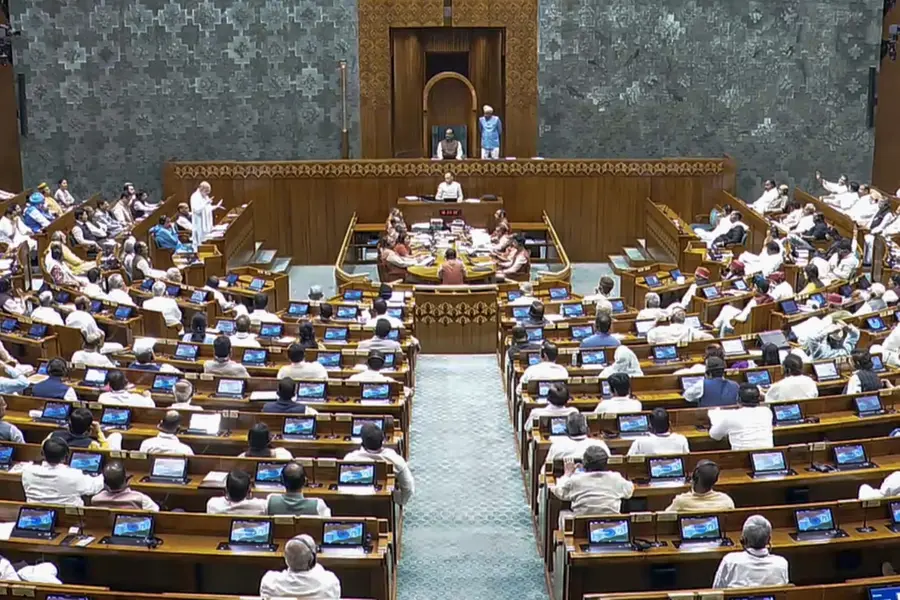
New Delhi: A day after the government’s proposal to reserve 33 percent of seats in the Lok Sabha for women was defeated, the Centre released a detailed set of Frequently Asked Questions (FAQs) explaining the Women’s Reservation Bill and related legislation.
The Bill required a two-thirds majority to pass. However, the National Democratic Alliance (NDA) secured support from 298 members, while 230 voted against it.
What Bills were introduced on April 16?
The government introduced three major Bills in the Lok Sabha on April 16, 2026. These were:
- The Constitution (One Hundred and Thirty-First Amendment) Bill, 2026
- The Delimitation Bill, 2026
- The Union Territories Laws (Amendment) Bill, 2026
Why were the Bills introduced now?
According to the Nari Shakti Vandan Adhiniyam, women’s reservation will be implemented after delimitation based on the Census conducted post-2026.
However, the government stated that waiting for the Census and delimitation process would delay benefits, meaning women would not receive 33 percent reservation in the 2029 Lok Sabha elections. To avoid this, it said implementation needed to be delinked from those conditions.
What would have changed if the bills passed?
If approved, the Bills would have enabled 33 percent reservation for women in the Lok Sabha starting from the 2029 general elections.
Why was there a proposal to increase Lok Sabha seats?
Delimitation refers to the process of redrawing constituency boundaries. It is necessary for implementing women’s reservation.
The Lok Sabha seat limit was fixed at 550 in 1976. At that time, India’s population was around 54 crore. With the population now at approximately 140 crore, the government said there is a need to increase seats to around 850 to ensure fair representation.
Will elections or the Delimitation Act be affected?
The government clarified that no changes have been proposed to the Delimitation Commission Act. The existing legal framework will remain unchanged.
Any recommendations by the Commission will still require parliamentary approval and the President’s assent. It also stated that ongoing and upcoming state elections in Tamil Nadu, West Bengal and other states will not be affected, as elections until 2029 will follow the current system.
Why 850 Lok Sabha seats were proposed
The proposal is based on a proportional expansion model. A uniform 50 percent increase in seats would maintain representation balance across states and Union Territories.
Applying this to the current 543 seats results in around 815 seats, which the government rounded to justify increasing the limit from 550 to 850.
Will southern states be affected?
The government said no state would be disadvantaged. All states would see a uniform 50 percent increase in seats.
| State | Total Seats (543) | Present Status (% of 543) | Increase of 50% (Approx.) | Revised Status (% of 816) |
| Karnataka | 28 | 5.15% | 42 | 5.14% |
| Andhra Pradesh | 25 | 4.60% | 38 | 4.65% |
| Telangana | 17 | 3.13% | 26 | 3.18% |
| Tamil Nadu | 39 | 7.18% | 59 | 7.23% |
| Keralam | 20 | 3.68% | 30 | 3.67% |
| Total | 129 | 23.76% (Approx. 24%) | 195 | 23.87% |
According to the government, southern states currently hold 23.76 percent of Lok Sabha seats, which would slightly increase to 23.87 percent under the proposal.
Will states with population control be impacted?
No. The government said proportional representation would remain stable or slightly improve, as seat increases apply uniformly across all states.
What about SC and ST representation?
The government clarified that reservation for Scheduled Castes and Scheduled Tribes is maintained proportionally. With more seats, their overall representation would also increase.
Was the Bill linked to caste census delay?
No. The government stated that a time-bound caste census process has already been initiated. It will include detailed enumeration and recording of caste-related data during the population count.
Why no separate quota for Muslim women?
The government said the Constitution does not provide reservation on the basis of religion. Reservation policies are based on social and economic backwardness.
Why wasn’t the Bill implemented in 2024 elections?
The government said delimitation is required for implementing reservation, which is a lengthy and consultative process taking around two years. Therefore, immediate implementation was not possible.
Why was the Bill passed in 2023 if implementation was delayed?
The Women’s Reservation Bill was passed in 2023 to establish the legal and constitutional framework for future implementation. This enabled the enactment of the Nari Shakti Vandan Adhiniyam.
Why a separate Bill for Union Territories?
Union Territories such as Jammu and Kashmir, Delhi and Puducherry follow separate legislative frameworks. Therefore, specific amendments were required to implement women’s reservation in these regions.
Published: 19 Apr 2026, 03:40 pm IST
Related Topics
Disclaimer: Kindly avoid objectionable, derogatory, unlawful and lewd comments, while responding to reports. Such comments are punishable under cyber laws. Please keep away from personal attacks. The opinions expressed here are the personal opinions of readers and not that of Mathrubhumi.
