
After ruling Bengal for 34 years, the Left Front now faces its toughest political test yet, battling leadership gaps, shrinking vote share, and a sharply polarised TMC vs BJP contest ahead of 2026.
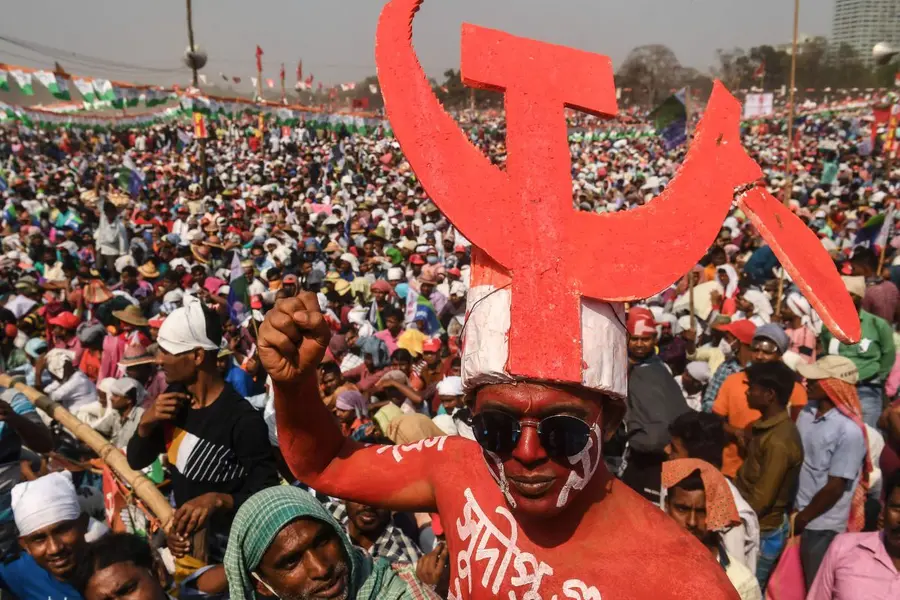
The Left Front, led by the Communist Party of India (Marxist), governed West Bengal uninterrupted from 1977 to 2011, one of the longest democratically elected communist regimes in the world.
As many as 15 years after its fall, the coalition is struggling to remain politically relevant in a state now dominated by a bipolar contest between the Trinamool Congress (TMC) and the Bharatiya Janata Party (BJP).
As the 2026 Assembly election approaches, the Left faces a fundamental question: Can it reinvent itself in a dramatically altered political landscape, or will it remain confined to the margins?
Leadership vacuum and organisational decline
One of the most visible reasons behind the Left’s decline is the erosion of its leadership structure.
The party once boasted towering figures such as Jyoti Basu and Buddhadeb Bhattacharjee, backed by a highly disciplined cadre network built by organisers like Pramode Dasgupta and Anil Biswas.
Today, that ecosystem has weakened significantly. The current leadership, including state secretary Mohammed Salim, lacks the mass connection and administrative credibility of earlier leaders.
The absence of a second-rung leadership with statewide appeal has further compounded the problem.
While younger leaders such as Meenakshi Mukherjee have emerged, their influence remains limited within a party still perceived as hierarchical and resistant to internal change.
The decline of booth-level organisation, once the Left’s biggest strength, has also reduced its ability to mobilise voters effectively.
Collapse of vote share and rise of bipolar politics
The Left’s electoral decline is stark and well-documented. In 2011, despite losing power, the Left Front still secured over 40% of the vote.
This dropped to around 26% in the 2014 Lok Sabha elections and roughly 21% in the 2016 Assembly polls, when allied with Congress.
The real collapse came thereafter. In the 2021 Assembly elections, the Left failed to win a single seat, with its vote share plummeting to around 5%.
A similar trend was visible in the 2024 Lok Sabha elections, where it remained electorally insignificant.
This decline coincided with the rapid rise of the BJP, which expanded from a marginal player to the principal Opposition. The BJP’s vote share surged to nearly 40% in the 2019 Lok Sabha elections and remained strong in 2021.
This shift highlights a structural transformation in Bengal politics, from a Left vs Congress/TMC contest to a sharply polarised TMC vs BJP battle.
In such a scenario, voters increasingly prefer a “winnable” alternative, squeezing out smaller players like the Left.
Alliance gaps and fragmentation of opposition space
Alliances have historically played a crucial role in Bengal politics, but the Left enters the 2026 race without a clear or strong coalition.
In 2016, its alliance with the Congress helped it retain some relevance. In 2021, the broader “Mahajot” (Left, Congress, ISF) failed to deliver results but at least presented a united front. That cohesion now appears absent.
The Congress remains organisationally weak in the state, and seat-sharing negotiations have been inconsistent. The Indian Secular Front (ISF), which had some influence among minority voters, is no longer firmly aligned.
Additionally, the entry of smaller regional players and outfits such as AIMIM threatens to fragment minority votes, traditionally an important constituency for the Left.
This fragmentation further reduces the Left’s chances of consolidating an anti-TMC vote base.
Ideological messaging vs ground realities
The Left continues to position itself as an ideological alternative, often criticising both TMC and BJP, labelled together as “Bijemool”, for corruption and communal polarisation respectively.
However, critics argue that this messaging has limited electoral resonance. Bengal’s electorate today is driven more by welfare delivery, identity politics, and leadership charisma than ideological positioning alone.
The TMC has built a strong welfare ecosystem through schemes targeting women, farmers, and marginalised communities.
Meanwhile, the BJP has successfully mobilised voters using a mix of nationalism, Hindutva politics, and central welfare schemes.
In contrast, the Left struggles to shed perceptions associated with its past rule, particularly allegations of industrial stagnation, bureaucratic rigidity, and political violence.
Its traditional “bhadralok” image is also seen as a barrier in connecting with aspirational and younger voters.
Attempts at rebranding, such as grassroots protests, student mobilisation, and projecting young faces, have yet to translate into electoral gains.
Is there a realistic path to revival?
Despite the grim outlook, the Left is not entirely without opportunities.
Anti-incumbency against the TMC, if it intensifies, could create political space. Similarly, if the BJP’s growth plateaus or declines, a section of voters may look for an alternative.
The Left’s organisational legacy, though weakened, still exists in pockets, particularly in parts of north Bengal, central districts, and among trade unions and student bodies.
However, for a meaningful revival, the Left would need a multi-pronged strategy, rebuilding grassroots networks, forging effective alliances, crafting a sharper and more relatable narrative, and empowering a new generation of leaders. At present, these elements appear fragmented rather than cohesive.
The road to 2026
The 2026 Assembly election is likely to remain a primarily bipolar contest between Mamata Banerjee’s TMC and the BJP.
For the Left, the immediate goal may not be a return to power but regaining political relevance, measured in vote share, seats, and visibility.
Whether it can achieve even that modest objective will depend on how quickly and effectively it adapts to Bengal’s transformed political reality. For now, the odds remain firmly stacked against it.
Published: 06 Apr 2026, 09:18 am IST
Disclaimer: Kindly avoid objectionable, derogatory, unlawful and lewd comments, while responding to reports. Such comments are punishable under cyber laws. Please keep away from personal attacks. The opinions expressed here are the personal opinions of readers and not that of Mathrubhumi.
