
The strike, called by 10 central trade unions, aimed to protest against issues including liberalisation, rising prices of essential goods, joblessness, and the increasing prevalence of contractual work
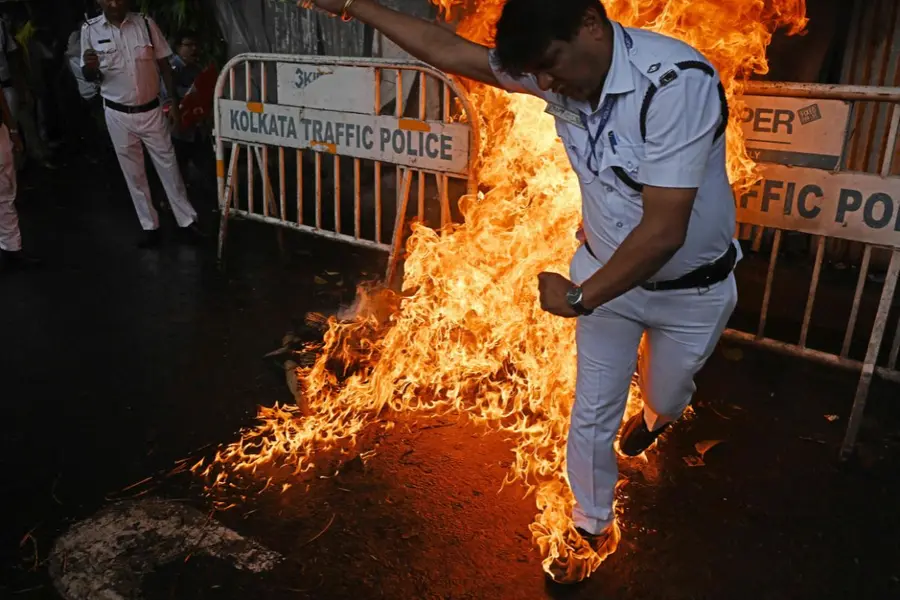
Kolkata: West Bengal witnessed sporadic incidents of violence and disruption on Wednesday as Left-wing activists supporting a nationwide general strike clashed with police and Trinamool Congress (TMC) supporters in several districts.
The strike, called by 10 central trade unions, aimed to protest against issues including liberalisation, rising prices of essential goods, joblessness, and the increasing prevalence of contractual work.
Despite additional security deployments and the West Bengal government's zero-tolerance stance towards bandhs, protestors blocked roads and railway tracks in various parts of the state. Attempts were made to forcibly shut down shops and public transport in select pockets, although the strike drew only a partial response overall.
Banking services across both public and private sectors were significantly impacted.
In Kolkata, Democratic Youth Federation of India (DYFI) and CPI(M) workers clashed with police in the Ganguly Bagan area during an attempt to block a main thoroughfare, leading to traffic disruptions.
Protestors reportedly threatened shopkeepers and burnt tyres, creating fire hazards that were swiftly dealt with by the authorities. Several demonstrators, including SFI leader Srijan Bhattacharya, were detained. Bhattacharya later alleged that the protests were peaceful and accused the police of heavy-handedness.
Violence was also reported from other parts of the state:
In North Kolkata’s College Street, clashes broke out as police tried to dismantle road blockades.
In Domjur, Howrah, police and Rapid Action Force (RAF) personnel used lathis to disperse protestors attempting to halt vehicles.
In Siliguri, strike supporters were removed from Hill Cart Road following a scuffle in which a protestor was seen knocking off a police officer’s cap.
In Buniadpur, Dakshin Dinajpur, a CPI(M) leader was slapped by the local police station chief during a heated exchange.
Tensions flared in Tufangunj, Cooch Behar, as CITU and INTTUC workers clashed.
In Birbhum’s Kirnahar and Rampurhat, violent confrontations broke out between Left and TMC activists, reportedly in the presence of police. Three CPI(M) supporters were injured and hospitalised.
Railway services were also disrupted in multiple areas including Diamond Harbour, Shyamnagar, Barrackpore, Durgapur, Lalgola, Uluberia, and Belgharia, as protestors attempted to block train movements.
The state government arranged additional public transport and deployed heavy police contingents at key locations to maintain order.
Senior CPI(M) leader Sujan Chakraborty criticised the TMC's response, accusing the ruling party of aligning itself with the BJP's politics. Congress leader Adhir Ranjan Chowdhury also voiced support for the strike, while condemning the TMC’s crackdown.
TMC spokesperson Debangshu Bhattacharya defended the government's stance, stating, “This is not a spontaneous people’s movement but hooliganism disguised as protest.” He added that even Kerala, governed by the CPI(M), had issued similar advisories against the strike.
The strike, which commenced at 6 am, was supported by trade unions affiliated with the Left and the Congress. West Bengal CITU president Anadi Sahu reiterated that the bandh was called in response to growing economic distress across the country.
Published: 09 Jul 2025, 04:03 pm IST
Related Topics
Disclaimer: Kindly avoid objectionable, derogatory, unlawful and lewd comments, while responding to reports. Such comments are punishable under cyber laws. Please keep away from personal attacks. The opinions expressed here are the personal opinions of readers and not that of Mathrubhumi.
