
HoverIt’s Divyastra MK2 UAV marks a major leap in India’s long-range unmanned defence capabilities and self-reliance drive.
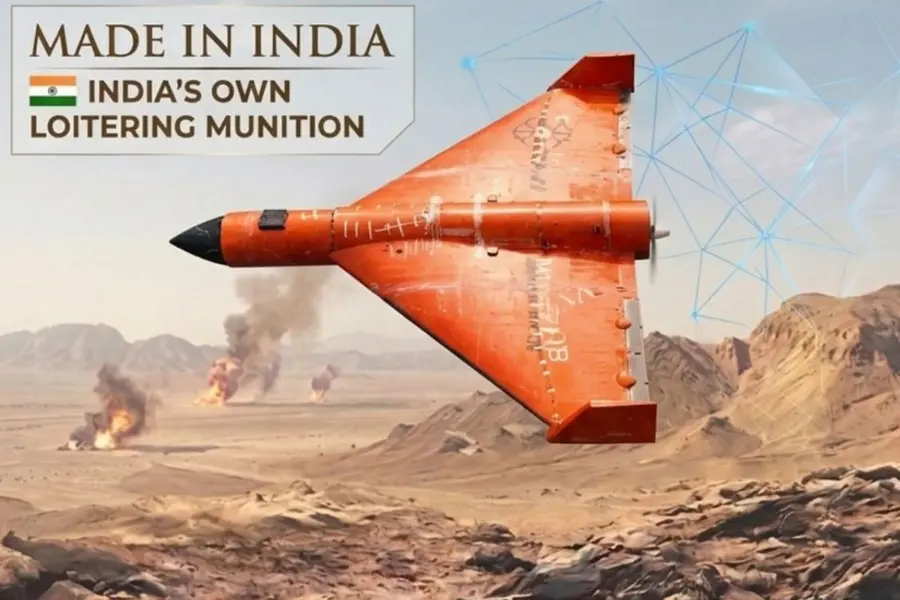
India’s defence innovation story is increasingly being shaped by a new generation of agile startups that are pushing the boundaries of unmanned systems and strategic technologies. At a time when modern warfare is rapidly evolving, marked by the growing use of autonomous platforms, electronic warfare, and long-range precision capabilities, indigenous solutions are no longer just desirable but essential.
Among the emerging players, HoverIt is drawing attention with its Divyastra series of long-range loitering munitions, particularly the latest Divyastra MK2. Designed as a fixed-wing unmanned aerial system with a reported range of up to 2,000 km, the platform represents a significant shift from conventional short-range drones to high-endurance, deep-strike capable systems. Its development also reflects a broader transformation underway in India’s defence ecosystem, where startups are increasingly complementing traditional players in delivering cutting-edge capabilities.
In this conversation, Saurav Singh Bhadauria, Founder, HoverIt, breaks down the technology behind Divyastra MK2, explains how it differs from commonly understood drones, and outlines what such advancements mean for India’s operational readiness, self-reliance goals, and position in the global unmanned systems landscape.
Excerpts from Mathrubhumi English's exclusive interview
For a common reader, how would you explain what the Divyastra MK2 is and how it is different from a regular drone?
The Divyastra series are fixed-wing unmanned aerial vehicles (UAVs), unlike the quadcopters or multirotor drones that most people are familiar with.
A typical quadcopter drone relies on multiple rotors to stay airborne, which limits its range and endurance. In contrast, Divyastra uses a fixed-wing aircraft configuration, similar to a small airplane. This allows it to fly much farther, faster, and for longer durations, making it suitable for strategic missions.
While quadcopters are excellent for short-range surveillance or tactical operations, fixed-wing UAVs like Divyastra are designed for long-distance missions, deeper penetration, and higher endurance, which are critical in modern defence operations.
The MK2 has a reported range of up to 2,000 km. What does this mean in practical terms for India’s defence capabilities?
A 2,000 km operational range is a major leap for India’s UAV ecosystem. Currently, India imports systems such as IAI Harop and IAI Harpy from the Israeli company Israel Aerospace Industries, which have significantly shorter ranges.
With Divyastra MK2, India moves closer to strategic self-reliance in long-range unmanned strike systems.
In practical terms, such a range allows the platform to cover extremely large operational areas without requiring forward deployment, which increases operational flexibility and reduces risk to personnel. It also means the system can operate deep into contested environments, giving commanders more strategic options during conflict scenarios.
How big of a leap is the MK2 compared to your earlier Divyastra MK1, and what drove this rapid advancement?
The jump from Divyastra MK1 to MK2 is roughly a 4× increase in endurance and operational range. While the core technological architecture remains similar, MK2 incorporates several improvements in aerodynamics, propulsion efficiency, onboard electronics, and mission optimization systems.
What enabled this rapid advancement was the learning curve from real field deployments and trials. The feedback from operational environments helped us refine the platform quickly. In defence technology, iterative development based on real-world data often leads to faster breakthroughs than purely laboratory development.
We often hear about GPS jamming in modern warfare. How does Divyastra MK2 manage to operate in such environments, and why is that important?
GPS jamming and spoofing are becoming increasingly common in modern warfare. We are seeing this not just in military environments but also affecting commercial aviation and maritime navigation systems worldwide.
Electronic warfare systems create a jamming envelope, where satellite navigation signals become unreliable or completely unavailable. Inside this envelope, navigation becomes one of the biggest operational challenges for unmanned systems.
To address this, Divyastra MK1/2 is designed with multiple alternative navigation methods. While I cannot disclose all technical details, the platform incorporates systems such as:
- Visual navigation
- Dead-reckoning navigation
- AI-assisted navigation using pre-fed terrain data
These redundant navigation systems allow the UAV to continue its mission even in contested electromagnetic environments, which is becoming essential in modern warfare scenarios.
What stage is the project currently at after the high-speed taxi trials, and how far are we from real-world deployment?
Following the high-speed taxi trials, the next phase is aerodynamic flight testing.
We expect the first flight tests to begin in early May, where the Divyastra MK2, a 3-meter wingspan platform, will take to the air for the first time.
After the initial flight, we will conduct a series of tests covering:
- Range validation
- Endurance testing
- Mission system performance
- Autonomous operations
These tests are critical to ensure reliability and operational readiness. Typically, 6 to 9 months of flight testing are required before the system can move toward induction into operational service.
As an Indian startup, what were the biggest challenges you faced in developing such an advanced system?
The biggest challenge for any defence startup is building deep-tech hardware in an ecosystem that historically depended heavily on imports.
Unlike software startups, defence technology requires extensive testing, certifications, hardware development, and supply chain reliability. Access to specialized components, testing infrastructure, and funding for long development cycles can be difficult for startups.
However, things are changing rapidly in India. Today, we are seeing a strong push for indigenous defence manufacturing, and that has helped companies like ours move faster. Our focus has always been to build systems in India using an increasingly Indian supply chain, which strengthens long-term strategic independence.
How does India’s progress in unmanned systems like Divyastra compare with global players such as the US, China, or Israel?
Countries like the United States, Israel, and China have been investing in unmanned systems for decades, so they naturally have a head start.
However, India is now moving very rapidly. The combination of government policy support, private sector innovation, and real operational demand from the armed forces is accelerating development.
Indian startups today are able to develop advanced systems faster and more cost-effectively, especially when compared to traditional defence development cycles. In many niche segments, we are already seeing globally competitive platforms emerging from Indian companies.
Your company operates from the Uttar Pradesh Defence Industrial Corridor. How important has this ecosystem been in supporting startups like yours?
The Uttar Pradesh Defence Industrial Corridor is a very important initiative for India’s defence manufacturing ecosystem.
For startups like ours, having access to a dedicated defence manufacturing cluster brings several advantages: infrastructure, proximity to suppliers, policy support, and collaboration opportunities with other defence companies.
For HoverIt, setting up in this ecosystem allows us to build manufacturing capability, scale production, and integrate more Indian suppliers into the supply chain, which is crucial for long-term self-reliance in defence technology.
Beyond defence, do you see any future civilian or homeland security applications for technologies developed in Divyastra?
Yes, many of the technologies developed for defence UAVs can have significant civilian and homeland security applications.
Long-range unmanned systems can be extremely useful for:
- Border surveillance
- Maritime monitoring
As the technology matures, we expect some of these capabilities to eventually be adapted for non-military applications where persistent aerial monitoring is required.
Finally, what is your long-term vision for HoverIt, are you aiming to become a global player in advanced drone and unmanned warfare systems?
Our long-term vision is to build HoverIt into a globally recognized unmanned systems company from India.
We want to develop a full ecosystem of platforms from surveillance drones to advanced unmanned strike systems and autonomous defence technologies.
India has the engineering talent, the operational experience, and now the policy support to build world-class defence technology. Our goal is not only to serve India’s armed forces but eventually to position India as a global hub for advanced unmanned systems.
Published: 11 Apr 2026, 09:58 am IST
ABOUT THE AUTHOR

Disclaimer: Kindly avoid objectionable, derogatory, unlawful and lewd comments, while responding to reports. Such comments are punishable under cyber laws. Please keep away from personal attacks. The opinions expressed here are the personal opinions of readers and not that of Mathrubhumi.