
Tribal communities in Madhya Pradesh protest the Ken-Betwa River Link Project through Chita and Phansi Satyagraha, raising concerns over displacement, rehabilitation and environmental impact.
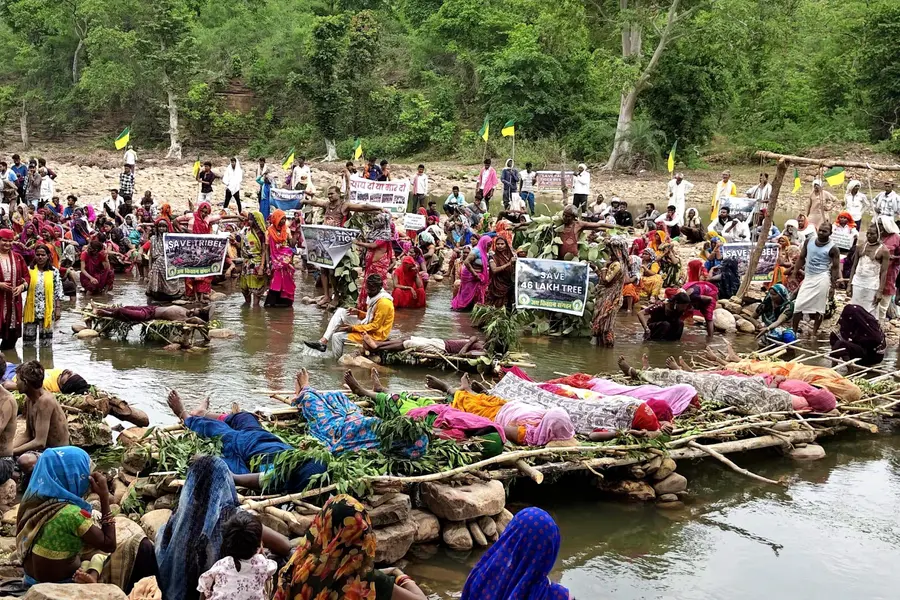
Madhya Pardesh: Tribal communities in Madhya Pradesh’s Chhatarpur district have launched dramatic symbolic protests against the Ken-Betwa River Link Project, sitting on funeral pyres and wearing nooses around their necks to highlight their concerns over displacement, rehabilitation and loss of ancestral land.
While the government presents the project as a major water solution for Bundelkhand, affected families say development cannot come at the cost of their homes, forests and livelihoods.
Tribal protesters turn to extreme symbolism against Ken-Betwa project
Images of tribal women sitting on symbolic funeral pyres and placing nooses around their necks during the protest have drawn attention across Madhya Pradesh. The demonstrations, known as Chita Satyagraha and Phansi Satyagraha, are symbolic forms of non-violent resistance.
The protesters say the loss of their ancestral land, forests and rivers would mean the destruction of their traditional way of life. According to them, displacement without proper rehabilitation is equal to losing their identity and future.
The agitation took place near the Barana River in Chhatarpur district, where villagers affected by the Ken-Betwa River Link Project and other irrigation schemes gathered to demand justice.
What is the Ken-Betwa River Link Project?
The Ken-Betwa Link Project is India's first major river interlinking project under the National Perspective Plan. It aims to transfer water from the Ken River basin in Madhya Pradesh to the Betwa River basin in Uttar Pradesh.
The government says the project will address water shortages in drought-prone Bundelkhand and provide major benefits, including:
- Irrigation for around 10.62 lakh hectares of land
- Drinking water supply for nearly 62 lakh people
- Generation of 130 MW of hydroelectric power
The project includes the construction of the Daudhan Dam, which is considered the key component of the river-linking plan.
The estimated cost of the project is around ₹44,605 crore.
Why are tribal communities opposing the project?
Affected villagers argue that the project threatens their land, forests, water sources and cultural identity.
They claim that many families have either not received adequate compensation or have not been properly included in official lists of project-affected people.
Their main concerns include:
- Rehabilitation and compensation disputes
- Protesters allege that land acquisition has moved ahead without completing proper rehabilitation.
They have demanded:
- Complete disclosure of project-affected family lists
- Fair compensation under the Land Acquisition Act, 2013
- Land-for-land rehabilitation options
- Restoration of lost livelihoods
Villagers argue that financial compensation alone cannot replace the relationship they have with forests and agricultural land.
For many tribal communities, Jal, Jangal, Jameen (water, forest and land) are not just economic resources but part of their social and cultural existence.
Villagers accuse administration of ignoring concerns
Protesters have accused authorities of failing to address their complaints despite repeated assurances.
They allege that:
- Families were displaced before complete rehabilitation
- Some eligible families were excluded from official records
- Police cases were filed against villagers
- Authorities attempted to weaken the protest instead of resolving issues
Activists have also raised questions about whether legal protections for tribal communities, including provisions under the Forest Rights Act and PESA Act, were properly followed.
The laws require greater participation of local tribal communities in decisions affecting their traditional lands.
Government defends project, rejects allegations
The Madhya Pradesh government and local administration have defended the Ken-Betwa project, arguing that it is essential for the development of Bundelkhand.
Officials have said rehabilitation packages are being provided and that additional funds have been approved for affected families.
The Chhatarpur administration said the state government increased rehabilitation assistance from ₹5 lakh to ₹12.5 lakh per eligible family and sanctioned an additional ₹202.5 crore for rehabilitation.
Officials have maintained that discussions with protesters were held and that grievances were being examined.
However, protesters argue that announcements on paper have not translated into relief on the ground.
Environmental concerns around Ken-Betwa project
Apart from displacement concerns, environmental groups have raised questions about the ecological impact of the project.
The Daudhan Dam is expected to affect parts of the Panna Tiger Reserve, raising concerns about wildlife habitats, including those of tigers and other endangered species.
Critics argue that large infrastructure projects involving forests must consider long-term environmental consequences, especially in areas with fragile ecosystems.
Supporters of the project, however, say development benefits for drought-affected regions must also be considered.
Women become the face of the resistance
Tribal women have played a major role in the protests.
They participated in multiple forms of resistance, including:
- Jal Satyagraha — standing in river water as a protest
- Chita Satyagraha — lying on symbolic funeral pyres
- Phansi Satyagraha — wearing symbolic nooses
Women protesters said the fight was not only about compensation but about protecting their communities and their connection with ancestral land.
Amit Bhatnagar's hunger strike becomes a focal point
The protest was led by activist Amit Bhatnagar of Jai Kisan Organisation, who launched an indefinite hunger strike demanding action on rehabilitation issues.
Protesters said the concerns also involved families affected by other irrigation projects, including Majhgaon and Runjh.
Bhatnagar alleged that several promises made by authorities remained incomplete.
Political attention grows over tribal agitation
The protest gained political attention after Congress leader and Madhya Pradesh Leader of Opposition Umang Singhar visited the site.
Singhar supported the protesters' demand for a review of rehabilitation measures and questioned the administration's handling of the agitation.
He demanded greater transparency and suggested a joint committee involving government officials and representatives of affected communities.
Police action ends the protest
After around 15 days of agitation, Madhya Pradesh Police removed protesters from the demonstration site near Kupi village.
The removal came after the administration maintained that rehabilitation measures were underway and urged protesters to return home.
Activist Amit Bhatnagar, who was leading the hunger strike, was reportedly detained during the police action.
The protesters, however, said their concerns remained unresolved.
Development versus displacement debate
The Ken-Betwa project represents a larger national debate — whether major development projects can move forward without causing hardship to communities living on the land where they are built.
The government views the project as a major step towards solving Bundelkhand's water crisis. Critics argue that infrastructure development must not ignore the rights of displaced communities.
For tribal families in Chhatarpur, the protest is not only against a dam but against what they describe as a loss of their homes, forests and identity.
As construction progresses, the biggest challenge for authorities will be ensuring that development goals do not come at the cost of constitutional protections and the dignity of affected communities.
Published: 19 Jul 2026, 11:02 am IST
Disclaimer: Kindly avoid objectionable, derogatory, unlawful and lewd comments, while responding to reports. Such comments are punishable under cyber laws. Please keep away from personal attacks. The opinions expressed here are the personal opinions of readers and not that of Mathrubhumi.
