
Indian businessman quietly rescued five Jewish families from Nazi-occupied Austria using forged job offers, compassion, and sheer courage.
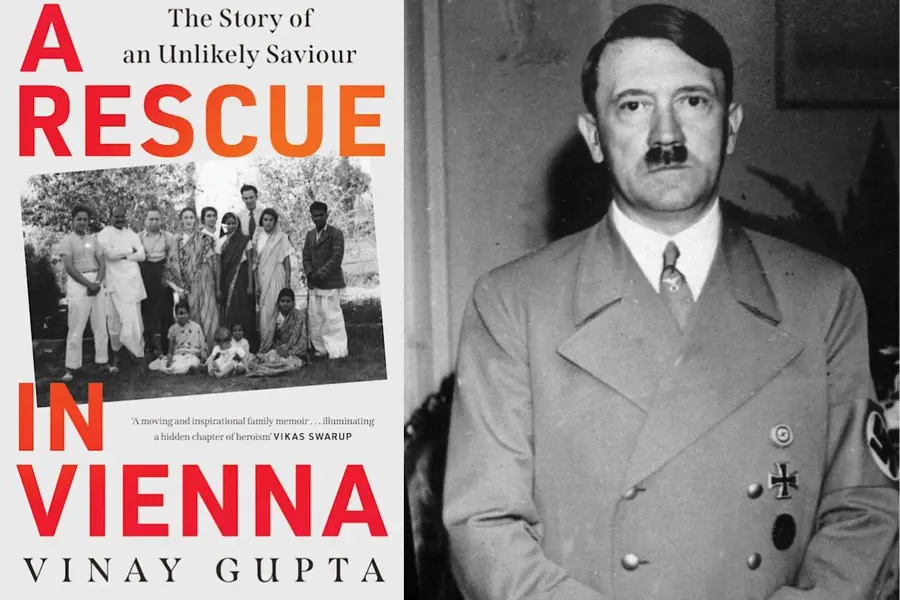
Decades before the world learned of ‘Schindler’s List’, a quiet act of defiance played out far from Europe, in the industrial town of Ludhiana, Punjab. At its centre was Kundan Lal, an Indian entrepreneur whose name remained hidden from history until a family secret brought it to light.
It all began with a single sentence from his mother: “Let me tell you a secret. Your nana (grandfather) helped Jewish families escape the Nazis.” That revelation set Vinay Gupta, a US-based professional, on a journey into his grandfather’s past, a journey that would uncover a remarkable story of resistance, compassion and bravery.
Gupta pieced together his grandfather’s untold legacy through family letters, survivor interviews, and historical documents, culminating in his memoir ,A Rescue in Vienna,. What he found was more gripping than fiction: Kundan Lal, a successful businessman from Punjab, had orchestrated a daring rescue of Jewish families fleeing Nazi-occupied Austria, using job offers, false company names, and sheer willpower.
An unexpected beginning in Vienna
In 1938, Kundan Lal, then 45, travelled from India to Vienna for medical treatment for diabetes and haemorrhoids. During his recovery in hospital, he encountered Alfred and Lucy Wachsler, a young Jewish couple expecting their first child. Through them, he witnessed the worsening climate for Jews in Austria following Hitler’s annexation.
Instead of turning away, he quietly stepped into action. Kundan Lal began offering job contracts, some through fictitious firms, to help Jewish families secure visas to India. He had no legal authority, no political clout, and no obligation. What he had was resolve.
Jobs as lifelines
Kundan Lal placed newspaper ads in Austria offering employment in woodworking and textiles in India. These ads served one purpose: to create legal documentation that would enable Jewish professionals to escape Europe.
Among the first to respond was Hans Losch, a textile expert, who had been dismissed from his job under anti-Jewish laws and watched his family business fall apart. Kundan Lal offered him not just a job, but housing and a stake in the imaginary “Kundan Cloth Mills.” When Losch expressed disbelief, Kundan Lal replied, “Of course. You and others, if possible.”
Between early 1938 and February 1939, he rescued five Jewish families, including:
- Fritz Weiss, a lawyer hiding in a hospital, who received a visa through a job offer at “Kundan Agencies.”
- Hans Losch, who took the first boat and train to India after accepting Kundan Lal’s job offer.
- Alfred and Lucy Wachsler, who made the journey with their newborn.
- Alfred and Siegfried Schafranek, former plywood factory owners, who helped establish one of India’s first plywood units.
- Siegmund Retter, a machine tool dealer, who was approached by Kundan Lal just as his business was being dismantled.
None of them knew much about India. For many, it didn’t matter. They just needed a way out.
Life in Ludhiana: A harsh transition
When the families arrived in Ludhiana, reality set in. The city was nothing like Vienna, hot, isolated, with no Jewish community or familiar comforts. Losch and Weiss left within weeks, relocating to Bombay, then eventually to the West. Kundan Lal held no resentment. Gupta writes, “My aunt told me he actually felt embarrassed that he could not provide a lifestyle and social environment more suited to Vienna.”
Others stayed longer. The Wachsler and Schafranek families moved into homes Kundan Lal had built side by side. Alfred Wachsler established a furniture workshop, crafting elegant pieces with local artisans and Burmese teak. Some of that furniture still survives.
In 1939, the Schafraneks launched one of India’s earliest plywood factories in a shed behind their new home, determined to build something lasting in their new country.
Then came the war
With Hitler’s invasion of Poland in 1939, the world changed overnight. British-controlled India was pulled into World War II. Suddenly, all German nationals, even Jewish refugees, were deemed “enemy aliens.”
The Wachsler and Schafranek families were sent to internment camps near Pune, despite having committed no crime. Their only fault was their passport.
Conditions were harsh. Eventually, freedom came in exchange for employment. The Schafraneks found work in Bangalore and moved south to rebuild their lives. The Wachsler family relocated to Karachi in 1942. By 1948, they were resettled in the United States.
Gupta later found Alfred Wachsler’s son, Alex, in the US. Despite having left India at age 10, Alex still speaks Urdu and frequents Indian restaurants. He even owns the teak desk his father built for Kundan Lal, a physical reminder of their time in India.
A legacy hidden for decades
Kundan Lal never spoke of his rescue efforts. He returned home from Europe and resumed business, running a matchstick factory, building a school for his daughters, and raising five children with his wife Saraswati.
But his life wasn’t without tragedy. Saraswati grew increasingly distant in her later years, battling depression. She died in 1965 after a fall from their terrace. Kundan Lal passed away a year later, at 73, from a heart attack.
His family remained unaware of the extent of his efforts until decades later, when Vinay Gupta began digging into his past.
Gupta writes, “The notion of a 'passive bystander' was anathema to Kundanlal. If he saw something, or someone, that required attention, he attended to it, never intimidated by the enormity of the problem.”
Published: 13 Jul 2025, 12:09 pm IST
Related Topics
Disclaimer: Kindly avoid objectionable, derogatory, unlawful and lewd comments, while responding to reports. Such comments are punishable under cyber laws. Please keep away from personal attacks. The opinions expressed here are the personal opinions of readers and not that of Mathrubhumi.
