
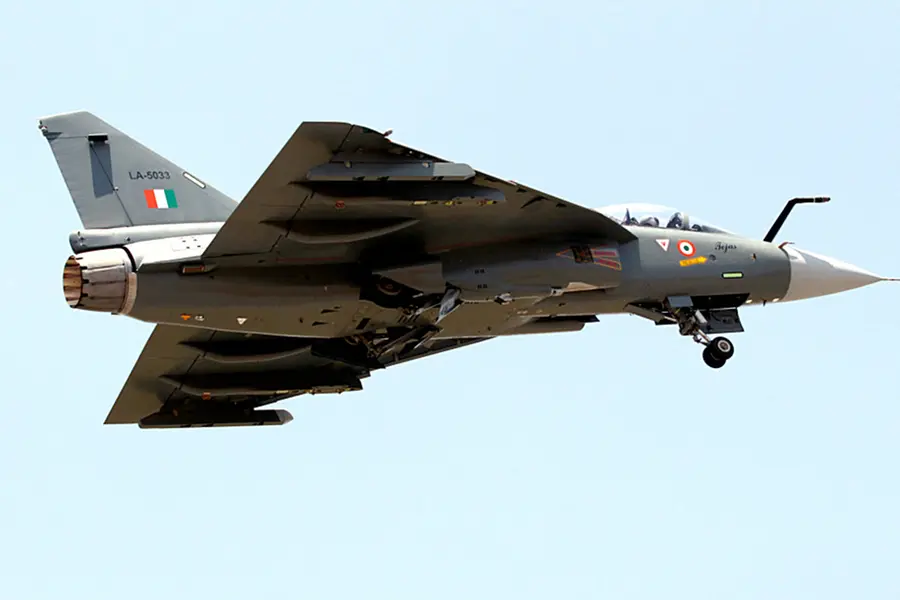
Hindustan Aeronautics Limited (HAL) intends to continue with the American F404 engines for the Tejas Mk-1A fighter aircraft despite GE Aerospace flagging off delay in the supply of the engines citing supply chain bottlenecks currently prevailing in the aerospace industry.
When contacted, senior HAL officials, who requested anonymity, told Mathrubhumi English that there were no immediate proposals to replace GE engines. They noted that any such decision would require structural design changes, potentially delaying the already-delayed project by five to seven years.
Also Read

There are 83 Tejas Mk-1A aircraft awaiting the American F404 engines. This has caused a 9-month delay and cast a cloud over the indigenously-made fighter aircraft programme.
Meanwhile, multiple media reports cited GE officials as saying the company, itself, is not facing any problems, but that issues arise from various intermediaries. This situation is affecting not just the Indian government, which ordered the fighter jets from HAL, but also North America’s space industry, the reports noted.
As a possible solution, officials in Delhi are considering stopping their reliance on HAL and directly working with American companies. The main goal of this plan is to get American firms to set up production in India. This would bring several benefits, such as removing unreliable subcontractors and allowing India to produce high-tech parts locally.
Additionally, the issue with the missing engines for Indian aircraft has become so serious that Indian engineers are now rethinking the use of the Russian RD-33 engine, although they previously ruled it out.
Given the situation, local aviation experts and analysts are looking into alternative options as a backup plan. Some suggest that the EuroJet EJ200 and Snecma M88-2 engines could be good replacements, since they are important for a light combat aircraft’s performance.
Although HAL has not officially looked for new engines for the LCA Tejas Mk-1A programme, having a Plan-B could be crucial. If necessary, HAL may consider evaluating these western engine options for the LCA Tejas programme.
What Is Plan-B?
The EJ200 engine is made by European consortium EUROJET Turbo GmbH, which includes MTU, Rolls-Royce, Avio Aero and ITP Aero. EJ200 engines are used in the Eurofighter Typhoon. M88-2 engines are used in the Dassault Rafale.
The EJ200 engine has a slightly lower inlet temperature, while the M88-2 engine includes extra cooling channels and specially designed nozzles to reduce its infrared (IR) signature. This feature gives a tactical advantage by making it harder for enemy IR systems to detect the aircraft.
An infrared heat signature refers to the pattern of heat emitted by objects, which can be detected using infrared sensors. This heat is invisible to the naked eye, but can be seen with infrared cameras, allowing for the detection of living beings or warm objects, even in darkness.
The choice of either EJ200 or M88 engine depends on priorities. If the priority is fuel efficiency and ease of maintenance, the EJ200 is a better option. However, if better acceleration and a lower IR signature are more important, the M88 may be the right choice.
The EJ200 engine has a wet thrust of 90 kN, which is higher than the GE F404 engine’s 84 kN. In contrast, the M88 engine has a wet thrust of 75 kN, which is less than both the GE F404’s 84 kN and the older F404 engines used in earlier prototypes that produced 78 kN.
If fuel efficiency and a lower IR signature are most important, the M88-2 is a great choice. However, if the focus is on higher thrust-to-drag and thrust-to-weight ratios, as well as ease of maintenance and reliability, the EJ200 is the better option.
Tejas Mk-1A Fighter Upgrades
The Tejas Mk-1A is an improved model of the original Tejas Mk1, with upgrades to boost its combat abilities and operational efficiency.
One major difference between the Tejas and Tejas Mk-1A is their avionics. The Tejas Mk-1A features advanced avionics, including an active electronically scanned array (AESA) radar, which provides better target detection and tracking compared to the mechanically scanned radar in the Tejas Mk1.
Another important upgrade in the Tejas Mk-1A is the addition of an electronic warfare (EW) suite. This includes a self-protection jammer and advanced electronic countermeasures, which improve the aircraft’s ability to survive in hostile environments. The original Tejas Mk1 does not have this complete EW suite.
The Tejas Mk-1A also features better maintainability and operational readiness. When it comes to weaponry, the Tejas MK1A can carry and use a wider variety of advanced munitions. These include beyond-visual-range (BVR) missiles, precision-guided munitions and standoff weapons, giving it a more advanced weapons cache in contrast to the Tejas MK1.
The Tejas Mk-1A also has better flight performance and handling. It features an upgraded flight control system and aerodynamic improvements that boost its maneuverability and overall performance in combat. These improvements make the Tejas Mk-1A more agile and effective compared to the Tejas MK1.
The author of this article is a defence, aerospace and political analyst based in Bengaluru.
Published: 18 Jul 2024, 02:05 pm IST
Related Topics
Disclaimer: Kindly avoid objectionable, derogatory, unlawful and lewd comments, while responding to reports. Such comments are punishable under cyber laws. Please keep away from personal attacks. The opinions expressed here are the personal opinions of readers and not that of Mathrubhumi.