
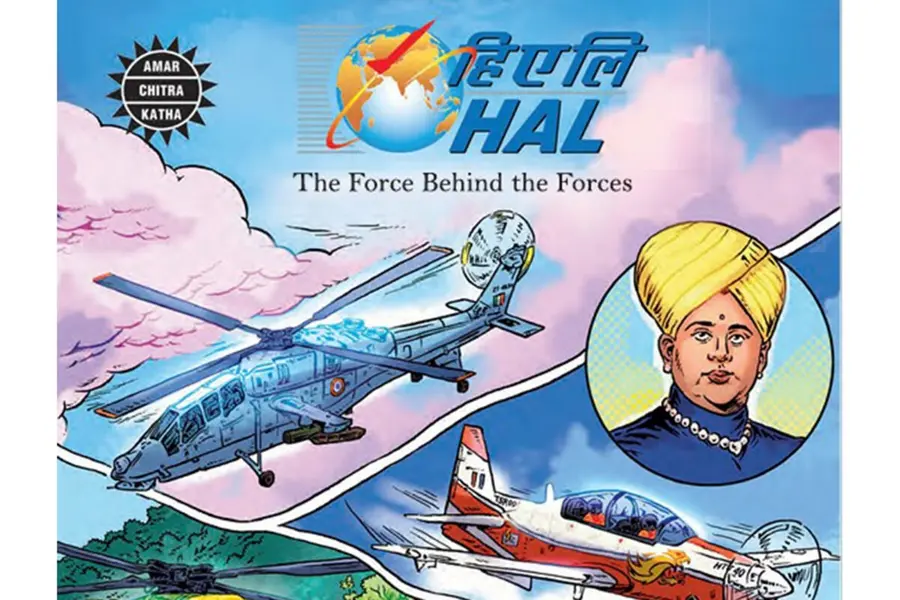
HAL has teamed up with Amar Chitra Katha to launch 'HAL: The Force Behind the Forces', an illustrated comic that introduces children to India's aerospace journey—from Tejas and Prachand to Gaganyaan—in an engaging, easy-to-understand format.
"He dared to dream of an aircraft factory in India when we didn't even have a bicycle factory." That one line is enough to make you pause.
If you grew up in India, chances are your childhood bookshelf had a few well-thumbed copies of Amar Chitra Katha. Maybe it was the story of Shivaji Maharaj, Rani Lakshmibai, Birbal, Tenali Raman, or Swami Vivekananda. Many of us also spent afternoons laughing over the adventures of Chacha Chaudhary and Sabu, whose wit and humour made reading irresistible.
Those colourful comics did something magical. They made history feel alive. They turned great personalities into heroes we could relate to. They sparked curiosity without feeling like school textbooks. Now, imagine opening an Amar Chitra Katha comic and finding... fighter aircraft, helicopters, engineers and rocket technology.
That is exactly what Hindustan Aeronautics Limited (HAL) has done.
In a refreshing and heartwarming initiative, India's aerospace giant has partnered with Amar Chitra Katha to publish "HAL: The Force Behind the Forces", an illustrated comic that tells the story of India's remarkable aerospace journey in a language children can understand and enjoy.
And perhaps, this may be one of HAL's most important missions yet.
Not just another comic
At first glance, it may look like just another Amar Chitra Katha comic. But this one carries the story of a nation that learned to build its own wings.
Instead of kings and warriors, the heroes here are engineers, designers, scientists, pilots and visionaries who spent decades building India's aerospace capability.
The comic takes readers on a fascinating journey, from assembling imported aircraft during the early years to designing and manufacturing world-class indigenous platforms like the Light Combat Aircraft (LCA) Tejas Mk1A, Dhruv Advanced Light Helicopter, Light Combat Helicopter Prachand, Light Utility Helicopter, HTT-40 trainer aircraft, and many others.
It tells a story that many young Indians may not know, that India's aerospace success did not happen overnight. It was built patiently over more than eight decades.
An adventure read!
One of the most charming aspects of the comic is its storytelling. Rather than presenting facts like a history lesson, the story begins with a group of schoolchildren visiting the HAL Museum in Bengaluru.
Through their curious questions, readers discover how HAL came into existence, how industrialist Walchand Hirachand dreamed of building aircraft in India during British rule, and how the company gradually evolved into one of the country's most important defence manufacturers. The conversations feel natural.
Instead of complicated engineering explanations, readers experience the excitement of discovery alongside the children. It's storytelling at its simplest and perhaps its most powerful.
Imported aircraft to indigenous pride
One of the comic's strongest messages is India's journey towards self-reliance. A memorable illustration captures this beautifully.
"We assembled MiG-21s and MiG-27s." "Then we started making half." "Now we make almost everything." In just a few lines, the comic explains decades of technological progress.
For young readers, it offers an easy way to understand what "indigenisation" really means, not just manufacturing aircraft, but building confidence, capability and national pride.
The Tejas Light Combat Aircraft naturally takes centre stage. The comic proudly highlights how Tejas has flown at prestigious international air shows such as Dubai and Farnborough, proving that Indian aircraft are no longer copies, they are innovations in their own right.
Engineering can be exciting too…
One of the biggest challenges in encouraging children to pursue careers in science is making technology feel exciting. HAL seems to understand this perfectly. The comic introduces readers to engineers working not only on aircraft but also on India's growing space programme.
One scene shows an engineer explaining the Gaganyaan crew module, helping children understand that Indian astronauts will one day travel into space using systems built by Indian engineers. Suddenly, aerospace no longer feels distant or complicated. It becomes something a young reader can dream about. Perhaps one child reading the comic today may become tomorrow's aircraft designer or spacecraft engineer or a test pilot.
Amar Chitra Katha magic
There is something timeless about Amar Chitra Katha. For nearly sixty years, it has introduced generations of Indians to the stories that shaped the nation. Unlike digital videos that disappear after a few minutes, these comics stay with readers. Parents pass them to children; libraries preserve them collectors collect them.
The illustrations, simple language and engaging narratives make even complex subjects feel approachable. That is precisely why HAL chose Amar Chitra Katha.
Instead of publishing another coffee-table book or corporate history, it decided to tell its story through a medium that generations already know and trust. It is an unusual decision, but a wonderfully human one.
More than aircraft
Of course, the comic celebrates aircraft like the HF-24 Marut, HT-2, Kiran, Dhruv, Prachand, LUH and Tejas. But underneath all the aviation achievements lie another story. It is about dreaming big and believing India could build its own aircraft when many thought it impossible. The story weaves around thousands of engineers, technicians and workers who quietly spent decades turning those dreams into reality. Children may finish reading the comic remembering the helicopters and fighter jets. Adults, however, may come away remembering something else, the courage to imagine.
For many adults, reading Amar Chitra Katha again is like opening a window to childhood. It brings back memories of school holidays, library visits, comics exchanged with friends, and afternoons spent lost in colourful pages. Now, those same pages carry a different kind of hero. Not a king, not a mythological figure but an institution that helped India build its wings.
In a world where children are surrounded by screens and endless distractions, "HAL: The Force Behind the Forces" reminds us that a simple comic can still inspire curiosity, imagination and ambition. And perhaps that is its greatest achievement.
Because somewhere, a child may close this comic, look up at an aircraft crossing the sky and think, "One day... I want to build one of those."
That is where every great journey begins.
Published: 16 Jul 2026, 05:54 pm IST
Disclaimer: Kindly avoid objectionable, derogatory, unlawful and lewd comments, while responding to reports. Such comments are punishable under cyber laws. Please keep away from personal attacks. The opinions expressed here are the personal opinions of readers and not that of Mathrubhumi.
