
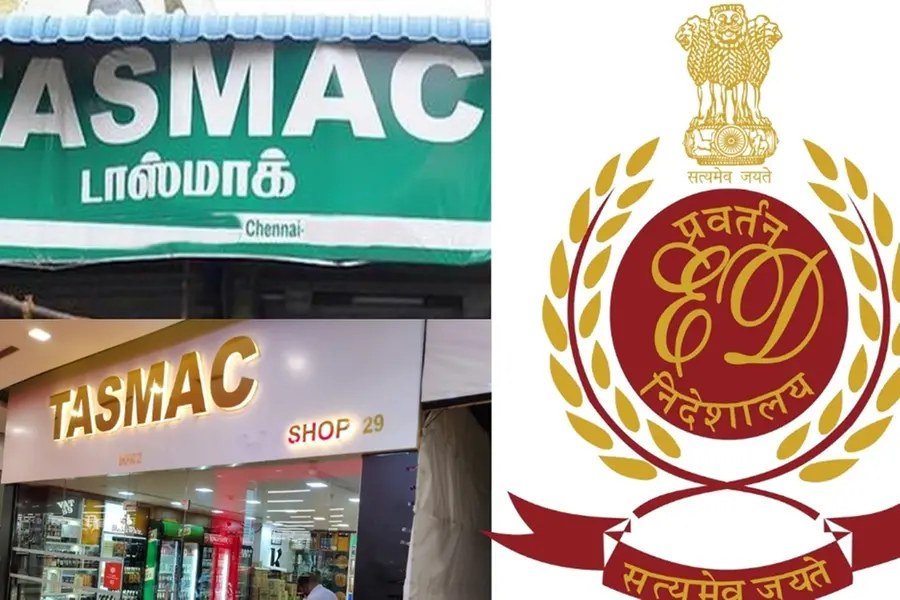
Chennai: Tamil Nadu’s state-run liquor monopoly, Tamil Nadu State Marketing Corporation Limited (TASMAC), today finds itself under intense scrutiny over allegations of corruption. The Enforcement Directorate (ED) has alleged that a network of politicians, bureaucrats, and distillery owners siphoned off more than Rs 1,000 crore through manipulated tenders, inflated expenses, and illegal transactions.
The controversy has sent shockwaves through the state's political landscape, putting the ruling Dravida Munnetra Kazhagam (DMK) government on the defensive while giving opposition parties, including the Bharatiya Janata Party (BJP) and the All India Anna Dravida Munnetra Kazhagam (AIADMK), ammunition to attack the administration.

What is TASMAC?
TASMAC, established in 1983, is the sole authority responsible for liquor sales in Tamil Nadu. The state government holds a complete monopoly over both wholesale and retail liquor distribution, making TASMAC one of its largest revenue sources. The corporation procures liquor from distilleries and distributes it to state-run retail outlets.
With over 4,700 retail outlets, TASMAC contributes nearly Rs 45,000 crore annually to Tamil Nadu’s economy, making liquor sales a crucial component of state revenue. While it provides significant income, TASMAC has frequently been criticised for lack of transparency, alleged corruption, and its role in increasing alcohol consumption in the state.
How did the scam unfold?
The ED's investigation has uncovered an elaborate network of corruption within TASMAC, where politicians, government officials, and liquor manufacturers allegedly colluded to manipulate sales, procurement, and tender allocations.
Key allegations in the scam
1.Fake purchase records & inflated costs: According to the ED, distilleries in Tamil Nadu allegedly fabricated purchase records, inflating costs and diverting funds through shell companies. Bottle-making companies, including Devi Bottles, Crystal Bottles, and GLR Holding, allegedly played a key role in creating bogus invoices to launder money.
2.Kickbacks for inflated liquor supply orders: According to the ED, liquor manufacturers allegedly paid bribes to TASMAC officials to secure inflated supply orders. The agency accused distilleries such as SNJ, Kals, Accord, SAIFL, and Shiva Distillery of being reportedly involved in funnelling kickbacks.
3. Tender manipulation in bar licences & transport contracts: According to the ED, bar licence tenders were allegedly awarded to applicants who lacked proper documentation (e.g., GST, PAN, or KYC details). Transport tenders were allegedly manipulated to favour particular companies, with TASMAC paying Rs 100 crore annually to transporters despite irregularities.
4. Unaccounted cash transactions & money laundering: According to the ED, a major chunk of the illicit funds was converted into cash and channelled back into the political ecosystem. Investigators allegedly found direct interactions between distillery executives and senior TASMAC officials, suggesting efforts to secure undue favours.
Political fallout: The shaken Tamil Nadu politics
The TASMAC scam has led to major political confrontations, with opposition parties targeting the DMK-led government over alleged corruption.
BJP Tamil Nadu chief K Annamalai called Balaji the "kingpin" of the corruption network. Balaji, however, dismissed the allegations as baseless, stating, "There are no irregularities. The ED is creating an image as if there are."
Annamalai further claimed, "The TASMAC scam is even bigger than the Delhi liquor scam."
On Monday (March 17) BJP leader Tamilisai Soundararajan was detained by Tamil Nadu police while protesting against the scam. She alleged, “The ED has revealed Rs 1,000 crore irregularities in TASMAC, and we have a right to protest.”
Opposition AIADMK’s Edappadi K Palaniswami suggested that the actual scam could be as large as Rs 40,000 crore and demanded a high-level probe.
DMK’s defence
State Excise Minister V Senthil Balaji, who has been accused of orchestrating the scam, and other DMK leaders have argued that the allegations are politically motivated. "TASMAC operates transparently. There is no basis for the claim that there were Rs 1,000 crore irregularities," Balaji said.
The DMK has accused the central government of misusing investigative agencies like the ED to tarnish the state government’s image.
The ED has launched a large-scale investigation into TASMAC, conducting multiple raids at: TASMAC headquarters, private distilleries linked to the scam and government officials’ premises. The agency has reportedly recovered incriminating documents related to bribes and kickbacks, digital records of money laundering transactions and links between politicians, bureaucrats, and distillery owners.
The central agency has hinted at more arrests and a deeper probe into DMK leaders' involvement.
Published: 17 Mar 2025, 11:41 am IST
Related Topics
Disclaimer: Kindly avoid objectionable, derogatory, unlawful and lewd comments, while responding to reports. Such comments are punishable under cyber laws. Please keep away from personal attacks. The opinions expressed here are the personal opinions of readers and not that of Mathrubhumi.