
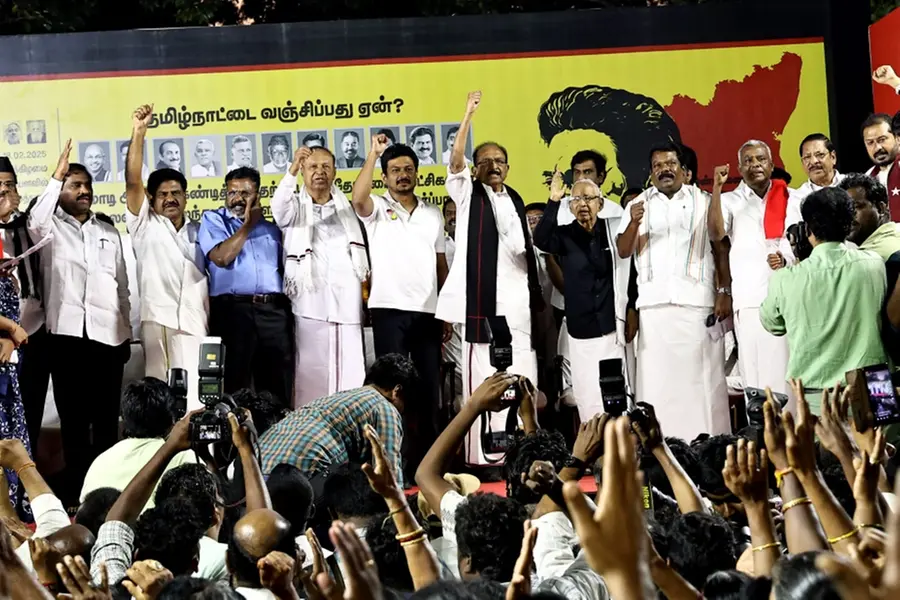
The three-language formula proposed in the National Education Policy (NEP) 2020 has become a significant point of contention between the DMK-led Tamil Nadu government and the central government.
Here is an explainer on what the formula entails and why it has sparked fresh political debate.
What is the three-language formula?
The three-language formula in NEP 2020 recommends that students learn three languages, at least two of which must be native to India. The policy applies to both government and private schools, with states being given flexibility to choose the languages, ensuring that no particular language is imposed.
The history of the three-language formula
The concept of the three-language formula dates back to the Education Commission (1964–66), officially known as the Kothari Commission. It was formally adopted in the National Policy on Education (NPE) 1968 under then-Prime Minister Indira Gandhi. The policy was reaffirmed in NPE 1986 under Prime Minister Rajiv Gandhi and later revised in 1992 by the Narasimha Rao-led Congress government to promote linguistic diversity and national unity.
The formula initially included three languages:
- The mother tongue or regional language
- The official language (Hindi)
- A modern Indian or European language (such as English or French)
What does NEP 2020 say about the three-language formula?
The NEP 2020 calls for an "early implementation of the three-language formula to promote multilingualism" from the school level. The document emphasises that the three-language policy should be implemented while "keeping in mind the Constitutional provisions, aspirations of the people, regions, and the Union, and the need to promote multilingualism as well as promote national unity."
The policy also introduces greater flexibility and explicitly states that no language will be imposed on any state.
"The three languages learned by children will be the choices of states, regions, and of course, the students themselves, so long as at least two of the three languages are native to India."
What about foreign languages?
In addition to Indian languages and English, NEP 2020 allows students at the secondary level to learn foreign languages such as Korean, Japanese, French, German, and Spanish, among others.
Why does Tamil Nadu oppose the three-language formula?
Tamil Nadu has historically opposed the three-language formula, viewing it as an attempt to impose Hindi on the state. The roots of this opposition date back to 1937 when the then Madras government, headed by C Rajagopalachari, introduced compulsory Hindi in schools. This decision triggered widespread protests led by the Justice Party and Dravidian leaders such as Periyar. The policy was eventually revoked in 1940, but anti-Hindi sentiments persisted.
When the three-language formula was officially introduced in 1968, Tamil Nadu refused to adopt it. Under Chief Minister C N Annadurai, the state implemented a two-language policy, teaching only Tamil and English. Tamil Nadu remains the only state in India that has never followed the three-language formula, preferring English over Hindi or other Indian languages.
What sparked the recent dispute?
Tamil Nadu's continued refusal to implement key aspects of NEP 2020, particularly the three-language formula, has led the Centre to withhold Rs 573 crore in central education assistance under the Samagra Shiksha Abhiyan (SSA).
According to policy rules, states must comply with NEP guidelines to receive SSA funding, of which 60 percent is provided by the Centre to states like Tamil Nadu. The withholding of funds has reignited political tensions, with the Tamil Nadu government standing firm on its long-held stance against the three-language formula.
(with agency inputs)
Published: 12 Mar 2025, 02:40 pm IST
Related Topics
Disclaimer: Kindly avoid objectionable, derogatory, unlawful and lewd comments, while responding to reports. Such comments are punishable under cyber laws. Please keep away from personal attacks. The opinions expressed here are the personal opinions of readers and not that of Mathrubhumi.
