
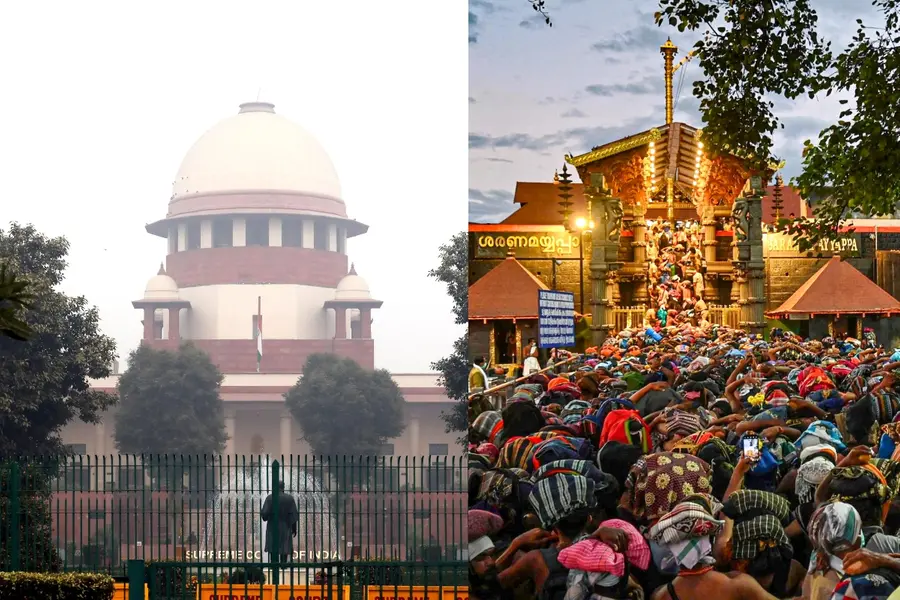
New Delhi: The Supreme Court of India on Thursday observed that if individuals begin questioning every religious practice before constitutional courts, it could lead to an unmanageable number of petitions and ultimately “break” the fabric of religious traditions in the country.
A nine-judge Constitution Bench, headed by Chief Justice Surya Kant, is currently hearing a series of petitions involving alleged discrimination against women in places of worship, including the Sabarimala Temple issue, as well as broader questions on the scope of religious freedom under Articles 25 and 26 of the Constitution.
During the hearing, the bench also comprising Justices B V Nagarathna, M M Sundresh, Ahsanuddin Amanullah, Aravind Kumar, Augustine George Masih, Prasanna B Varale, R Mahadevan and Joymalya Bagchi noted that religious practices are deeply interwoven with Indian society and must be examined carefully when challenged in court.
ALSO READ | Are you the nation’s chief priest?’; SC slams PIL on Sabarimala temple entry issue
The observations came while the court was hearing arguments from a group of reformist Dawoodi Bohra petitioners, who are challenging an earlier ruling that upheld the legality of excommunication practices within the community. Senior advocate Raju Ramachandran argued that practices affecting fundamental rights cannot automatically be protected under the guise of religion.
Representing the Government of Kerala, senior advocate Jaideep Gupta submitted that courts must rely on evidence from within religious communities when determining what constitutes essential religious practice, rather than imposing external theological interpretations.
Responding to these submissions, Justice Nagarathna cautioned that allowing unlimited challenges to religious practices could result in a flood of litigation, stating that such a scenario would have wide-ranging implications for India’s pluralistic society. Justice Sundresh similarly remarked that unchecked disputes over every aspect of religion could destabilise both religious systems and judicial workload.
ALSO READ | From Asoka to Ambedkar: The Buddhist threads in Kerala’s history
The bench emphasised that India’s constitutional framework recognises both individual rights and collective religious freedoms, and the balance between the two must be carefully maintained.
The hearing, which forms part of a wider constitutional examination of religious freedom and essential religious practices, remained inconclusive and is scheduled to continue next week.
Published: 07 May 2026, 09:38 pm IST
Related Topics
Disclaimer: Kindly avoid objectionable, derogatory, unlawful and lewd comments, while responding to reports. Such comments are punishable under cyber laws. Please keep away from personal attacks. The opinions expressed here are the personal opinions of readers and not that of Mathrubhumi.
