
Buddhist monuments and historical sites are being converted into Brahminical and Hindu temples
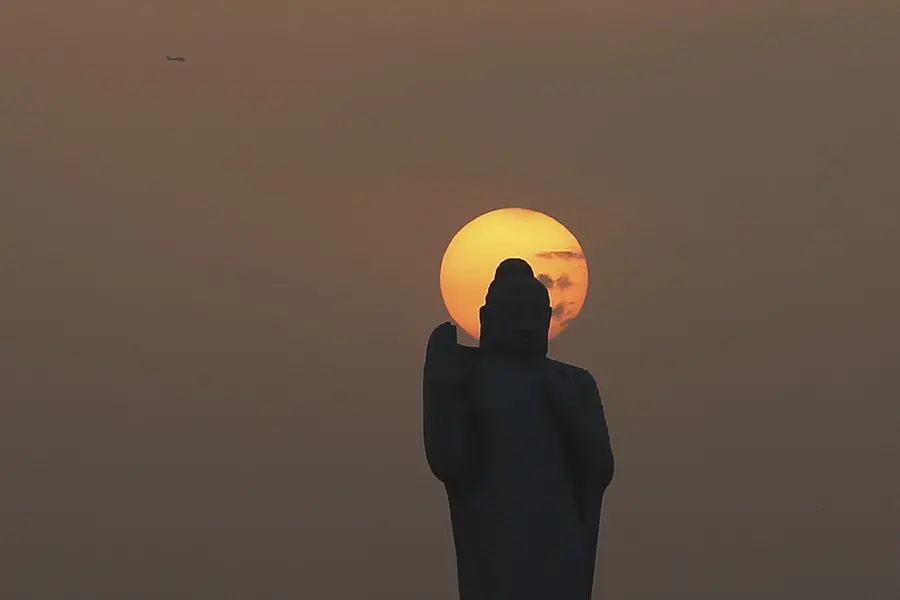
In the heat of summer, the full moon of Besak rises,
annihilating all sorrow…
Sahodaran, “Vaisakha Pournami”
The great Emperor Asoka Maurya was the first to greet the people of Kerala as his children with love and equanimity in history. Kerala, the Chera region, and Tamilakam or South India, became civilized through the Sangha culture during the time of Asoka in BCE 3rd century. The first written historical statement about Kerala is that of Asoka. In the Dhamma script, which was later known as Asokan-Brahmi, the Dhamma script that the emperor used to convey the Dhamma teachings of the Buddha to the people, in the second and thirteenth stone inscriptions or edicts are found the epigraphic veneration of Asoka to the enlightened people of Kerala as Keraputho and Ketalaputho.
Asoka’s last retreat is also in south India in Sannati. The Kanaganahally shrine or stupa remains are located on the banks of the Bhima River, in Sannati, in the Kalaburagi district of northern Karnataka in South India, on the border of ancient Tamilakam. Like his grandfather Chandragupta Maurya who came to Sravanabelgola southern Karnataka again on the border of the ancient Tamil country, towards the end, Asoka takes rest there, who came down to Tamilakam, following his own children Mahindra and Sanghamitta, who had gone to South India, Sri Lanka and South Asia to preach the Buddha's teachings as part of his missions. The memorial stupa in his shrine, called Kanaganahally, still remains as a foundation. The Sannati edict of Asoka attesting this history was discovered from underneath the Kali temple called Chandralamba, when it collapsed in mid 1990s.
The Tamil script Vattezhutu evolved from Asokan Dhamma script by the 8th century CE. Modern Tamil and Malayalam scripts are also developed from Dhamma script and Vattezhutu. Up until the 20th century, all communities used the Buddhist Vattezhutu script called Nanamonam and the Asokan Buddhist greeting as Namostu Jinatam or salutations to Sakya Jinamuni the Buddha, to initiate writing on Asoka Vijayadasami, the day of conversion of Asoka, according to honest Kerala historians including Elamkulam. Ambedkar also chose this day of Asokavijayadasami for his 1956 embracing of Buddhism at Nagpur Dikshabhumi.
Full moons mark the life of the Buddha in the ancient lunar calendar. Buddha Purnima is the full moon of Vaisakh, which coincides with the birth, enlightenment, and Mahaparinibana of the Buddha. Gautama Buddha (563-483 B.C.E.), the 28th enlightened being of the Saindhava or Indus Sramana civilization, was a democratic thinker who rewrote world history through a peaceful middle path of friendship and brotherhood, and a social implementer of the idea of inclusion and mass representation. The basis of social democratic thought is the Buddha's Anityavada, Samudpadavada, and Samudayavada. Anityavada is a philosophy of change with keen accent on equality, justice, compassion, and wisdom. Pratityasamudpadavada is the dependent existence theory and Samudayavada is the theory of social or collective rising or awakening.
Babasaheb Ambedkar, the architect of the Constitution and the first Minister of Justice and Law of India, who is a modern democratic thinker, has repeatedly stated that the basic values, principles, and practices of the Indian democratic constitution, which is based on representation and social justice, are derived from the Buddha, his master, and his Sangha Vinaya rules and practices. Narayana Guru, the philosopher of Kerala enlightnment modernity, had also made it clear a century ago that ours is also Buddhism. In 1918, during his first visit to Sri Lanka, the Sangha island or Ezham, cited Amarasimha who composed his lexicon Amarakosa in 5th century CE, and explained that we are on the path of the original non-dualist or Advayavadi, Vinayaka the Buddha. During his second visit in 1926, the Guru said that he would not return to Malayalam that is the Malayali land of Kerala. 2026 is the centenary of this historic statement and visit. The Guru's disciples and poets and writers who had discovered and carved the core of the Kerala language; like Mooloor, Karuppan, Asan, Sahodaran, C. V. Kunjuraman and Mithavadi, made possible the enlightenment and collective rising or Samudaya in Kerala that the Guru had started in 1918 in Lanka, through their writings and rendered the Guru himself as a modern Kerala Buddha in 1920s and 30s. In the 1890s, Ayyothitasa Pandiatar initiated the first modern Buddhist movement in India and started the Sakya Buddhist Society in Tamil Nadu in 1890s at the wake of modernity.
The word Gotama comes from the ancient and natural or Prakrit language of the masses, Pali. The ethical and moral thought of the Buddha, and the enlightenment teachings of the Buddha, as marked by the Tipitakas, shaped the worldview and simple grammar of Pali. The words, expressions, and symbols of Prakrit Pali have been transmitted to all the languages of the world. Just as the mother of all scripts of the Asian languages is the Dhamma script used by the Mauryan emperor Asoka to write Pali, the mother of post-Gupta Sanskrit and modern Indian languages is Pali, in which the Buddha spread the ethical gospel for the good and welfare of the people. Bahujan Hita and Sukha was his philosophy and praxes. Pali preserves the Buddha's thoughts, deeds and words. Pali is like a water-soaked half submerged lotus that has been soaked in water at the bottom of regional languages, dialects, and ancient village names and toponomy or etymology all over Asia in various cultural and linguistic locations or contexts.
Since his mother Maya died during childbirth, he was raised by his mother's younger sister Gotami in the 6th century BCE. That is how he got the name Gotama. It is also used as Kotama or Kotha for short in the southern Tamil-Pali dialects called Dekhini-Pali. Ambedkar, who is seen by the people as a neo-Buddhist, says that southern Prakrit is the Damila or Tamil, as observed in the preface to his book Who Were the Untouchables and How They Became So?
Kothaparamba, Kothad, Kothayam or Kothazham (Kottayam after the middle ages), Kothamapura (Gautamapuram), Kothakulangara, Kothanallur, Kothamangalam, Thirukothamangalam and Kokothamangalam, all of which are present in Kerala and Tamil Nadu. The mother of Gotama or Kotama, Mahamaya, is the goddess Mayadevi, who becomes Mangala, in Mangalapuram and Mangaladevikottam or Mangaladevi shrine in Kumaly, as in the Mahamangalasuta that is a key Buddhist sutra. In the Pali, her younger sister or Kaniya, is the same Gotami who appears in place names including Kaniyapuram. Like place names with Pally affixes are gradually changed to Pilly, Pully, Vally and Ully Kaniyapuras are modified to Kaniapurams in Kerala.
When democracy in Indian is in peril and the corporate crony capitalism and Brahmanical communalism, majoritarian forms of totalitarianism, over-representation of elites, and brute forces of oligarchy are increasing, replacing Ambedkar's Constitution clause by clause, which is the basis and ethical contract of modern democratic India, the social representational thinking and ethical gospel of the new enlightened people are very important and primary. The betrayal of the people, namely over-representation of the already forward social groups or castes in all fields and the economic reservation or “EWS” only for these already over represented upper castes and Syrians who also claim Brahmanical paternity, which were inserted into the Constitution in 2019 through Amendment 103, and the arson against truth and justice, are to be corrected through a collective rising and awakening of the people.
Buddhist monuments and historical sites are being converted into Brahminical and Hindu temples. Mahabodhi Vihara at Gaya built by Asoka is the best example. It is still under Hindu Brahmanical control and Buddhists are agitating for the last 90 years for its autonomy. All the ancient 'temples' in Kerala were kavus that were Asokan Sangharamas. Many were known as Mahayana viharas or Anpalams in the Middle Ages. In modern times, they were all made into Kshetras or “templed” and the masses and women were turned into firecrackers like in the Trichur Pooram or Sabarimala temple riots, and in 2018 and 2023. The Viswasi and Teendari riots or Sudra riots were carried out, subverting constitutional gender justice and social representation. The Ramayana/Mavarata and Geetagiri recitals by pandits and shastris in academia in the name of literature and culture provided the Hindu consensus and commonsense of the Sudra riots that sabotaged the democratic Constitution of India, from 2018 onwards as in Kerala’s passing of EWS in Devasam Board that was already over represented by caste Hindus 96 percent.
Buddhist relics, sculptures and architectural remains, including Karumadikuttan, are marked by brutal violence and genocidal attacks. Signs of the brutal Brahminical-Sudra violence, which even smashes stone sculptures and tramples them into the mud and cuts them under their feet and under their legs, as in the Vaikom-Dalavakulam genocide of 1806, are coming out all over the ancient Tamil lands of Chera, Chola and Pandya lands.
The Buddha statue at Ellapatti, found in the Curuliar in the Kumaly-Kumbam valley, reported by the author through a YouTube video in April 2024, is seen with its head cut off. The sculpture is of an ancient style dating back to the seventh or eighth century CE. The place called Talavettithevarayyam is near Adoor. Only the feet of a Buddha statue, whose head and body were demolished, can be seen to the west of the Bodhi tree near the temple here. The Buddha that was recovered from the ruined well near the paddy field in Adoor Pallikkal was also in a broken state. The beheaded sculpture was taken to the Napier Museum Trivandrum and was re-headed. This is a historical act of violence. The attempt to re-attach the severed hand of Karumadikuttan was stopped by the intervention of the local people and local historians in 2016-17.
Chakkamudi, or Chakramudi in Sanskrit, marked by the Dhammachakka (Pali original for Sanskrit Chakra) in Pali, the imperial icon of Asoka, is the third highest hill in Munnar after Anamudi and Kolukkumudi. The peak called Chakka(ChoKra)mudi is more than 2200 meters high. Just to the west is the gateway or Vatal/Vasal to the Munnar river confluence and township called Pallivasal. The nearby grassland top is called Pothamedu. In fact, it is Bodhamedu. Puthi, Potham, Puthakam, Puthalam, Puthedu, Puthur and Puthar are in the Kerala language. Bodhiyilmalai is also called in Tamil style as Poti or Potikam or Potiyilmalai in Trivandrum and is called Akathiarkoodam and even Agastyakoodam now.
The Bodhi Hills are the eastern hills of Chakramudi in Munnar. Bodhimedu has been renamed Bodimettu. Just to the east, there is Bodhinayakanur in Tamilakam. It has also been renamed Bodinaikkannur by Malayali caste Hindu hegemony after a non-existent Naikkan. In fact, Anamalai, Nagamalai, Tipadamalai, Meesapulimalai, Anparasanmudi, Rajaparamedu, Rajamalai, Mannavansolai are all completely Buddhist village names that have deeply marked the Buddha and Asoka in the soil, mind and waters of Munnar.
The Buddha Purnima celebrations held now in Karumadi Kuttan, Mavelikkara, Palakkad, Thiruvananthapuram, Calicut Kumbazha and many other towns and villages in Kerala should preserve the modern, democratic, representative cultural and political emancipation values and Constitutional ideals as envisioned by Ambedkar, Sahodaran, Guru and Ayyothitasar and develop the constitutional values of scientific attitude, ethical rationality, anti-caste values, secular humanity and social participation and democratic representation of the unrepresented people at the bottom. In 2018-20, we risked our lives to reclaim ancient Buddhist sites and historical archaeological sites including Karumadi and Mavelikkara from the caste-Hindu hooligans of cultural and political hegemony.
The recitals of the Mahabharata, Ramayana, Bhagavad Gita, the Shruti Smriti Purana Pattathanas, the ritualistic Vibhuti of priestocracy and Sudra militancy of Bhakti were effectively checked in Karumadi with a lot of sweat and labour in 2018 and following years. In order not to be led astray by the rituals of worship and devotion, knowingly or unknowingly, and not to fall prey to the deceits of cultural hegemony, and to give importance to compassionate knowledge, wisdom, compassion, great friendship, mercy, wisdom and universal brotherhood, it is best to remember Ambedkar's 1956 Asoka Vijayadashami vows. The 1925 Dhammapada of Mooloor in Kilipattu should become a textbook for all Malayalam students at all levels, it has completed a century. Sahodaran’s Buddha Kanda poems must be there in schools. The Guru's Tirukural translation must also be taught at the primary classes and universities and end the Mavarata Pattatanam recitals by fascists in disguise or Prachhanna Vamans parading as pandits of Kerala Bhasha. Lankan journeys and the pearls of Guru’s oceanic words/world/wisdom must be recited daily by the growing young minds. The compassion of Asan and his Karuna or Chandala Bhikshuki and Sri Buddha Charitam should be read and discussed widely in all libraries. As Sahodaran sang in the mid-1940s in “Caste India,” may the new generation and the new India grow towards the consciousness of a new democratic representative future India, with a heart that is grateful to the four-letter mantra of Ambedkar the neo Buddha. Through Ambedkar, guru and Sahodaran let them realise the Buddha. Buddha Purnima Greetings to all, may all beings be good and happy, may a thousand flowers bloom…
(The author is Associate Professor, Department of English, SSUS, Kalady. He can be reached at ajaysekher@ssus.ac.in)
Published: 01 May 2026, 10:54 am IST
Related Topics
Disclaimer: Kindly avoid objectionable, derogatory, unlawful and lewd comments, while responding to reports. Such comments are punishable under cyber laws. Please keep away from personal attacks. The opinions expressed here are the personal opinions of readers and not that of Mathrubhumi.
