
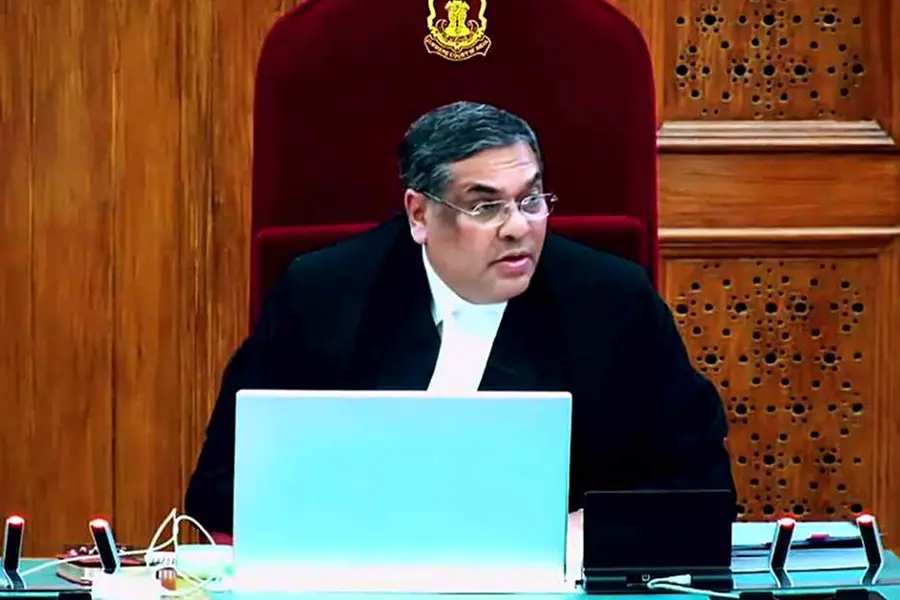
New Delhi: Justice Sanjiv Khanna has been appointed as the 51st Chief Justice of India. He will take oath on November 11, a day after the current Chief Justice, D Y Chandrachud, demits office upon reaching the age of 65.
Justice Chandrachud has served as Chief Justice since November 8, 2022. Justice Khanna will serve a tenure of just over six months, concluding his term on May 13, 2025.
Appointment Announcement
The appointment was officially announced by Law Minister Arjun Ram Meghwal on X, stating, “In exercise of the power conferred by the Constitution of India, Hon'ble President, after consultation with Hon'ble Chief Justice of India, is pleased to appoint Shri Justice Sanjiv Khanna, Judge of the Supreme Court of India as Chief Justice of India with effect from 11th November 2024.”
Career Highlights
Justice Khanna began his judicial career as an additional judge of the Delhi High Court in 2005, becoming a permanent judge the following year. On January 18, 2019, he was elevated to the Supreme Court.
Born on May 14, 1960, he studied law at the Campus Law Centre of Delhi University. Among his notable judgments are:
Upholding the use of electronic voting machines in elections, affirming their security and effectiveness in preventing booth capturing and bogus voting.
Being part of the five-judge bench that declared the electoral bond scheme unconstitutional.
Upholding the Centre's 2019 decision to abrogate Article 370 of the Constitution, which had granted special status to the erstwhile state of Jammu and Kashmir.
Justice Khanna is also the executive chairman of the National Legal Services Authority (NALSA) and has previously granted interim bail to Delhi Chief Minister Arvind Kejriwal in connection with the alleged Delhi excise policy scam, allowing him to campaign in Lok Sabha elections.
Family Legacy
Justice Khanna is the nephew of former Supreme Court judge H R Khanna, who was instrumental in the landmark Kesavananda Bharati case of 1973, which established the basic structure doctrine of the Constitution.
Succession Process
The retirement age for Supreme Court judges is 65 years, while High Court judges retire at 62. The Centre had recently requested Chief Justice Chandrachud to name his successor. According to the Memorandum of Procedure (MoP), which guides the appointments of judges, the law minister writes to the Chief Justice to suggest a successor. The senior-most judge of the Supreme Court is typically deemed suitable for the position of Chief Justice, and the outgoing Chief Justice's views are solicited "at an appropriate time." However, the MoP does not specify a timeline for initiating this process.
PTI inputs
Published: 24 Oct 2024, 09:44 pm IST
Related Topics
Disclaimer: Kindly avoid objectionable, derogatory, unlawful and lewd comments, while responding to reports. Such comments are punishable under cyber laws. Please keep away from personal attacks. The opinions expressed here are the personal opinions of readers and not that of Mathrubhumi.
