
According to a new report by the Confederation of Indian Industry (CII), air taxis could transform how people move, reducing long journeys of nearly 100 km from hours to just minutes.
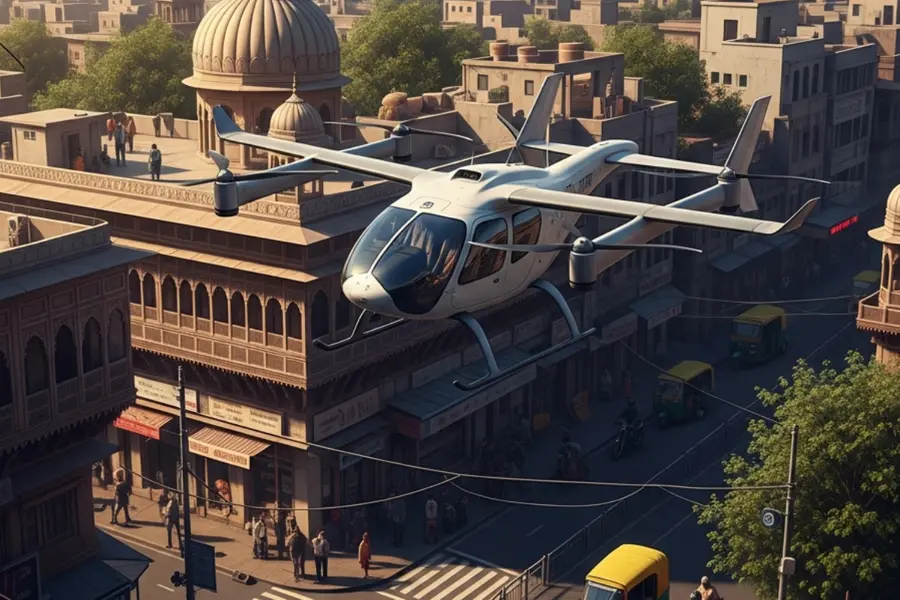
Are you tired of getting stuck in traffic daily? Then this news might bring some respite. According to a new report by the Confederation of Indian Industry (CII), air taxis could transform how people move, reducing long journeys of nearly 100 km from hours to just minutes.
In its report titled “Navigating the Future of Advanced Air Mobility in India,” CII studied the feasibility of using electric flying vehicles called electric vertical take-off and landing aircraft, or eVTOLs for short-distance urban travel. The report modelled a pilot corridor of about 65 to 75 km connecting Gurugram, Connaught Place, and the upcoming Noida International Airport at Jewar.
Also read | ‘Are you not ashamed of selling India?’: Rahul Gandhi’s remarks spark Lok Sabha uproar
CII said that setting up this flagship air taxi route could help India overcome traffic bottlenecks and position itself as a global leader in advanced air mobility. The report highlighted that such services could cut travel time from hours to just 10–30 minutes, while also supporting India’s Net-Zero 2070 goals by using zero-emission aircraft.
For commuters, the biggest benefit would be speed and convenience. The report estimates that a trip from central Delhi to Gurugram could take less than 12 minutes, compared to the current 1 to 1.5 hours by road. Similarly, travel from Connaught Place to Jewar Airport could be completed in under 20 minutes, instead of the usual 2 to 3 hours.
CII believes that air taxis could ease pressure on busy roads by shifting part of urban travel to the air, offering a faster and more efficient option for daily commuters, business travellers and airport passengers.
Also read | ‘More fighter jets coming’: IAF vice chief speaks as Rafale deal nears clearance
The proposed system would use specially designed electric aircraft that can take off and land vertically, similar to helicopters but quieter, cleaner and more energy-efficient. These aircraft would operate from “vertiports,” which are small landing and take-off hubs that could be built on rooftops, open grounds, hospitals and transport hubs.
However, the proposal has not yet received official approval. The report notes that strong safety rules and clear regulations will be needed before air taxis can become a reality. The Directorate General of Civil Aviation (DGCA) will have to define new flight routes, safety standards, fire safety systems, emergency evacuation procedures and obstacle-free zones.
There are also airspace restrictions in Delhi because of its status as the national capital. Air taxis would not be allowed to fly over sensitive areas such as Delhi Cantonment, Lutyens’ Delhi and the Indira Gandhi International Airport zone. Flight paths would need to be carefully designed to avoid these areas.
Beyond passenger travel, air taxis could also serve as air ambulances. Vertiports could be built at major hospitals, making it faster and easier to transfer patients between medical centres such as AIIMS and other large hospitals, especially in emergencies.
If the pilot project in Delhi-NCR is successful, the air taxi model could be expanded to other major Indian cities, including Mumbai, Bengaluru, Chennai and Hyderabad. This could mark the beginning of a new era in urban transport one where people spend less time stuck in traffic and more time reaching their destinations safely and quickly.
Published: 11 Feb 2026, 02:46 pm IST
Related Topics
Disclaimer: Kindly avoid objectionable, derogatory, unlawful and lewd comments, while responding to reports. Such comments are punishable under cyber laws. Please keep away from personal attacks. The opinions expressed here are the personal opinions of readers and not that of Mathrubhumi.
