
Elon Musk’s Starlink dispute with Indian authorities rattled markets as Reliance lost ₹39,718 crore in value.
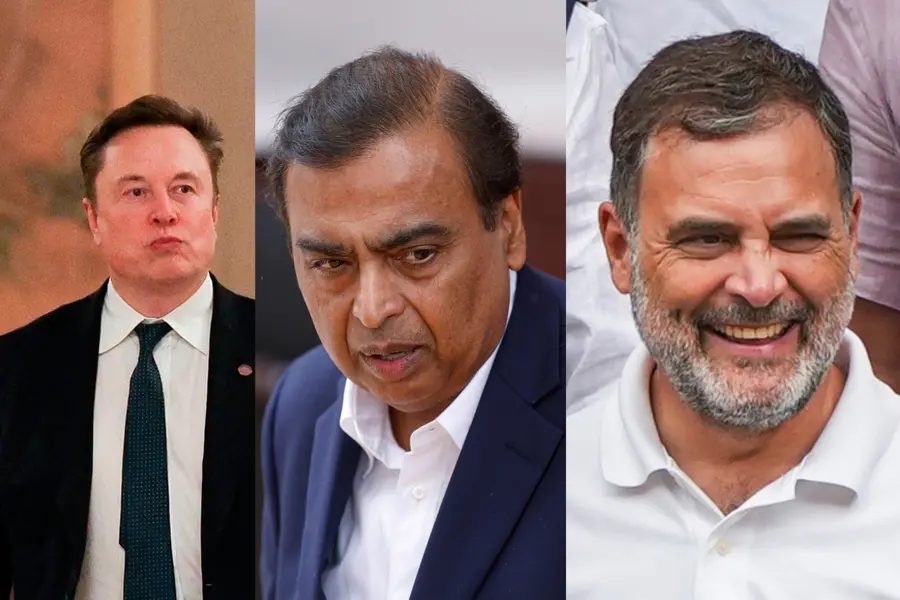
A fierce row between American billionaire Elon Musk and Indian authorities has sent shockwaves through Mumbai financial markets, wiping tens of thousands of crores off the valuation of Reliance Industries.
The market turmoil erupted after Musk publicly questioned whether Reliance founder Mukesh Ambani was the "real boss of India", alleging that domestic commercial interests were blocking his Starlink satellite internet network.
Billionaire questions regulatory delays
Musk sparked controversy by accusing "certain oligarchs" of protecting a "monopolistic chokehold" on India’s communications market. Addressing his global audience on social platform X, Musk expressed frustration over delays in obtaining an operational licence despite five years of compliance efforts.
"Starlink is licensed in over 165 countries and has spent five years complying with every single law and requirement of the government of India, so why still no license?" he posted, adding: "Is Ambani the real boss of India?".
Musk also rejected claims that Starlink services had been used by militants in Manipur, clarifying that its satellite beams remain switched off over India. He contended that launching Starlink would deliver high-speed, affordable internet connectivity to underserved populations.
Political row and market slide
The online outburst quickly escalated into a national political confrontation. Rahul Gandhi, the Leader of the Opposition in the Lok Sabha, took a direct swipe at both the government and corporate heavyweights. Sharing Musk's post, the Congress leader wrote on X: "Welcome to India, Elon. Wait till you discover the other guy".
The escalating dispute unnerved equity markets on Thursday. Shares in Reliance Industries fell over 2 per cent, closing down 2.43 per cent at Rs 1,177.30 on the BSE and 2.45 per cent at Rs 1,178 on the NSE.
The drop wiped out Rs 39,718 crore from Reliance’s market valuation, making it the biggest contributor to the benchmark BSE Sensex tumble of 1,045.46 points to a multi-year low. Shares in rival operators Bharti Airtel and Vodafone Idea also slipped by 2 per cent and 3.03 per cent respectively.
Security checks hold up all rivals
The Indian Telecom Department firmly rejected Musk’s allegations, calling claims that Starlink was being selectively blocked "baseless and misconceived". Officials clarified that three licensed operators—Starlink, Reliance Jio’s satellite unit, and Bharti-backed Eutelsat OneWeb—are all subject to the exact same regulatory requirements.
Minister of State for Communications Chandra Sekhar Pemmasani confirmed that security clearances are currently pending with the Ministry of Home Affairs for all three companies.
"The Department of Telecom has issued licences to all satcom companies as well as provisional spectrum. Now the issue is pending with MHA for security clearance. As soon as it is cleared, they will get it. It has nothing to do with one company," Pemmasani said on the sidelines of the India Mobile Congress.
Sunil Bharti Mittal, chairman of Bharti Airtel, echoed this stance, noting that OneWeb was similarly "waiting for our own approvals". Meanwhile, SpaceX vice president Lauren Dreyer stated Starlink has built 20 gateway sites in India with localized controls to comply with national regulations.
Tariff pressures and satellite race
Akash Ambani, chairman of Reliance Jio, declined to comment on Musk's posts. Speaking at the India Mobile Congress, he reiterated Jio's core market positioning: "Jio has always stood for being the most affordable player in the market and giving the highest quality of services value for money, and we'll always stand for that".
He also showcased Jio’s proprietary end-to-end satellite stack, highlighting plans to build a constellation of over 1,600 low-Earth orbit satellites.
The satellite licensing struggle unfolds amid broader pricing pressure for mobile consumers. Bharti Airtel raised its postpaid tariffs by Rs 50 on Thursday, with market analysts projecting industry-wide tariff increases of 12 to 15 per cent in the coming months.
Published: 08 Oct 2026, 09:51 pm IST
Disclaimer: Kindly avoid objectionable, derogatory, unlawful and lewd comments, while responding to reports. Such comments are punishable under cyber laws. Please keep away from personal attacks. The opinions expressed here are the personal opinions of readers and not that of Mathrubhumi.
