
The Centre is planning a special Parliament session to push 33 per cent women's reservation and increase Lok Sabha seats to 850. Here's the proposed timeline, political arithmetic and key challenges.
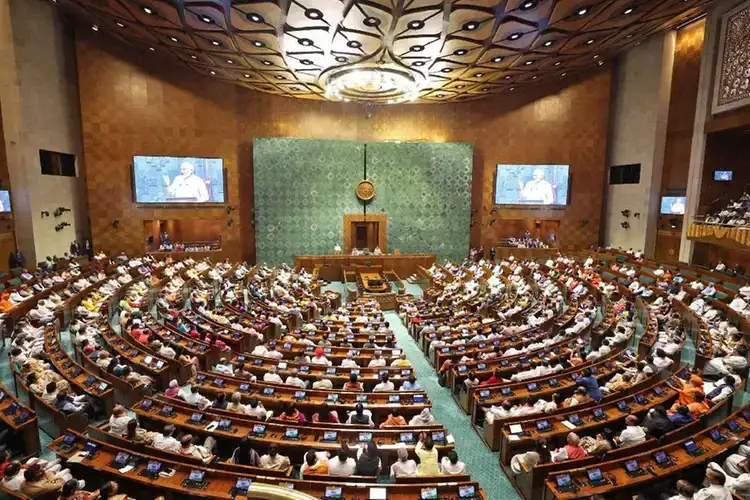
New Delhi: The Narendra Modi government is preparing to convene a special sitting of Parliament to push through a Constitution Amendment Bill that seeks to introduce 33 per cent reservation for women in the Lok Sabha and state legislative assemblies while increasing the strength of the Lower House.
According to a report by Jagran, the proposed legislation could increase the Lok Sabha's maximum strength from the existing 543 seats to 850 through a delimitation exercise.
Senior government leaders reportedly indicated that an announcement on the special sitting could be made after the Chhath festival, which concludes on November 16.
The session could take place after Prime Minister Narendra Modi returns from his foreign visit on November 16-17.
The government is also working around the political calendar, with Congress leader Rahul Gandhi scheduled to visit the United States between November 16 and 19.
Why does the government need a special session?
The proposed legislation involves constitutional changes relating to women's reservation and the composition of the Lok Sabha.
Passing a Constitution Amendment Bill requires a special majority in Parliament. It must receive the support of a majority of the total membership of each House and at least two-thirds of members present and voting.
This makes the proposed legislation more challenging to pass than an ordinary bill.
The government is also seeking to address the relationship between delimitation and the implementation of women's reservation.
The 33 per cent quota is intended to reserve seats for women in the Lok Sabha and state legislative assemblies. The proposed expansion of parliamentary seats is linked to the government's wider delimitation plans.
The numbers game: Can the government secure two-thirds support?
The biggest challenge for the Centre is assembling sufficient parliamentary support.
According to the report, the Lok Sabha currently has 539 members. If all 539 members are present and vote, the two-thirds threshold would be 360.
The legislation reportedly received 298 votes in favour and 234 against during an earlier attempt in April, falling short of the required special majority.
Government sources now claim that the ruling alliance has secured the support of 17 to 18 additional MPs beyond the required threshold.
However, the government has not publicly disclosed a complete breakdown of the expected support.
Several political developments could influence the outcome.
1. MPs reportedly joining the NDA camp
The report claims that 20 MPs who broke away from the Trinamool Congress and joined the Nationalist Citizens Party of India, along with six MPs who moved from the Shiv Sena (Uddhav Balasaheb Thackeray) faction to the NDA-aligned Shiv Sena, are expected to support the legislation.
2. NCP (Sharad Pawar) faction may support the bill
The NCP faction led by Sharad Pawar has eight MPs. Its position could become important, with Supriya Sule reportedly indicating a willingness to support the proposed legislation.
3. DMK's position remains uncertain
The DMK, which has reportedly moved away from the opposition alliance, is also being considered a potential source of support. However, its position on the proposed legislation has not been confirmed.
4. Abstentions could change the numbers
The government may also benefit if some opposition MPs abstain from voting.
Since the two-thirds requirement is calculated on the basis of members present and voting, abstentions can reduce the number of affirmative votes needed, provided the bill also meets the separate requirement of support from a majority of the House's total membership.
What is delimitation and why does it matter?
Delimitation refers to the process of redrawing electoral constituency boundaries and determining the number of seats allocated to different regions based on population and other constitutional considerations.
It directly affects how parliamentary representation is distributed across states.
The proposed increase in Lok Sabha seats from 543 to a maximum of 850 makes delimitation a politically sensitive issue.
One of the major concerns surrounding the exercise is whether states that have experienced slower population growth could lose relative political representation compared with states that have recorded faster population growth.
This has wider implications for federalism and the balance of political power between different regions.
The relationship between delimitation and women's reservation has therefore become a central part of the political debate.
When could the special Parliament session take place?
According to the report, the government is considering holding the special sitting after November 16, following the conclusion of Chhath Puja and the Prime Minister's return from his foreign visit.
The upcoming sitting is expected to be convened as part of the ongoing Monsoon Session, which has reportedly not yet been prorogued.
The Winter Session is separately expected to begin in the second week of December and conclude before Christmas.
The proposed special sitting could therefore become an important political test for the government before the Winter Session.
Published: 13 Nov 2026, 07:41 am IST


ABOUT THE AUTHOR

Disclaimer: Kindly avoid objectionable, derogatory, unlawful and lewd comments, while responding to reports. Such comments are punishable under cyber laws. Please keep away from personal attacks. The opinions expressed here are the personal opinions of readers and not that of Mathrubhumi.