
Some demonstrators argued that the circumstances surrounding the reservation framework had changed significantly over the decades and called for a wider discussion on possible reforms.
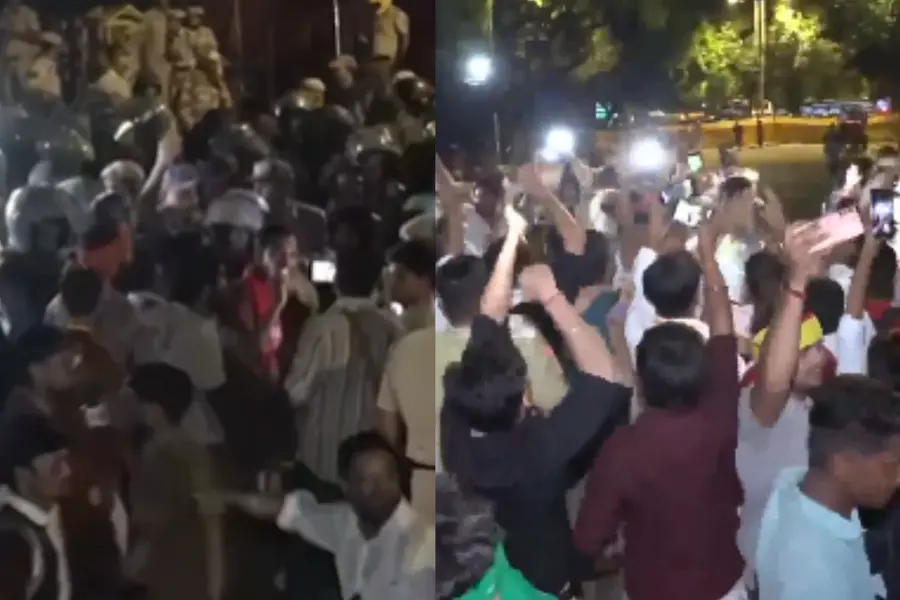
A large number of protesters gathered at Delhi’s Jantar Mantar on Friday to oppose the caste-based reservation system, prompting a heavy deployment of police and paramilitary personnel.
Security forces put up barricades around the area as crowds gathered and detained several demonstrators after tensions rose. Most of those detained were men.
The protest took place despite the Delhi Police stating on Thursday that no permission had been granted for an assembly at Jantar Mantar on August 21.
Delhi Police deny permission for protest
In an official statement, the Delhi Police said videos circulating online about permission being granted for a protest on reservation reforms were “false and misleading”.
“Various videos are circulating regarding the alleged grant of permission for a protest on the issue of reservation reforms at Jantar Mantar on 21 August, which is false and misleading,” the police said.
The force clarified that “no permission has been granted to anyone to hold a protest at Jantar Mantar on August 21”.
The police also pointed out that prohibitory orders under Section 163 of the Bharatiya Nagarik Suraksha Sanhita (BNSS), the provision that replaced Section 144 of the CrPC, were already in force in the New Delhi district.
Under the orders, assemblies of five or more people, demonstrations and marches are prohibited. Police also urged people not to circulate unverified information online and warned of legal action over fake news.
Protesters arrive with banners and flags
Despite the warning, small groups of protesters began reaching Jantar Mantar early on Friday.
They carried banners, posters and saffron flags while raising slogans against caste-based reservation. Police and paramilitary personnel were deployed in large numbers to manage the gathering and restrict movement around the protest site.
The police had denied permission for a demonstration at Jantar Mantar but had issued a no-objection certificate for a peaceful protest involving up to 500 people at Ramlila Ground until 4pm.
The protesters, however, did not gather at the approved venue and instead moved towards Jantar Mantar.
Some demonstrators also claimed that internet jammers had been deployed around the area to restrict access to social media. This claim could not be independently verified.
Protest mobilised through social media
The demonstration was mobilised online through an Instagram page called “Reservation Hatao Andolan”, which has 5.6 million followers.
The page posted a poster on Thursday calling for a peaceful protest at 2pm on Friday. The mobilisation gathered momentum online, with the page reportedly using tactics similar to those adopted by the Cockroach Janta Party (CJP).
The gathering at Jantar Mantar followed the online campaign despite the police’s warning that the protest had not been authorised at the site.
Protesters seek economic criteria for support
The demonstrators are demanding a review of the reservation system and want economic status to be given greater importance when deciding who should receive government support.
They argue that assistance should reach economically disadvantaged people irrespective of their caste, particularly in areas such as education, coaching and scholarships.
A protester associated with the Akhil Bharatiya Kshatriya Mahasabha said, “Our demand is that economic condition should be considered while deciding who needs government support. A poor person, irrespective of caste, should be provided assistance for education, coaching and other needs,”.
Another participant questioned whether the existing system was delivering its intended benefits.
“We have been raising this issue for several years. Our contention is that the government should examine whether the present system is achieving its intended purpose and whether benefits are reaching people at the grassroots level,” the protester said.
Calls for review of existing policies
The protesters also raised concerns about policies concerning Scheduled Castes, Scheduled Tribes and Other Backward Classes.
Their demands included a debate on provisions such as the SC/ST (Prevention of Atrocities) Act and the University Grants Commission framework.
Another protester said the demand was not to withdraw support for economically weaker sections, but to ensure that assistance was directed towards those who need it.
“We are not saying that economically weaker people should be left without support. We are saying that assistance should be targeted at those who need it, including through scholarships, fee support and coaching,” the participant said.
Some demonstrators argued that the circumstances surrounding the reservation framework had changed significantly over the decades and called for a wider discussion on possible reforms.
“The circumstances have changed considerably over the decades. There should be a wider discussion on whether the existing framework needs to be reviewed and how economic disadvantage can be addressed without discrimination,” another participant said.
Published: 21 Aug 2026, 11:27 pm IST
Disclaimer: Kindly avoid objectionable, derogatory, unlawful and lewd comments, while responding to reports. Such comments are punishable under cyber laws. Please keep away from personal attacks. The opinions expressed here are the personal opinions of readers and not that of Mathrubhumi.
