
The Supreme Court on Tuesday refused to entertain a PIL seeking the removal of Vinayak Damodar Savarkar’s portraits from Parliament and other public spaces
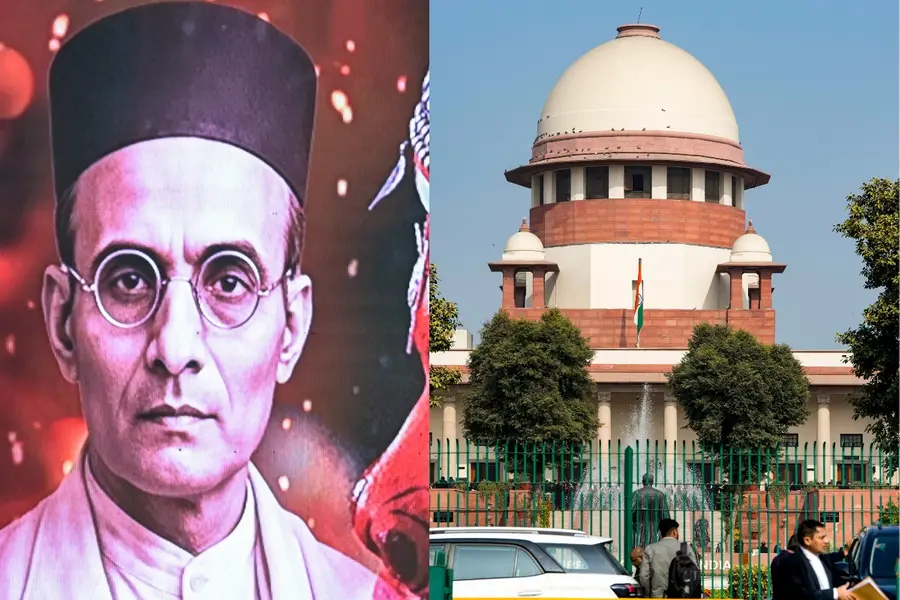
New Delhi: A bench comprising Chief Justice Surya Kant and Justices Joymalya Bagchi and Vipul M Pancholi cautioned retired IRS officer B Balamurugan against filing what it termed a frivolous petition. The bench warned that exemplary costs could be imposed for wasting the court’s time.
Balamurugan’s PIL sought directions to remove portraits of Savarkar from the Central Hall of Parliament and other public areas, and also requested that the government refrain from honouring individuals chargesheeted for serious crimes unless acquitted.
The court questioned the petitioner’s financial excuse for not appearing in person, noting his background as an IRS officer. Chief Justice Kant remarked, “You were in the IRS. You can afford to come to Delhi and show yourself and argue. We would like to impose exemplary costs on you. What do you think of yourself?”
Calling the plea an abuse of judicial process, the bench suggested that Balamurugan withdraw the case. He subsequently sought and was granted permission to do so. The CJI urged him to “enjoy your retirement” and contribute constructively to society.
What’s the issue about?
Vinayak Damodar Savarkar, often referred to as Veer Savarkar, was a freedom fighter, poet, and politician, but his legacy has long been a subject of controversy in India. While he is recognised for his contributions to India’s independence struggle, critics highlight his alleged involvement in revolutionary activities linked to political assassinations, particularly the assassination of Mahatma Gandhi, and his ideological advocacy for Hindu nationalism.
Portraits of Savarkar are displayed in the Central Hall of Parliament and other public spaces to honour his role in India’s freedom movement. However, these honours have periodically been challenged by individuals and groups who argue that his controversial political and ideological positions make such public recognition inappropriate. Past debates have included whether public funds and spaces should celebrate figures accused of crimes or associated with divisive ideologies.
The current PIL filed by retired IRS officer B Balamurugan is part of this ongoing debate. His petition specifically sought the removal of Savarkar portraits from Parliament and other public spaces, as well as a broader directive preventing the state from honouring any individual who has been chargesheeted for heinous crimes, unless legally acquitted.
The Supreme Court’s refusal to entertain the petition underscores the judiciary’s approach to handling such controversies: it prioritises substantive legal grounds over public or ideological debates, and takes a strong stance against petitions considered frivolous or lacking a sufficient legal basis. This episode also highlights the tension in India’s public discourse between historical recognition and the ethical evaluation of public figures.
Published: 13 Jan 2026, 04:43 pm IST
Disclaimer: Kindly avoid objectionable, derogatory, unlawful and lewd comments, while responding to reports. Such comments are punishable under cyber laws. Please keep away from personal attacks. The opinions expressed here are the personal opinions of readers and not that of Mathrubhumi.
