
A colour dispute at Kolkata’s Academy of Fine Arts has escalated after theatre practitioners and BJP workers repeatedly repainted the same room.
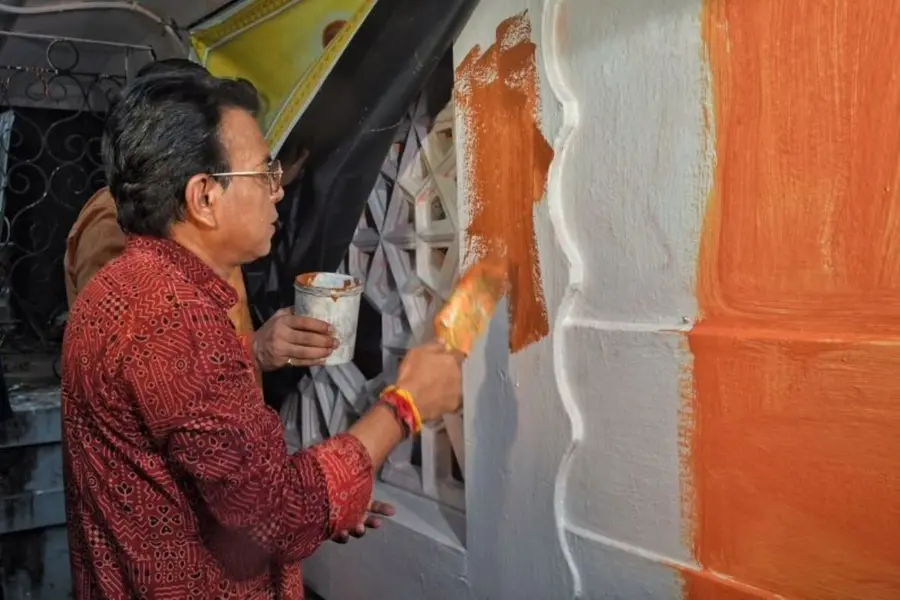
Kolkata: Saffron, white and saffron again. In a matter of two days, a room at Kolkata’s Academy of Fine Arts has become the unlikely canvas for a political and cultural confrontation in Bengal.
The room, located to the left of the Academy’s main entrance, was painted white on Tuesday by a group of theatre practitioners who had objected to its earlier saffron makeover.
A day later, BJP workers, including some Academy employees, returned to repaint it saffron. Chants of ‘Bharat Mata ki Jai’ accompanied the fresh coat of paint.
The dispute dates back to the first week of July, when the room was painted saffron between July 5 and 6, according to a source at the Academy. Banners featuring Prime Minister Narendra Modi were also put up on one of its walls.
The move immediately drew criticism, including from BJP Bengal president Samik Bhattacharya, who said the party did not subscribe to the practice of changing the colours of public spaces for political reasons.
After the latest repainting, however, the controversy has intensified, with theatre personalities accusing the ruling establishment of imposing a political aesthetic on a cultural institution.
Actor and BJP MLA from Howrah Shibpur Rudranil Ghosh, who led the group that painted the room saffron on Wednesday, rejected the criticism.
Ghosh argued that saffron was not being introduced to the room for the first time.
According to him, the space had also been painted saffron and deep chocolate during the Trinamool Congress regime and had at times been used by former Ward 73 councillor Ashim Bose.
He also alleged that Trinamool symbols had been displayed there.
Ghosh questioned the decision to paint the room white and accused his critics of distorting the space's history.
He also took a direct swipe at CPM leader and senior advocate Bikash Ranjan Bhattacharyya, who had joined the group of theatre practitioners that painted the room white.
‘I have no clue when Bikash Ranjan Bhattacharyya became a theatre worker,’ Ghosh said. Bhattacharyya, however, said he had gone to the Academy not as a theatre practitioner but as a concerned citizen.
He argued that the significance of saffron had been diminished by turning the colour into a political symbol, saying it represents sacrifice.
Theatre practitioners had earlier written to Samik Bhattacharya protesting what they described as the ‘abrupt’ decision to paint the room saffron.
Veteran theatre actor and director Chandan Sen, one of the signatories to the letter, said the room had never been saffron and pointed to what he described as a gap between the BJP leadership’s position and the actions of its workers on the ground.
Sen said the theatre community would decide its next course of action and would not remain silent over the issue.
Actor and theatre activist Joyraj Bhattacharjee, who was among those who painted the room white, described the latest development as a ‘state-sponsored attack on Bengali aesthetics’.
He also accused those behind the saffron repainting of having little understanding of the history associated with the institution.
The controversy has placed the Academy of Fine Arts, one of Kolkata’s most recognised cultural institutions, at the centre of an increasingly charged debate over politics, colour and cultural identity.
The room itself is modest in function compared with the symbolism now attached to it. Once used as a ticket counter, it currently serves as a space for security guards.
Yet its walls have become the latest flashpoint in a wider argument over whether political colours should find a place inside Bengal’s cultural institutions.
Established in 1933 by Lady Ranu Mukherjee, the Academy of Fine Arts houses a sprawling gallery, an auditorium, a conference centre and an extensive collection of paintings.
For generations, it has been regarded as an important part of Kolkata’s cultural landscape.
Now, one of its rooms has acquired a very different distinction: a patch of wall where saffron, white and saffron have come to represent a much larger battle over politics, aesthetics and the cultural character of Bengal.
Published: 13 Aug 2026, 06:30 pm IST
ABOUT THE AUTHOR

Related Topics
Disclaimer: Kindly avoid objectionable, derogatory, unlawful and lewd comments, while responding to reports. Such comments are punishable under cyber laws. Please keep away from personal attacks. The opinions expressed here are the personal opinions of readers and not that of Mathrubhumi.