
The floriculture drive has already begun generating local employment. The wider plan aims to bring 200 acres of cold desert land under high-value flower cultivation.
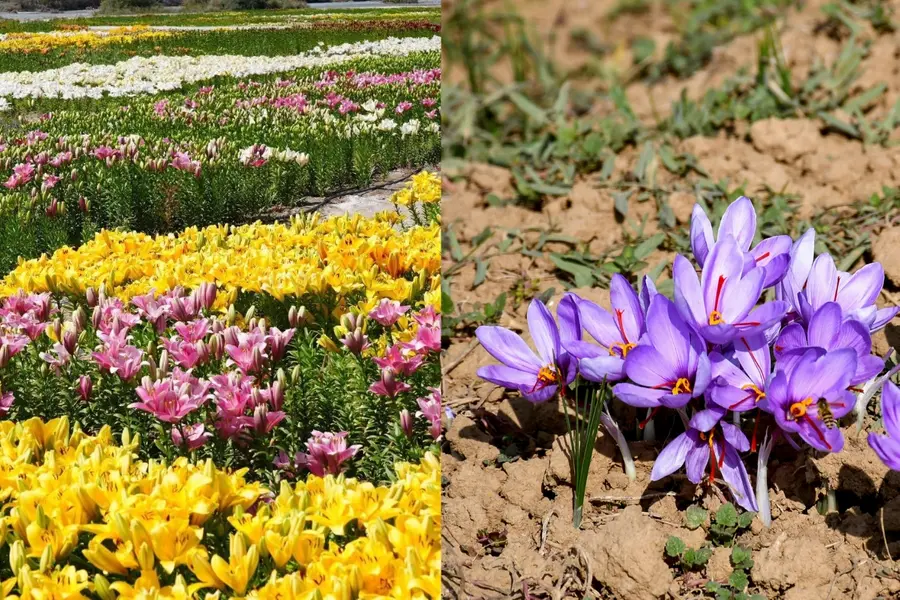
High up in the cold desert of Ladakh, an agricultural experiment has yielded its first harvest in record time. Farmers and officials in Leh collected nearly 22 grams of pure saffron within four days of the first flowers appearing. The experimental project had begun on October 2 over 4,000 square metres of restored barren land at Spituk Pharka. Lieutenant Governor Vinai Kumar Saxena confirmed on November 1 (Sunday) that the crop bloomed in just 30 days, cutting the usual two-month timeline in half.
Record harvest from restored desert soil
To kick off the trial, agricultural teams planted 800 kilograms of roughly 90,000 Iranian saffron corms suited for high altitudes. The land at Spituk Pharka was previously degraded and uncultivated. Inspecting the fields, the Lieutenant Governor observed that an average of 20 to 25 flowers were blooming each day. On Sunday morning alone, workers counted 72 fresh blooms.
This rapid flowering marks an important milestone for farming in cold, dry regions. Officials expect the pilot project to encourage new farming choices, boost local enterprise, and support self-reliance across the Union Territory. Credit for the achievement was extended to field staff and the Ladakh Agriculture Department for their hands-on efforts.
Success built on high-altitude Lilium farming
The saffron initiative builds directly on the success of Ladakh's commercial Lilium project launched earlier this year. Work on the country's highest commercial flower field started at Choglamsar on June 22, sitting at an altitude of nearly 3,265 metres near the banks of the River Sindhu. Planting began on July 16 with over 50,000 Lilium bulbs covering 93,000 square metres. Scientific support for the project came from the CSIR-Institute of Himalayan Bioresource Technology in Palampur.
The cold climate proved ideal for the crop, as Lilium bulbs thrive in cold weather and multiply naturally every three years. Within 60 days, the Choglamsar field produced more than 25 lakh flowers and opened to the public on September 17. Shortly after, on September 29, the first commercial consignment of 15,000 stems was sent by air from Leh airport to major national markets in Delhi, Mumbai, and Chandigarh. The premium stems fetch between 150 and 200 rupees per stick in retail markets.
Creating local jobs and regional expansion
The floriculture drive has already begun generating local employment. Fifteen local women earned daily wages of 900 rupees for sorting and packaging the stems, while a young local botanist managed commercial sales. Under the project guidelines, flower fields are handed over to local Self-Help Groups and cooperative societies once the blooms appear. This setup aligns with central government initiatives to strengthen rural cooperatives and raise local incomes.
Following the results in Leh, district authorities across Drass, Kargil, Sham, Changthang, and Zanskar have been instructed to locate at least 20 acres in each area for flower farming. The wider plan aims to bring 200 acres of cold desert land under high-value flower cultivation by next year, turning rugged mountain terrain into productive agricultural hubs.
Published: 01 Nov 2026, 08:53 pm IST


Related Topics
Disclaimer: Kindly avoid objectionable, derogatory, unlawful and lewd comments, while responding to reports. Such comments are punishable under cyber laws. Please keep away from personal attacks. The opinions expressed here are the personal opinions of readers and not that of Mathrubhumi.
