
A rare sighting of the elusive caracal in Rajasthan’s border region has reignited hope for the species’ survival, even as its numbers continue to decline sharply.
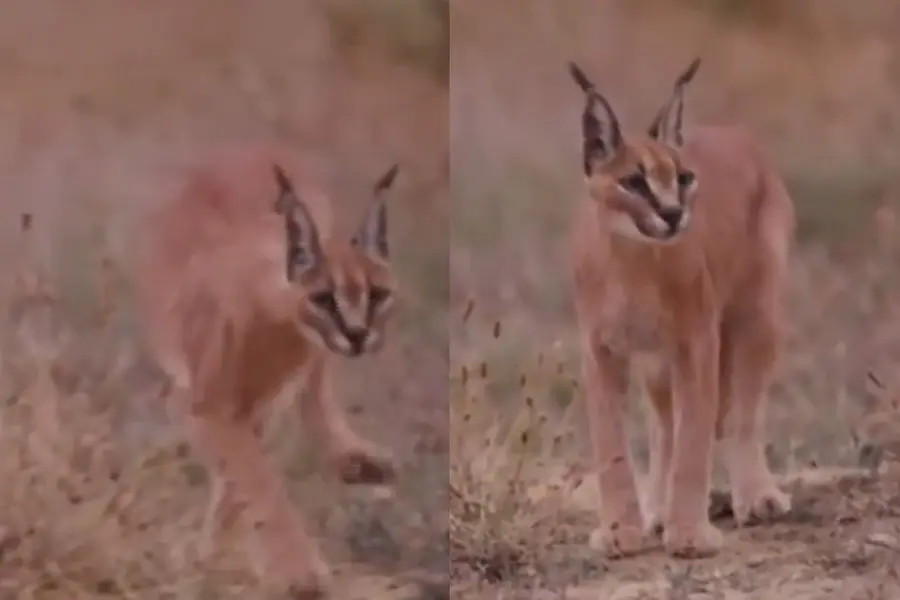
A rare sighting of the elusive caracal near the India–Pakistan border in Rajasthan’s Thar Desert has sparked fresh hope for the survival of one of India’s most endangered wild cats, even as concerns over its dwindling population persist.
Forest officials recently confirmed the presence of at least three caracals in the border region of Jaisalmer using motion-sensing camera traps and radio-collaring technology.
The sighting, captured on video and widely shared online, is being seen as a significant development in ongoing conservation efforts. Watch the viral video below:
The caracal, often referred to as the “desert lynx” due to its distinctive long, black-tufted ears, is a nocturnal and highly secretive predator adapted to arid ecosystems.
Once widely distributed across northwestern India, its population has declined sharply over the decades due to habitat loss, hunting, and fragmentation of grasslands.
Experts estimate that fewer than 100 caracals remain in India today, primarily in Rajasthan and parts of Gujarat. The species has already lost nearly 95% of its historical habitat, making every confirmed sighting crucial for its conservation.
Authorities have intensified monitoring in the border belt, deploying a network of camera traps and tracking devices to study the animal’s movement, behaviour, and habitat use in real time.
Researchers from the Wildlife Institute of India are also involved in analysing the data to build a clearer understanding of the species’ ecology in the harsh desert landscape.
The renewed focus on conservation comes in the wake of alarming incidents, including the recent killing of a caracal near the same border region. The animal was allegedly hunted and its carcass burned, highlighting threats from poaching and retaliatory attacks by locals after livestock losses.
Wildlife experts say shrinking grasslands, often misclassified as “wastelands” and diverted for development, remain one of the biggest threats to the species.
In addition, increasing human-wildlife conflict and the absence of dedicated long-term conservation programmes have pushed the caracal to the brink in India.
In response, the Rajasthan Forest Department has stepped up efforts, including awareness campaigns in border villages, anti-poaching measures, and plans to designate key habitats in the Thar Desert as protected zones.
Conservationists believe that the latest sighting could mark a turning point. If sustained protection and habitat restoration efforts continue, the fragile population of caracals in India may yet have a chance to recover.
Published: 24 Mar 2026, 01:48 pm IST
Related Topics
Disclaimer: Kindly avoid objectionable, derogatory, unlawful and lewd comments, while responding to reports. Such comments are punishable under cyber laws. Please keep away from personal attacks. The opinions expressed here are the personal opinions of readers and not that of Mathrubhumi.
