
Rahul Gandhi has accused the Modi government of allowing Washington to dictate the terms of diplomatic engagements after US Secretary of State Marco Rubio’s upcoming India visit was announced by the US State Department. The MEA has confirmed that External Affairs Minister S Jaishankar will meet Rubio in Mumbai on October 20.
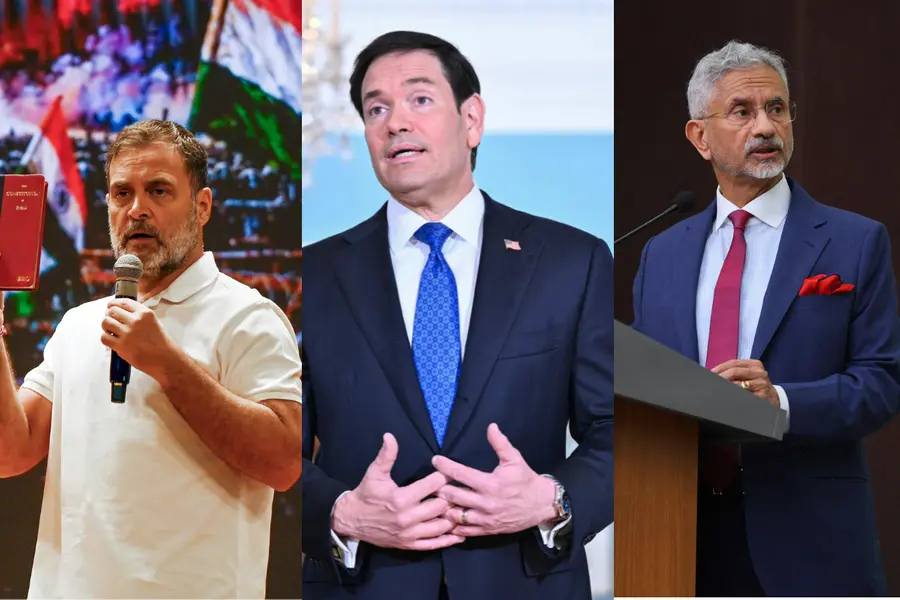
New Delhi: Congress leader Rahul Gandhi has criticised the Narendra Modi government over the upcoming meeting between External Affairs Minister S Jaishankar and US Secretary of State Marco Rubio in Mumbai, questioning whether Washington is influencing India’s diplomatic engagements.
“Rubio has summoned his employee to Mumbai,” Rahul said in a social media post, alleging confusion within the Ministry of External Affairs (MEA) over the visit.
The controversy erupted after the US State Department announced Rubio’s India visit before the Indian government formally confirmed the details. US Ambassador to India Sergio Gor subsequently said that American officials expected Jaishankar to join Rubio in Mumbai, prompting the Congress to question why the meeting was announced by a US official rather than the MEA.
What did Rahul Gandhi say?
Rahul Gandhi, the Leader of the Opposition in the Lok Sabha, used the planned meeting to renew his criticism of Prime Minister Narendra Modi’s handling of India-US relations.
“Rubio has summoned his employee to Mumbai. Modi, your officials in the External Affairs Ministry are confused about what's going on. You might want to explain. Unless, of course, you want me to,” Rahul posted.
Congress leaders argued that the sequence of announcements raised questions about India’s diplomatic protocol and its ability to independently communicate details of high-level bilateral engagements.
Rajya Sabha MP Jairam Ramesh also questioned the US ambassador’s remarks, particularly his statement that Washington expected Jaishankar to attend the meeting.
Congress spokesperson Pawan Khera alleged that a foreign government summoning India’s External Affairs Minister on Indian soil represented a serious diplomatic setback.
What has the MEA clarified?
The Ministry of External Affairs confirmed on Friday that Jaishankar would meet Rubio in Mumbai on October 20. Jaishankar will also attend celebrations marking the 250th anniversary of US independence as the Guest of Honour.
MEA spokesperson Randhir Jaiswal defended the decision to hold the meeting outside New Delhi, stating that India had hosted foreign dignitaries in different cities over the past decade.
He cited Prime Minister Narendra Modi’s meetings with the Spanish prime minister in Vadodara, German Chancellor Friedrich Merz in Ahmedabad and the prime minister of Mauritius in Varanasi. He also referred to Jaishankar’s diplomatic engagements in Goa, Kevadia in Gujarat and Amritsar.
The MEA said Rubio’s visit would provide an opportunity for both countries to review bilateral relations and strengthen their Comprehensive Global Strategic Partnership.
The discussions are expected to cover energy, trade, investment, defence, critical and emerging technologies, and regional and global developments.
However, the clarification addressed the choice of venue and the proposed agenda without directly responding to the Congress’s criticism over the sequence of announcements.
Why is Rubio visiting India?
Rubio is scheduled to visit Mumbai and Jamnagar in Gujarat during his second trip to India in six months. Jamnagar is home to Reliance Industries’ refinery operations.
According to the US State Department’s announcement, the visit is intended to deepen energy cooperation, alongside discussions with senior Indian government officials.
The visit comes amid tensions over trade negotiations and US pressure on countries purchasing Russian energy.
India and the US have yet to finalise a trade agreement, although Commerce Minister Piyush Goyal has said that the first phase was undergoing legal drafting.
Relations have also been affected by the US legislation known as the Lindsey Graham Sanctioning Russia and Iran Act, which gives the US President powers to impose tariffs of up to 100% on countries purchasing Russian oil and gas, including India and China.
What the controversy means for India-US relations
The dispute centres on two distinct issues: the location of the meeting and the protocol surrounding its announcement.
Holding diplomatic meetings outside a national capital is not, by itself, evidence of a loss of sovereignty or a departure from established practice. The MEA has cited several precedents to support its position on the choice of Mumbai.
The Congress’s criticism, however, focuses on the sequence of public announcements. Gor’s statement that US officials expected Jaishankar to attend came before the Indian government’s formal confirmation. This prompted questions about diplomatic communication and whether India was being represented on its own terms.
The broader context is also significant. India and the US are attempting to maintain cooperation in defence, energy and technology while managing disagreements over trade and India’s purchases of Russian energy.
Rubio’s visit could provide an opportunity to address these differences. The outcome of the discussions, rather than the choice of venue alone, will be important in assessing the direction of bilateral relations.
The meeting on October 20 is therefore likely to attract attention not only because of the political controversy but also because of its implications for trade negotiations, energy cooperation and the wider strategic partnership.
Published: 17 Oct 2026, 07:42 am IST
ABOUT THE AUTHOR

Related Topics
Disclaimer: Kindly avoid objectionable, derogatory, unlawful and lewd comments, while responding to reports. Such comments are punishable under cyber laws. Please keep away from personal attacks. The opinions expressed here are the personal opinions of readers and not that of Mathrubhumi.