
Priyanka Gandhi questioned police action against students as MPs pitched competing ideas on NEET reforms.
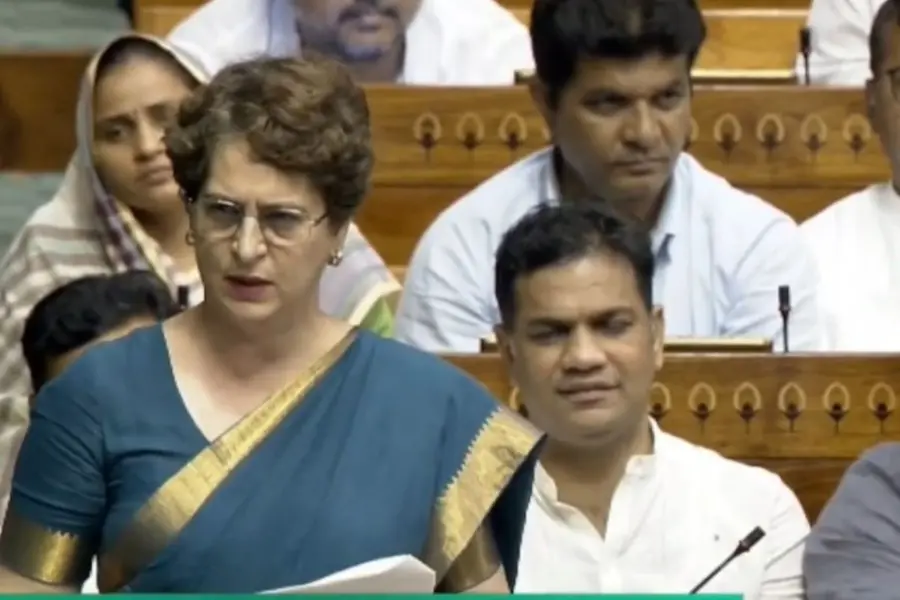
New Delhi: Congress MP Priyanka Gandhi Vadra on Tuesday escalated the Opposition's attack during the Lok Sabha debate on the anti-paper leak Bill, demanding to know who ordered the use of pellet guns against protesting students and questioning the police action during demonstrations over examination irregularities.
She sought answers from Prime Minister Narendra Modi and Union Home Minister Amit Shah, asking why such force was used against young aspirants.
Participating in the debate on the Public Examinations (Prevention of Unfair Means) Amendment Bill, 2026, Priyanka Gandhi condemned what she described as police brutality during a Parliament march by students.
'Who gave the order to fire pellet guns on students? What was the necessity of using brute force by police during the Parliament March?' she asked, arguing that students demanding fair examinations should not have been met with force.
The debate then expanded beyond the proposed legislation to wider concerns surrounding the country's examination system.
Shiv Sena MP Shrikant Eknath Shinde called for reforms in the National Eligibility cum Entrance Test (NEET), saying the examination pattern should be revisited and students should be given multiple opportunities to appear for the test instead of relying on a single attempt.
Telugu Desam Party MP Lavu Sri Krishna Devarayalu proposed the creation of a national question bank and decentralised question paper-setting committees, arguing that such a system would make examinations more transparent and equitable. During an exchange, he responded to DMK MP Dayanidhi Maran's demand to 'ban NEET' by remarking that Tamil Nadu 'wants to ban everything' and claimed industries were instead moving to Andhra Pradesh.
Lavu also said the Centre had done a 'phenomenal job' in responding to students' concerns and implementing necessary changes.
DMK MP Dayanidhi Maran, however, argued that it was 'Gen Z' students who compelled Parliament to debate the NEET issue after the government initially sought to 'brush it under the carpet'.
Referring to police action against protesters, internet restrictions and the reported use of Meta glasses by police personnel during demonstrations, Maran concluded his speech by reiterating his demand to 'ban NEET'.
Earlier, Trinamool Congress MP Abhishek Banerjee launched a sharp attack on the Centre during the Lok Sabha debate on the anti-paper leak Bill, saying the proposed amendments amount to an admission of the government's failure rather than a solution to examination fraud.
He argued that while stronger laws are necessary, they cannot substitute effective governance.
Participating in the debate on the Public Examinations (Prevention of Unfair Means) Amendment Bill, 2026, Banerjee said the government had 'mastered the art of changing laws when governance fails'.
He claimed that while the names of examinations, victims and accused keep changing, the pattern of crime and the government's response remain the same.
Questioning the Centre's handling of examination security, the TMC MP criticised the deployment of Indian Air Force helicopters to transport question papers.
'The youth of India are asking for honesty, not helicopters,' he said, arguing that such extraordinary measures reflected the government's inability to ensure the secure conduct of examinations through normal administrative mechanisms.
Banerjee maintained that a stronger law was 'necessary but not sufficient', adding that the Bill was 'not a solution but an admission of the government's failure' to prevent repeated paper leak incidents.
Earlier, Samajwadi Party chief Akhilesh Yadav intensified the Opposition's attack on the Centre during the Lok Sabha debate on the anti-paper leak Bill, accusing the BJP government of offering 'jumlas' instead of assurances and claiming that student protests over examination paper leaks forced the government to change its stand.
Participating in the debate on the Public Examinations (Prevention of Unfair Means) Amendment Bill, 2026, Yadav said the government believed it was 'invincible' until students took to the streets.
Referring to the protests, he remarked that youngsters proved 'jhukti hai duniya jhukane wala chahiye', adding that the government eventually bowed to public pressure and even made a minister resign.
The SP chief also said he had watched the protests from a distance and claimed that, after the protesters secured a victory, slogans were raised against the government. He accused the BJP of projecting itself as a government that never bows down, but argued that the agitation over paper leaks forced it to relent.
Targeting the ruling party further, Yadav said the BJP government gives 'jumlas' instead of assurances and expressed hope that the promises made to young people would ultimately be fulfilled.
Before Yadav, Congress MP Gaurav Gogoi questioned the effectiveness of the 2024 anti-paper leak law, arguing that examination leaks had continued despite the legislation and citing bail granted to several accused in such cases.
He argued that despite Parliament enacting the anti-paper leak law in 2024, examination leaks have continued to surface in the following years.
Questioning the government's commitment to tackling organised examination fraud, Gogoi claimed that 45 individuals booked in paper leak cases are currently out on bail.
He also referred to alleged mastermind Sanjay Mukhiya, saying he secured bail after the CBI failed to file a chargesheet within the stipulated period, and contended that such developments undermine confidence in the law's effectiveness.
Defending the amendments, BJP MP Bansuri Swaraj described them as a transformative step to safeguard students' futures. She said the issue was above politics and warned that the 'paper mafia' would face the strictest action under the strengthened law.
Earlier, opening the debate on the Bill, Minister of State for Personnel Dr Jitendra Singh said the Bill proposes amendments to the Public Examinations (Prevention of Unfair Means) Act, 2024, which he described as India's first dedicated law to protect the integrity of public examinations.
Defending the amendments, Singh said the existing law primarily enabled action against the immediate offenders, whereas the proposed changes seek to bring within the legal net everyone involved in a paper leak, whether directly or indirectly. He added that the enhanced penal provisions are intended to ensure accountability across the entire network behind such crimes.
Calling the amendments a step towards 'speedy justice', Singh argued that paper leak incidents had occurred in several states governed by different political parties and stressed that the issue should not be reduced to a political blame game.
He also asserted that despite multiple paper leak incidents before 2014, the country lacked a comprehensive law to deal with the menace.
According to Singh, the Narendra Modi government addressed that gap by enacting the 2024 law, while the latest amendments seek to further strengthen its implementation.
The Public Examinations (Prevention of Unfair Means) Amendment Bill, 2026, was introduced in the Lok Sabha by Dr. Jitendra Singh on Monday and seeks to amend the 2024 legislation.
Published: 28 Jul 2026, 02:41 pm IST
Disclaimer: Kindly avoid objectionable, derogatory, unlawful and lewd comments, while responding to reports. Such comments are punishable under cyber laws. Please keep away from personal attacks. The opinions expressed here are the personal opinions of readers and not that of Mathrubhumi.
