
President Droupadi Murmu has accepted Dharmendra Pradhan's resignation as Union Education Minister, while Cabinet Minister Pralhad Joshi has been given additional charge of the ministry with immediate effect.
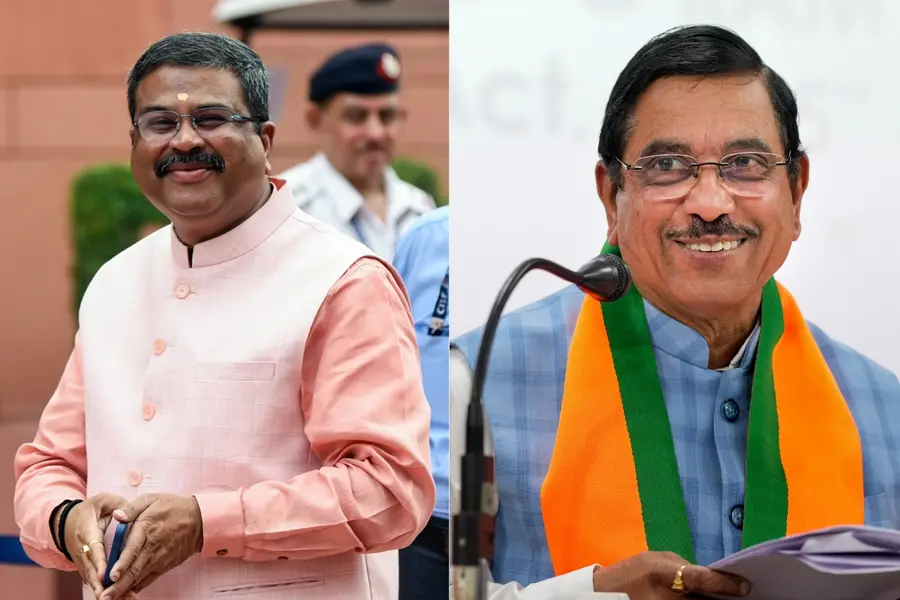
New Delhi: President Droupadi Murmu on Saturday accepted Dharmendra Pradhan's resignation from the Union Council of Ministers, formally ending his tenure as Union Education Minister.
The resignation was accepted on the advice of Prime Minister Narendra Modi under Article 75(2) of the Constitution, which deals with the tenure of Union ministers.
Also Read

Following Pradhan's exit, President Murmu assigned additional charge of the Ministry of Education to Cabinet Minister Pralhad Joshi. Joshi will continue handling his existing responsibilities while temporarily overseeing the Education Ministry.
Pralhad Joshi takes additional charge of education ministry
Pralhad Venkatesh Joshi is a senior BJP leader and a member of the Union Cabinet.
He has been serving as the Minister of Consumer Affairs, Food and Public Distribution and the Minister of New and Renewable Energy since 2024.
Before his current responsibilities, Joshi served as Union Minister for Parliamentary Affairs, Coal and Mines from 2019 to 2024.
With the additional education portfolio, Joshi will now oversee key issues including examination reforms, paper leak concerns, higher education policies and ongoing discussions around improving India's education system.
Dharmendra Pradhan's resignation after student protests
Pradhan's resignation came amid weeks of protests over alleged examination irregularities, including concerns related to the NEET paper leak controversy.
The agitation saw participation from students and activists, including a 26-day hunger strike by Sonam Wangchuk and a prolonged protest by the Cockroach Janta Party (CJP) at Jantar Mantar.
After Pradhan announced his resignation, CJP described it as a major achievement of its movement and later withdrew its protest after receiving assurances from the government on key demands.
What happens next for the education ministry?
Pralhad Joshi's immediate challenge will be addressing concerns related to examination security, restoring student confidence and implementing measures announced by the government following the paper leak controversy.
The Education Ministry is also expected to continue work on examination reforms, including strengthening systems to prevent future irregularities.
The change in leadership comes at a crucial time, with student groups and opposition parties continuing to demand greater accountability and transparency in the education sector.
Published: 25 Jul 2026, 08:33 pm IST
ABOUT THE AUTHOR
Related Topics
Disclaimer: Kindly avoid objectionable, derogatory, unlawful and lewd comments, while responding to reports. Such comments are punishable under cyber laws. Please keep away from personal attacks. The opinions expressed here are the personal opinions of readers and not that of Mathrubhumi.