
The move to Seva Teerth, a modern hub for key government offices, signifies a shift towards citizen-centric governance and a break from colonial-era structures.
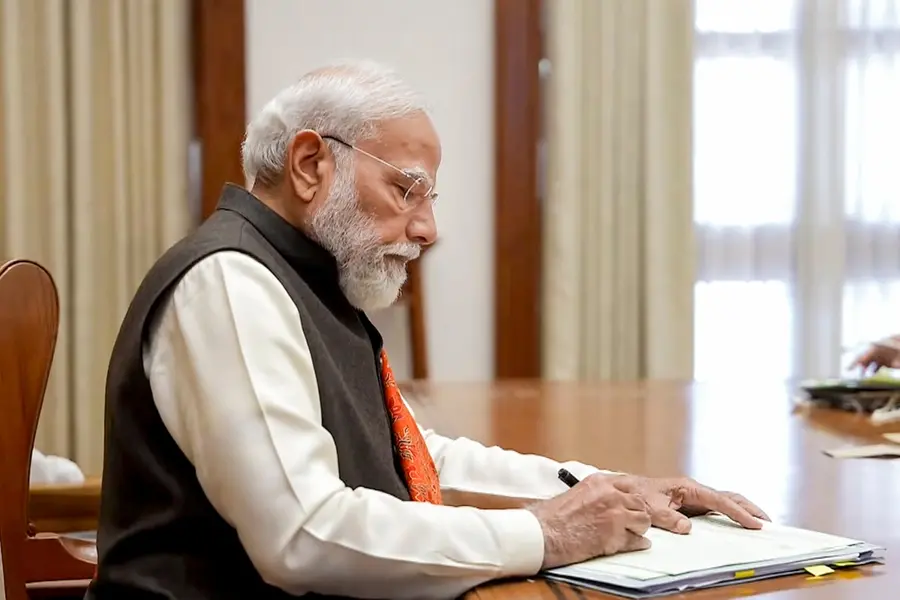
New Delhi: Prime Minister Narendra Modi marked his first day in the newly inaugurated "Seva Teerth" office on Friday by approving four major welfare initiatives aimed at farmers, women, and the nation’s youth.
The transition from the colonial-era South Block to the state-of-the-art complex on Kartavya Path serves as a cornerstone for what the government describes as a "citizen-centric" governance model. Upon assuming charge, the Prime Minister signed files for projects centred on the principle of "Seva," or service, specifically targeting the country's most vulnerable sections.
The "Seva Teerth" Mandate
The four key decisions approved Friday include:
- PM RAHAT Scheme: Designed as a "protection shield" for road accident victims, this nationwide initiative provides cashless medical treatment of up to Rs 1.5 lakh. The program aims to eliminate preventable fatalities during the "Golden Hour" by ensuring immediate care regardless of a victim's ability to pay.
- Lakhpati Didi Expansion: Building on the success of surpassing the 3-crore mark ahead of schedule, the government has doubled its ambition. The new target seeks to empower 6 crore women as "Lakhpati Didis" (women with an annual household income of Rs 1 lakh or more) by March 2029.
- Agri-Infrastructure Boost: In a move to fortify the agricultural value chain, the Prime Minister authorised doubling the Agriculture Infrastructure Fund (AIF) from Rs 1 lakh crore to Rs 2 lakh crore. The funds are earmarked for post-harvest management and community farming assets.
- Startup India FoF 2.0: A new Rs 10,000 crore corpus was allocated for the "Fund of Funds 2.0." This initiative is specifically geared toward high-growth sectors, including deep tech, advanced manufacturing, and early-stage innovation.
A New Governance Hub
The "Seva Teerth" complex now serves as the unified headquarters for the Prime Minister’s Office (PMO), the National Security Council Secretariat (NSCS), and the Cabinet Secretariat. Located on the reimagined Kartavya Path (formerly Rajpath), the facility replaces the fragmented administrative infrastructure that previously spanned several ageing buildings across the Central Vista.
According to officials, the move is more than a change of address; it represents a formal break from colonial administrative nomenclature. Along with the PMO’s relocation, the Central Secretariat has been renamed Kartavya Bhavan, while various Raj Bhavans across the country have been designated as Lok Bhavans.
"Our goal is to ensure that the administrative machinery is in close proximity to the people it serves," a PMO official stated, noting that the new office features digitally integrated zones designed for better public interface and inter-departmental coordination.
With inputs from IANS
Published: 13 Feb 2026, 04:47 pm IST
Related Topics
Disclaimer: Kindly avoid objectionable, derogatory, unlawful and lewd comments, while responding to reports. Such comments are punishable under cyber laws. Please keep away from personal attacks. The opinions expressed here are the personal opinions of readers and not that of Mathrubhumi.