
The move is part of the government’s broader effort, undertaken since 2014, to shed symbols associated with India’s colonial past
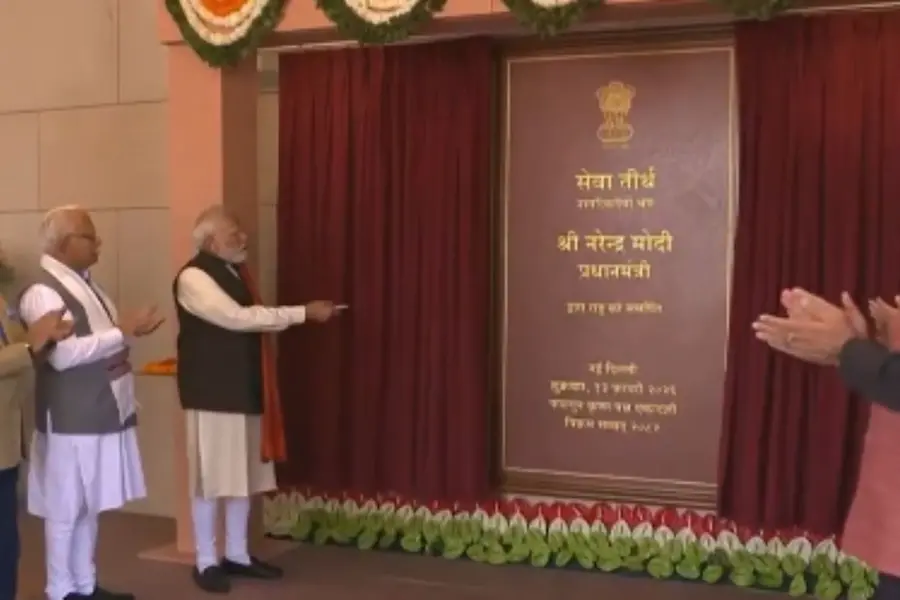
New Delhi: Prime Minister Narendra Modi on Friday unveiled the new complex, Seva Teerth, which will house the Prime Minister’s Office (PMO), the National Security Council Secretariat (NSCS) and the Cabinet Secretariat.
The Prime Minister was joined by several Union Ministers, including Dr Jitendra Singh, Minister of State in the PMO, Manohar Lal Khattar, Minister for Housing and Urban Affairs, National Security Advisor Ajit Doval, and other senior dignitaries.
The inauguration marks a significant milestone and represents a formal transition from the old PMO office located in South Block to the new state-of-the-art complex on Kartavya Path (formerly Rajpath).
Situated barely one kilometre from the iconic South Block building on Raisina Hill, the new PMO office is set to become the central hub of governance, bringing the administrative machinery closer together.
In the evening, the Prime Minister will also inaugurate the Kartavya Bhawan complex – Buildings 1 and 2 – from where several key ministries, including Finance, Defence, Health and Family Welfare, and Education, among others, will operate.
For decades, ministries have been spread across scattered, ageing buildings throughout the Central Vista, leading to logistical challenges and coordination gaps.
The new complexes are expected to address these long-standing issues by integrating ministries into modern, digitally enabled infrastructure.
Officials have said the buildings feature digitally integrated offices, structured public interface zones and centralised reception facilities, all designed to enhance collaboration, efficiency, citizen engagement and employee well-being.
The complexes have been designed to meet 4-Star GRIHA standards and incorporate renewable energy systems, water conservation measures, waste management solutions and high-performance building envelopes.
“These measures significantly reduce environmental impact while enhancing operational efficiency,” the statement added.
The buildings also include comprehensive safety and security frameworks, including smart access control systems, surveillance networks and advanced emergency response infrastructure, ensuring a secure and accessible environment for officials and visitors, officials said.
The inauguration is being viewed as a transformative milestone in India’s administrative governance architecture and reflects the Prime Minister’s commitment to building a modern, efficient and citizen-centric governance ecosystem.
More than symbolic
The inauguration of the Seva Teerth complex will be more than a symbolic renaming, as the North Block and South Block have served as the seat of power since 1931. The North Block, which historically housed the Home and Finance ministries, has largely moved out of the British-era building, while the South Block — once home to the Defence Ministry, the External Affairs Ministry and the PMO — is also undergoing transformation.
The government has planned for the upcoming Yuge Yugeen Bharat National Museum, billed as the world’s largest museum, to be housed within the North and South Block premises. This is part of a wider redevelopment of the Central Vista, the nation’s power corridor.
The Raisina Hill complex — including the Viceroy’s House (now Rashtrapati Bhavan) and the two iconic blocks — was the centrepiece of New Delhi when the capital was inaugurated. The foundation stones for the new capital were laid over a century ago by King George V and Queen Mary, and the city was officially inaugurated on 13 February 1931 by Viceroy Lord Irwin.
The inauguration was preceded by the dedication of the All India War Memorial Arch (now India Gate) on 12 February 1931, in memory of soldiers who died in the First World War and the Third Anglo-Afghan War. The new imperial city was announced in 1911 during a grand Durbar when King George V declared the capital would move from Calcutta to Delhi. Architects Sir Edwin Lutyens and Sir Herbert Baker were commissioned to design the new city, which took more than 20 years to build.
The Central Vista redevelopment project also includes the new Parliament building — whose foundation stone was laid in 1921 and which was inaugurated in 1927 — as well as the new Parliament building inaugurated by Prime Minister Modi in 2023, a revamped Kartavya Path, and new residences for the Prime Minister and Vice President.
Published: 13 Feb 2026, 02:12 pm IST
Related Topics
Disclaimer: Kindly avoid objectionable, derogatory, unlawful and lewd comments, while responding to reports. Such comments are punishable under cyber laws. Please keep away from personal attacks. The opinions expressed here are the personal opinions of readers and not that of Mathrubhumi.
