
PM Modi inaugurated Dahod’s new electric locomotive factory, boosting India’s rail infrastructure and ‘Make in India’ initiative.
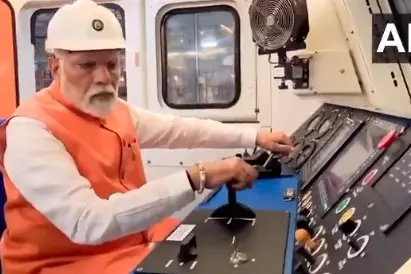
Dahod: Prime Minister Narendra Modi on Monday inaugurated the Loco Manufacturing Shop–Rolling Stock Workshop in Dahod, Gujarat, and flagged off the first electric locomotive produced at the facility—marking a significant infrastructure milestone for Indian Railways.
Dedicating the Dahod locomotive manufacturing unit to the nation, Prime Minister Modi underlined the importance of the workshop, which has been developed at an investment of Rs 20,000 crore.
Rapid project completion
The foundation stone for the project was laid in 2022, and within just three years, the state-of-the-art production facility was ready for operations.
The workshop has been designed with an annual production capacity of 120 electric locomotives, which can be increased to 150 units based on future demand.
Production under PPP model
Under the Public Private Partnership (PPP) model, Indian Railways aims to manufacture 1,200 electric locomotives at this facility over the next ten years.
Each of these 9,000 HP locomotives, in line with Prime Minister Modi's vision of 'Make in India' and 'Atmanirbhar Bharat', will carry the label ‘Manufactured in Dahod’.
Advanced capabilities and features
These high-powered engines are capable of hauling 4,600 tonnes of cargo and are intended for both domestic use and export.
In a first, the locomotives will feature air conditioning and toilet facilities for drivers, significantly enhancing crew comfort.
In addition, an advanced cover system has been installed to improve safety and help prevent accidents.
Boost to freight transport
At present, four locomotives are under production at the Dahod facility, all of which will proudly bear the 'Manufactured in Dahod' tag.
These locomotives are expected to operate mainly on the Western Dedicated Freight Corridor (DFC) and other graded railway sections.
Designed to haul container freight trains in double-stack configurations weighing up to 4,500 tonnes at 75 km/h on a one-in-200 gradient, they aim to increase the average speed of such trains from the current 20–25 km/h to around 50–60 km/h.
This improvement in operational capability is expected to significantly boost freight throughput and enhance line capacity across Indian Railways.
IANS inputs
Published: 26 May 2025, 12:32 pm IST
Related Topics
Disclaimer: Kindly avoid objectionable, derogatory, unlawful and lewd comments, while responding to reports. Such comments are punishable under cyber laws. Please keep away from personal attacks. The opinions expressed here are the personal opinions of readers and not that of Mathrubhumi.
