
Taller than the Eiffel Tower by 35 metres, it now holds the title of the highest railway bridge in the world
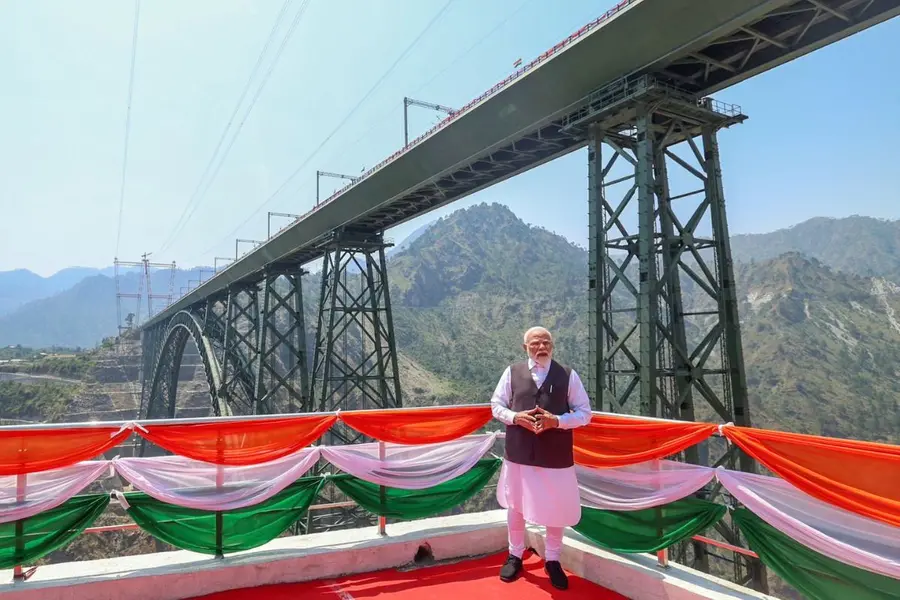
Reasi: Prime Minister Narendra Modi has inaugurated the world’s tallest rail bridge, the Chenab Rail Bridge, on Friday. The ceremony marks the opening of the 63-kilometre Katra–Sangaldan section of the Udhampur–Srinagar–Baramulla Rail Link (USBRL), a critical infrastructure project for the region. Also included in the inauguration is the Anji Bridge, India’s first cable-stayed rail bridge.
Following the event, the Prime Minister flagged off the first Vande Bharat Express to run over the Chenab Bridge, officially bringing the record-breaking structure into operation. Often described as an engineering marvel, the bridge was completed using advanced machinery and skilled human craftsmanship.
The Chenab Rail Bridge crosses the Chenab River in Jammu and Kashmir’s Reasi district. At 359 metres above the riverbed—taller than the Eiffel Tower by 35 metres--it now holds the title of the highest railway bridge in the world, surpassing the Daduhe River Railway Bridge in China. Built by Afcons Infrastructure under the Konkan Railway Corporation, the bridge spans 1,315 metres and cost ₹1,486 crore to construct. It has an estimated lifespan of 120 years.
The bridge features a two-rib steel arch with an open spandrel design, meaning the rail track is supported by vertical columns rising from the arch rather than resting directly on it. Weathering steel, known for its corrosion resistance and ability to handle extreme temperatures from -20°C to 45°C, was used throughout the structure. Each segment weighs approximately 34 metric tonnes and was installed using the world’s tallest cable crane with a 127-metre-high pylon--taller than the Qutub Minar.
The Chenab Bridge is designed to withstand strong winds of up to 266 km/h and seismic forces of Zone V, India’s highest earthquake risk category. More than 5,84,000 kilometres of welding--roughly the same as 14 trips from Jammu to Delhi--were needed to join the bridge’s components. For safety, Indian Railways used Phased Array Ultrasonic Testing, a first in the country, to inspect critical welds.
To ensure real-time safety monitoring, over 100 sensors have been installed across the bridge. These devices track environmental conditions, wind speeds, vibrations, and structural load. If any data exceeds safe limits, the system automatically triggers red signals to halt train operations and alerts relevant control rooms. The bridge’s health monitoring is managed by Tranz Rail Solutions in collaboration with Strainstall, part of the UK-based James Fisher group.
Published: 06 Jun 2025, 12:08 pm IST
Related Topics
Disclaimer: Kindly avoid objectionable, derogatory, unlawful and lewd comments, while responding to reports. Such comments are punishable under cyber laws. Please keep away from personal attacks. The opinions expressed here are the personal opinions of readers and not that of Mathrubhumi.
