
Periyar's birth anniversary marks the legacy of the Tamil social reformer whose campaigns transformed debates on caste, rationalism, equality and women's rights.
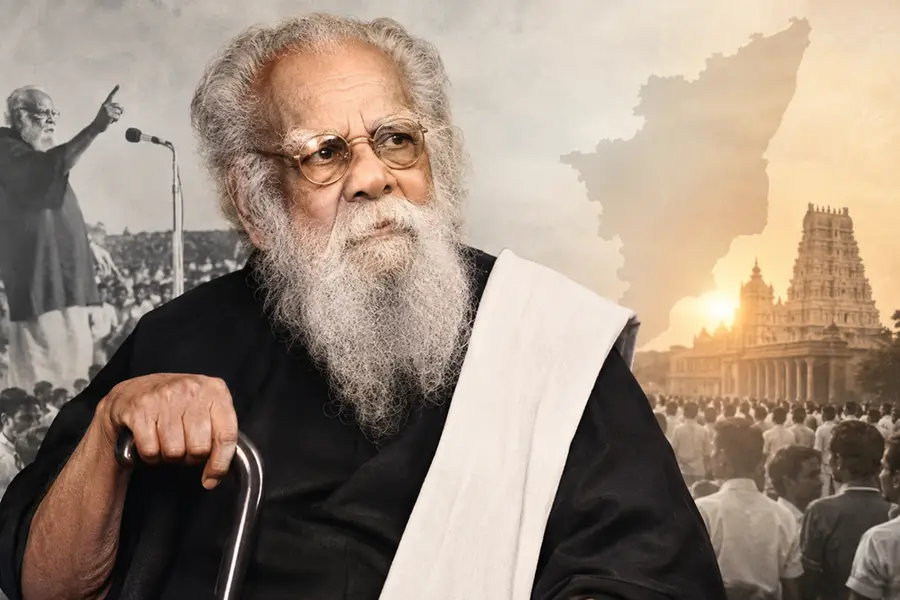
Chennai: September 17 marks the birth anniversary of Erode Venkatappa Ramasamy, popularly known as Periyar, one of the most influential social reformers in Tamil Nadu's modern history.
Born in Erode on September 17, 1879, Periyar spent decades campaigning against caste discrimination, social inequality and religious orthodoxy, while advocating rationalism, self-respect and equal rights.
His ideas played a major role in shaping the social justice discourse in Tamil Nadu and influenced the wider Dravidian movement.
The Tamil Nadu government observes his birth anniversary as Social Justice Day.
Periyar was born into a prosperous family in Erode and entered public life after working in his family's business.
He later joined the Indian National Congress and became involved in the freedom movement.
However, his association with the Congress eventually ended over disagreements concerning caste discrimination and representation.
In 1925, Periyar launched the Self-Respect Movement, which sought to challenge caste-based social hierarchies and promote dignity and equality.
The movement encouraged people to question customs and institutions that Periyar believed perpetuated social inequality.
Periyar and the Self-Respect Movement
The Self-Respect Movement became the central platform for many of Periyar's social reform campaigns.
It advocated equality irrespective of caste and promoted rationalist thinking instead of unquestioned acceptance of religious and social traditions.
The movement also encouraged changes in marriage practices. Self-Respect marriages were conducted without the traditional religious rituals and sought to emphasise equality between the partners.
The movement's activities also included campaigns for women's education, widow remarriage, and greater rights for women.
Periyar believed that political independence alone could not guarantee social freedom.
He argued that society also needed to confront caste-based discrimination and other forms of inherited inequality.
His opposition to caste discrimination
The abolition of caste hierarchy remained one of Periyar's principal objectives.
He repeatedly argued that a person's social position should not be determined by birth and criticised practices that placed communities in a hierarchy.
Periyar was also associated with the Vaikom Satyagraha in present-day Kerala, where lower-caste people fought for the right to use public roads around the Vaikom temple.
His participation in the movement earned him the title 'Vaikom Veerar', or Hero of Vaikom.
His anti-caste politics later became closely associated with the Dravidian movement. In 1944, the Justice Party was transformed into the Dravidar Kazhagam under his leadership.
Periyar and the Hindi question
Periyar was also a prominent opponent of the imposition of Hindi in the Madras Presidency.
He argued that compulsory Hindi education could disadvantage Tamil-speaking people and viewed language as closely connected with questions of social and cultural equality.
His campaigns contributed to the emergence of a strong anti-Hindi movement in Tamil Nadu. Language rights subsequently became an important element of Dravidian politics in the state.
His views on women's rights
Women's rights formed another important part of Periyar's reform agenda.
He questioned practices that restricted women's independence and advocated women's education, property rights and freedom in marriage.
He opposed child marriage and supported widow remarriage. He also argued that women should have greater control over decisions concerning their own lives and marriages.
Periyar's writings and speeches frequently connected women's emancipation with his broader campaign against social hierarchy.
Periyar's rationalist philosophy
Rationalism was at the heart of Periyar's worldview. He urged people to question established beliefs and customs and emphasised the importance of reason and critical thinking.
His criticism of religion and religious institutions was often uncompromising and made him a controversial figure. Supporters regarded his arguments as an important challenge to entrenched social practices, while critics objected to the nature and scope of his attacks on religion and religious traditions.
Famous quotes by Periyar
Periyar's speeches and writings continue to be quoted in discussions about rationalism, equality and social justice. Some of his widely cited statements include:
- “Wisdom lies in thinking. The spear-head of thinking is rationalism.”
- “There is no god. There is no god. There is no god at all. He who created god is a fool.”
- “Men are equal by birth; it is their deeds that make them unequal.”
- “Women should have the right to education, property and independence.”
- “The greatest service that one can do to society is to develop self-respect in the people.”
Periyar's legacy
Periyar died on December 24, 1973, at the age of 94. His influence, however, continued through the Dravidian social and political movements that emerged and developed around many of the principles he championed.
His legacy remains a subject of public debate, particularly on questions of caste, religion, language, social justice and Tamil identity.
Supporters remember him as a pioneering anti-caste reformer and rationalist, while critics have questioned some of his rhetoric and political positions.
Tamil Nadu's continued observance of his birth anniversary as Social Justice Day reflects the enduring place of his ideas in the state's public discourse.
More than five decades after his death, Periyar remains a significant figure in India's history of social reform.
His central message was that social practices and hierarchies should not be accepted simply because they were inherited from the past, but should be examined through the principles of equality, reason and human dignity.
Published: 17 Sept 2026, 03:08 pm IST
ABOUT THE AUTHOR

Related Topics
Disclaimer: Kindly avoid objectionable, derogatory, unlawful and lewd comments, while responding to reports. Such comments are punishable under cyber laws. Please keep away from personal attacks. The opinions expressed here are the personal opinions of readers and not that of Mathrubhumi.