
Onion prices have reached Rs 80 per kg in some states. The Centre is releasing buffer stock and selling onions at Rs 35/kg through NCCF, NAFED and Kendriya Bhandar.
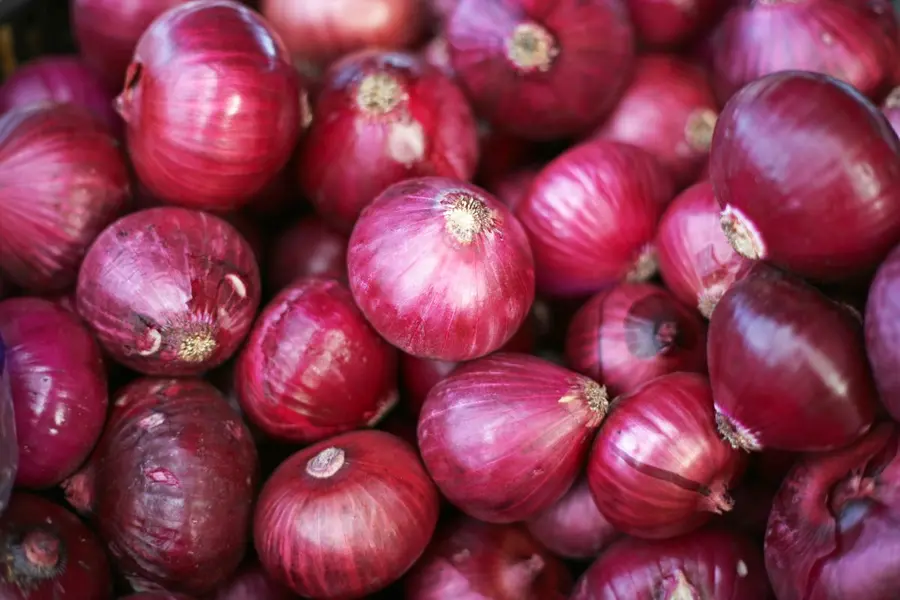
Onion prices have surged to as much as Rs 80 per kg in some parts of India, putting pressure on consumers as supplies tighten in several markets. Retail prices have also risen sharply in Delhi-NCR and other states, despite the Centre maintaining that there is no overall shortage of onions.
To contain the price rise, the government has begun a calibrated release of buffer stocks, with onions being sold at a subsidised rate of Rs 35 per kg through NCCF, NAFED, Kendriya Bhandar outlets and mobile vans in Delhi-NCR.
Why are onion prices rising despite the government's buffer stock?
The Centre has started releasing onions from its price-stabilisation buffer to increase availability and contain seasonal price pressures as retail prices rise across several states.
Consumer Affairs Secretary Nidhi Khare flagged off onion vans from Krishi Bhawan in New Delhi for retail distribution in the National Capital Region.
The government says there is no shortage in onion production or overall availability. It expects onion production to exceed 307 lakh metric tonnes in 2025-26, which it says is sufficient to meet domestic demand in the coming months.
However, market prices have risen sharply in several locations.
In Delhi-NCR, retail onions are reportedly selling for around Rs 50-55 per kg, while prices in some open markets have reached Rs 60-70 per kg. In some states, prices have climbed to around Rs 80 per kg.
Government onions to be sold at Rs 35 per kg
To provide relief to consumers, onions from the government's buffer stock are being sold at a subsidised price of Rs 35 per kg in Delhi-NCR.
The sales are being carried out through NCCF, NAFED and Kendriya Bhandar outlets, as well as mobile vans.
The government has said that such retail intervention is undertaken when onion prices begin to rise sharply, with the objective of increasing supplies in major consumption centres and moderating prices.
Onion prices rise across states
The price increase is not limited to Delhi.
In West Bengal, onion prices have reportedly risen to around Rs 70-80 per kg from Rs 30-35 per kg over the past two weeks.
In Rajasthan, prices have reached around Rs 50 per kg, while onion prices in Jammu have risen to about Rs 60 per kg from Rs 20-25 per kg in the past 15 days.
In Dehradun, onions are reportedly selling for around Rs 60 per kg, while prices at Jwalapur Mandi in Haridwar have reached around Rs 50 per kg.
The wholesale market has also seen increases.
At Agra's Sikandra market, around 15 truckloads of onions, equivalent to roughly 300 tonnes, are reportedly arriving daily from Nashik, with wholesale prices hovering around Rs 40 per kg.
What is happening to onion supplies?
Traders and market participants have pointed to limited arrivals from some producing regions as one reason behind the price increase.
Onions are currently arriving in smaller quantities from places including Shivpuri in Madhya Pradesh and Alwar in Rajasthan. Market conditions are expected to remain firm in some regions until fresh crop harvesting begins.
In parts of Uttar Pradesh, traders have reported a sharp increase in wholesale prices over a short period.
The situation varies across markets because onion prices depend on local arrivals, demand, transportation and the availability of stored stocks.
Centre rejects reports of 30% buffer stock spoilage
The government's intervention comes amid reports concerning the condition of its stored onion stocks.
The Centre has rejected claims that around 30% of its 1.21 lakh tonnes of onion buffer stock had spoiled.
Consumer Affairs Secretary Nidhi Khare said the onions in the government's stock were of good quality and rejected the suggestion that the reported quantity had rotted.
The government has also changed its storage arrangements. For the first time this year, the Central Warehousing Corporation (CWC) has been entrusted with storing onions, with the aim of improving storage and shelf life.
What is Kanda Express?
The Centre has also begun using dedicated rail transport to move onions from producing areas to major consumption centres.
The first Kanda Express carrying 453.65 tonnes of onions from Nashik reached Delhi on Friday.
The dedicated 21-wagon rake is part of the government's effort to move buffer-stock onions quickly to areas experiencing higher prices.
Some of the stock transported through the initiative is also being sent to Chandigarh, Ludhiana and Jammu.
Is India facing an onion shortage?
The Centre maintains that India is not facing an overall production shortage.
The Consumer Affairs Ministry said estimated production of more than 307 lakh metric tonnes in 2025-26, combined with available buffer stocks and government intervention, should ensure adequate supplies.
However, the current price rise indicates that availability at the national level does not necessarily mean uniform availability across individual markets.
Factors such as regional arrivals, transportation, storage losses, weather-related damage and the timing of fresh-crop harvesting can affect retail prices even when total national production remains adequate.
Why onion prices matter
Onions are a major part of household food consumption in India, making sudden price increases politically and economically sensitive.
The Centre's buffer-stock mechanism is designed to intervene when prices rise by releasing stored onions into markets. Selling the stock at a subsidised rate can provide consumers with a cheaper alternative while increasing supply in high-demand locations.
The effectiveness of the current intervention will depend on how quickly buffer stocks reach affected markets and whether fresh arrivals improve in the coming weeks.
Analysis
The current onion-price rise appears to be driven more by market-level supply constraints and seasonal factors than by an outright nationwide production shortage, according to the Centre's assessment.
The government is therefore using several measures simultaneously: releasing buffer stocks, selling onions at Rs 35 per kg, transporting stocks through Kanda Express and strengthening storage arrangements.
The immediate challenge is to bridge the gap between adequate national production and higher prices in individual markets. Unseasonal rainfall, storage losses, transportation and delayed fresh-crop arrivals can tighten supplies locally even when overall production remains strong.
The coming weeks will be important because the arrival of the new crop could ease pressure on prices. Until then, the Centre's buffer-stock releases and subsidised retail sales are intended to prevent temporary supply constraints from turning into a wider price shock.
Published: 30 Aug 2026, 03:39 pm IST
ABOUT THE AUTHOR

Related Topics
Disclaimer: Kindly avoid objectionable, derogatory, unlawful and lewd comments, while responding to reports. Such comments are punishable under cyber laws. Please keep away from personal attacks. The opinions expressed here are the personal opinions of readers and not that of Mathrubhumi.