
Prime Minister Narendra Modi and Chinese President Xi Jinping met on the sidelines of the SCO Summit in Tianjin, stressing that India and China are “partners, not rivals.” The leaders discussed border peace, cross-border terrorism, trade balance, and people-to-people ties while agreeing that their common interests outweigh differences
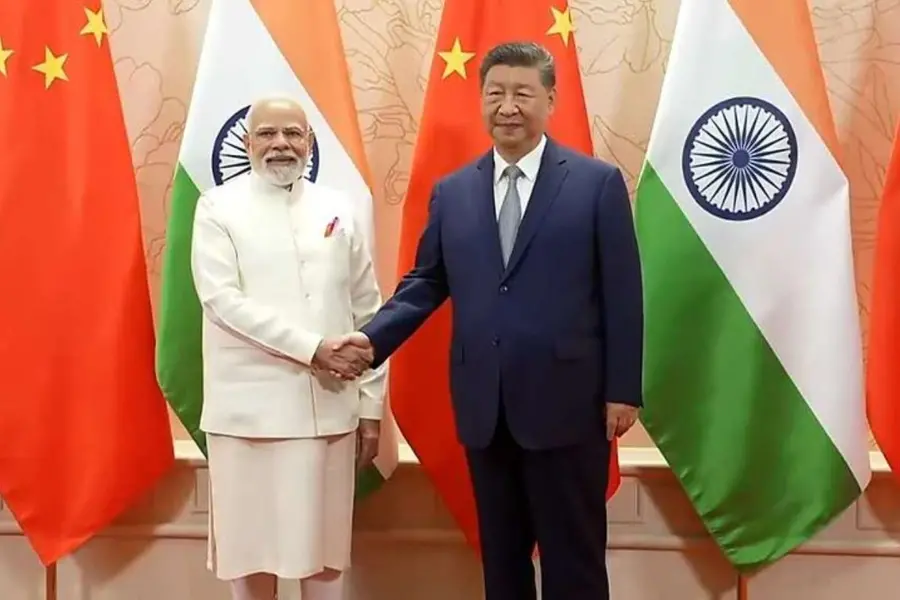
Tianjin: Prime Minister Narendra Modi and Chinese President Xi Jinping held wide-ranging discussions on Sunday on the sidelines of the Shanghai Cooperation Organisation (SCO) Summit in Tianjin. Both leaders underlined that India and China are “partners, not rivals”, stressing that their shared interests far outweigh their differences.
Foreign Secretary Vikram Misri briefed reporters after the meeting, saying the two leaders agreed their countries were primarily focused on domestic development goals. “It was a point of consensus that a stable and amicable relationship between India and China benefits the 2.8 billion people of both countries,” Misri said, adding that the leaders agreed differences must never be allowed to escalate into disputes.
‘Asian Century’ and Multipolar World
The talks also highlighted the role of India-China cooperation in shaping what has often been called the Asian Century. Both leaders agreed their partnership is essential for a balanced, multipolar world order, according to Misri.
Cross-Border Terrorism Featured in Talks
A key issue raised by Prime Minister Modi was cross-border terrorism, which he described as a shared challenge for both nations. “The Prime Minister underlined that this is something that impacts both India and China, and we need to extend understanding and support to each other in combating it,” Misri noted.
The remarks come in the backdrop of recent Pahalgam attacks and Operation Sindoor, amid heightened tensions between India and Pakistan, with Beijing often seen as a supporter of Islamabad.
Border Peace and the LAC Question
On the contentious border issue, both sides acknowledged last year’s “successful disengagement” and the relative peace along the Line of Actual Control (LAC).
“The Prime Minister underlined that peace and tranquillity along the border are vital for the smooth progress of bilateral ties,” Misri said. Both leaders expressed commitment to a “fair, reasonable, and mutually acceptable resolution” of the boundary issue, while stressing the use of existing mechanisms to avoid flare-ups.
Xi Jinping’s Four Suggestions
Foreign Secretary Misri outlined President Xi’s four proposals to take ties forward:
- Strengthen strategic communication and deepen mutual trust.
- Expand exchanges and cooperation.
- Ensure mutual benefit and win-win results while accommodating each other’s concerns.
- Enhance multilateral cooperation to safeguard shared interests.
“All these points were responded to positively by Prime Minister Modi,” Misri confirmed.
Trade, Economy, and ‘Strategic Autonomy’
On the economic front, Modi and Xi emphasised that India and China can help stabilise global trade. Both leaders agreed to work on reducing the trade deficit, improving transparency, and encouraging bilateral investment flows.
Prime Minister Modi also said the relationship between India and China should be viewed independently, without a third-country lens, reiterating both nations’ pursuit of “strategic autonomy.”
People-to-People Ties and Future Engagements
The talks also touched upon people-to-people exchanges. Both sides welcomed the resumption of the Kailash Manasarovar Yatra, pledged to expand direct flights, and agreed to streamline visa facilitation.
Modi formally invited Xi to attend the BRICS Summit in India in 2026, which Xi accepted, promising full support to India’s presidency.
In a social media post after the meeting, Modi described the talks as “fruitful,” adding: “We reviewed the positive momentum in India-China relations since our last meeting in Kazan. We agreed on the importance of peace on the border and reaffirmed our commitment to cooperation based on mutual respect, mutual interest, and mutual sensitivity.”
Meeting with Politburo Standing Committee Member Cai Qi
Apart from his talks with Xi, Modi also met Cai Qi, member of the Politburo Standing Committee of the Communist Party of China. Originally, a banquet was proposed to be hosted by Cai on behalf of Xi, but due to scheduling issues, a shorter meeting was arranged. During the interaction, Modi shared his vision for the India-China relationship, while Cai assured that Beijing seeks to expand exchanges, address economic concerns, and strengthen ties in line with the leaders’ consensus.
Published: 31 Aug 2025, 08:33 pm IST
Disclaimer: Kindly avoid objectionable, derogatory, unlawful and lewd comments, while responding to reports. Such comments are punishable under cyber laws. Please keep away from personal attacks. The opinions expressed here are the personal opinions of readers and not that of Mathrubhumi.
