
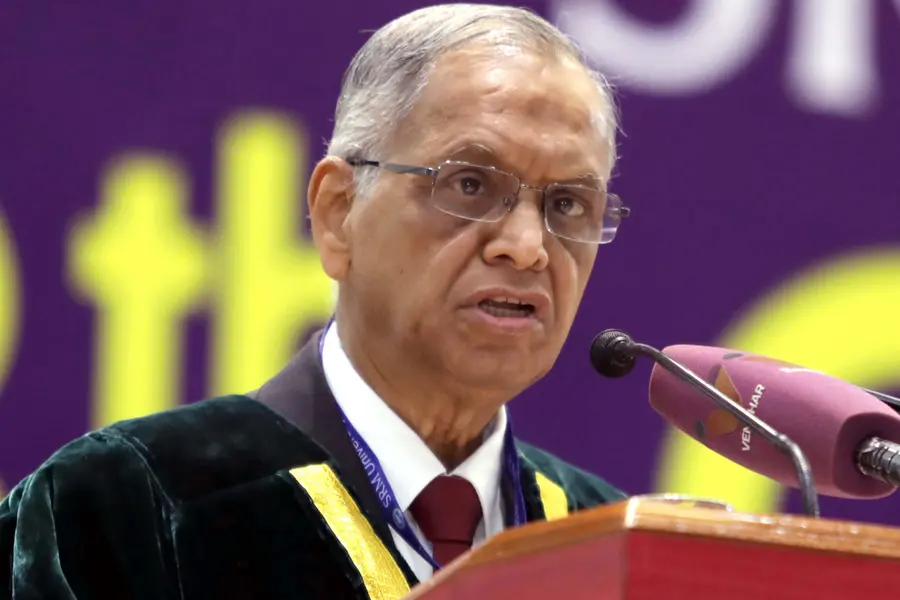
The debate surrounding work hours has reignited after Infosys founder Narayana Murthy clarified his earlier statement about working long hours, emphasizing the value of hard work in the corporate world. Murthy had previously mentioned working a 70+ hour workweek, which sparked discussion about work culture and its impact on employee well-being.
In a recent clarification, Murthy elaborated on his personal work ethic, stating, "I used to get to the office at 6.20 am and leave by 8.30 pm. That's a fact. I have done it. Nobody can say that is wrong. I have done it for 40 and more years. These are not issues that need to be discussed and debated. These are issues one can introspect, ingest and conclude whatever they want."
Murthy's comments reflect a traditional view of hard work and dedication to one's job, which has long been associated with success in the corporate world. However, this sentiment contrasts with the growing calls from other industry leaders for a more flexible, employee-centric approach to work culture.
Adar Poonawalla, CEO of Serum Institute of India, had recently advocated for a work culture that prioritizes flexibility while still valuing hard work. He pointed out that while dedication is essential, the glorification of long working hours could be detrimental to employees' mental health and personal lives. “Long hours should not be glorified to the detriment of employees’ mental health and personal lives,” Poonawalla said, emphasizing the importance of productivity over sheer hours worked. He believes in fostering a work environment that allows employees to maintain a healthy balance between work and personal life, ensuring sustained motivation and well-being.
Similarly, Anand Mahindra, Chairman of the Mahindra Group, has voiced his disagreement with the notion that success should be measured by the number of hours worked. Speaking at the National Youth Festival in New Delhi, Mahindra said, “Focus on the quality of work, not the quantity,” adding, “Even if it’s 10 hours, you can change the world in 10 hours.” He underscored that it’s not about the number of hours spent working, but rather the outcomes and the quality of work achieved during that time. Mahindra also pointed out that a balanced life leads to better decision-making, stressing that leaders should have exposure to diverse experiences, including time spent with family and reflection outside of work, to make informed decisions.
In the debate around work hours, Elon Musk, CEO of Tesla and SpaceX, has also made his views clear, emphasizing intense work ethics in his companies. Musk has famously advocated for working 80-100 hours per week, saying that “work like hell” and “put in 80 to 100 hour weeks every week” if you want to achieve something extraordinary. While acknowledging the toll that such long hours can take, Musk has argued that the rewards for putting in such effort are significant, especially when aiming to solve challenging problems.
The conversation around long work hours took a turn when S.N. Subrahmanyan, Chairman of Larsen & Toubro (L&T), suggested a 90-hour workweek and even advocated for Sunday work. His comments, made in a viral video, faced widespread criticism, especially when he downplayed the significance of personal time, asking why one would "stare at their spouse" instead of working. Subrahmanyan also compared Indian workers unfavorably to their Chinese counterparts, suggesting that such dedication was necessary for India’s global competitiveness.
In response to the backlash, Amitabh Kant, India's G20 Sherpa, defended Subrahmanyan, clarifying that his remark had been “twisted” and “taken out of context.” Kant explained that Subrahmanyan’s intention was not to enforce extreme work hours but to motivate his team to deliver projects ahead of time. Kant said, “He was telling them, ‘… please work hard, so we can deliver our projects before time.’”
The contrasting views of these prominent business leaders underscore the evolving discourse on work culture, with some advocating for long hours as a measure of commitment, while others stress the importance of work-life balance for sustainable productivity and mental well-being.
Published: 21 Jan 2025, 12:43 pm IST
Related Topics
Disclaimer: Kindly avoid objectionable, derogatory, unlawful and lewd comments, while responding to reports. Such comments are punishable under cyber laws. Please keep away from personal attacks. The opinions expressed here are the personal opinions of readers and not that of Mathrubhumi.
