
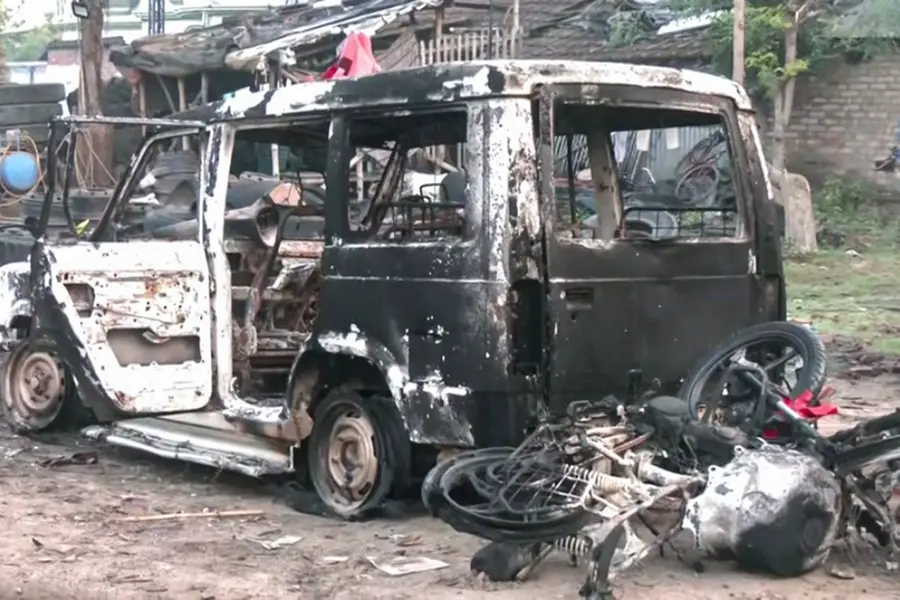
West Bengal: The ruling Trinamool Congress (TMC) has accused the BJP of spreading fake images and videos online amid communal unrest in Murshidabad district, where at least three people died and many were injured after protests over the Waqf (Amendment) Act turned violent in Suti and Samserganj.
TMC leaders Sagarika Ghose and Kunal Ghosh claimed that BJP was circulating unrelated images from other states and falsely attributing them to West Bengal. Ghose described this as part of a campaign of “communal polarisation and incitement,” calling for police action.
In contrast, BJP leaders, including West Bengal Leader of the Opposition Suvendu Adhikari, alleged that Hindus in Murshidabad were facing religious persecution. Adhikari claimed over 400 Hindus had fled Dhulian and taken shelter in Malda due to fear.
Amid rising tensions, the Calcutta High Court ordered deployment of Central Armed Police Forces (CAPF) in Murshidabad. A special bench was convened to address Adhikari's petition requesting central force deployment. The court cited incidents of vandalism and a breakdown of law and order.
BJP’s Sukanta Majumdar alleged that homes and businesses of a specific community were being targeted. He also criticised internet shutdowns in the affected regions, claiming it silenced victims' voices.
Violence on Friday saw vehicles, including police vans, torched, roads blocked, and stones hurled at security forces. Over 150 people have been arrested. Prohibitory orders under Section 163 of the Bharatiya Nagarik Suraksha Sanhita (BNSS) are in place, with the BSF deployed in Suti, Dhuliyan, and Samserganj.
In recent years, the Bharatiya Janata Party (BJP) has been repeatedly accused by opposition parties, civil society groups, and independent observers of contributing to communal tensions in India for political gain. These allegations include the use of inflammatory rhetoric, dissemination of unverified or misleading content on social media, and attempts to frame local incidents as part of a broader communal narrative. In the context of the Murshidabad violence, the BJP claimed that Hindus were being targeted, while the Trinamool Congress (TMC) countered that the visuals shared by the BJP were from unrelated incidents in other states. These exchanges have drawn attention to a recurring pattern where political discourse becomes heavily communalised, often leading to heightened social divisions and polarisation during politically sensitive periods.
Published: 13 Apr 2025, 07:04 pm IST
Disclaimer: Kindly avoid objectionable, derogatory, unlawful and lewd comments, while responding to reports. Such comments are punishable under cyber laws. Please keep away from personal attacks. The opinions expressed here are the personal opinions of readers and not that of Mathrubhumi.
