
Delhi court dismisses plea against Sonia Gandhi’s citizenship and voter roll entry citing lack of jurisdiction.
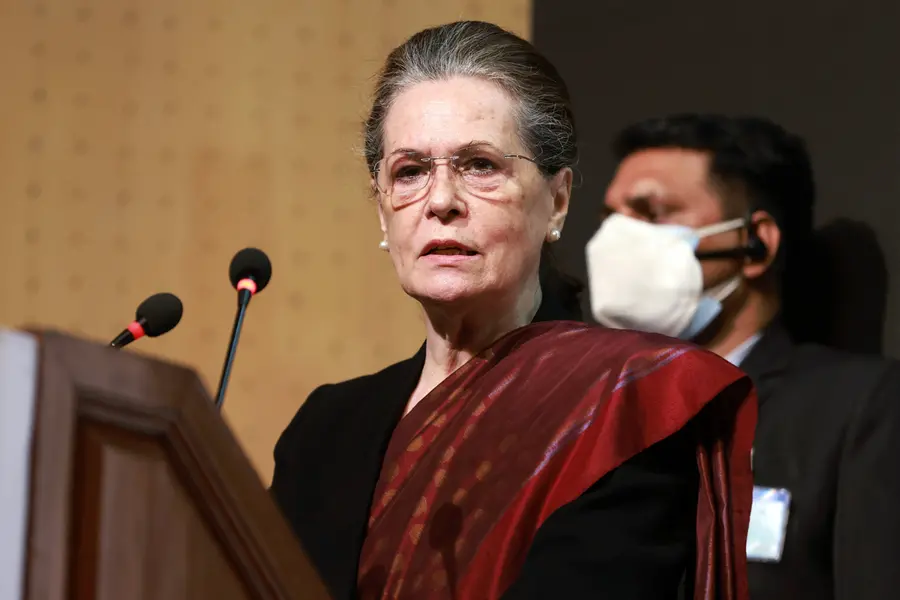
New Delhi: A Delhi court on Thursday dismissed a plea seeking a probe against senior Congress leader Sonia Gandhi, alleging her name was included in electoral rolls three years before she acquired Indian citizenship in 1983.
Observing that the issue of citizenship fell under the “exclusive constitutional and statutory mandate of the central government”, additional chief judicial magistrate Vaibhav Chaurasia said:
Also Read

"Such a course, in substance, amounts to a misuse of the process of law by projecting a civil or ordinary dispute in the garb of criminality, solely to create a jurisdiction where none exists."
The court further remarked that the complaint was "fashioned with the object of clothing the court with jurisdiction through allegations which are legally untenable, deficient in substance, and beyond the scope of this forum's authority".
Complaint by advocate
The complaint was filed by advocate Vikas Tripathi, vice president of the Central Delhi Court Bar Association of the Rouse Avenue courts. Tripathi’s counsel, senior advocate Pavan Narang, alleged that in January 1980, Gandhi’s name was added as a voter of the New Delhi constituency when she was not yet an Indian citizen. He claimed there was "some forgery" and that a public authority had been "cheated".
Court rejects claims of forgery
The court, however, ruled that the complainant was trying to set the criminal law in motion by persuading the court to assume jurisdiction which did not vest in it legally.
It observed:
"A scrutiny of the averments discloses that an endeavour has been made to invoke the provisions relating to the offences of cheating and forgery in order to provide a colour of jurisdiction before this forum. However, the fundamental ingredients necessary to constitute the alleged offences are conspicuously lacking."
The court held that "mere bald assertions, unaccompanied by the essential particulars required to attract the statutory elements of cheating or forgery" cannot substitute a legally sustainable accusation.
Electoral roll evidence insufficient
The plea relied upon an extract of the electoral roll, described as "a photocopy of a photocopy of an alleged extract of an uncertified electoral roll" of 1980. Deprecating the complaint, the court reiterated that such a course amounted to misuse of law by projecting a civil or ordinary dispute as criminality.
Jurisdiction lies with Centre and Election Commission
The court underscored it was not empowered to adjudicate upon citizenship questions, which fall exclusively under the Centre’s jurisdiction.
It also stressed that determining the eligibility of a person to be included in or excluded from the electoral roll lies solely with the Election Commission of India under the Representation of the People Act, 1950 and 1951.
Bar under Constitution
The judge said:
"Any attempt by this court to embark upon such an inquiry would result in an unwarranted transgression into fields expressly entrusted to the competent constitutional authorities and would be a violation of Article 329 (bar to interference by courts in electoral matters) of the Constitution."
The court ruled that the private complaint could not encroach upon the exclusive jurisdiction of the Election Commission of India and the Central Government, as citizenship was a sovereign matter.
It concluded:
"Whatever cannot be done directly, cannot be done indirectly. Mere addition of predicate offences under the Bharatiya Nyaya Sanhita (BNS), with the mask of cognisability, will not justify any interference in the constitutional functionaries by this court."
(With PTI inputs)
Published: 11 Sept 2025, 08:19 pm IST
Related Topics
Disclaimer: Kindly avoid objectionable, derogatory, unlawful and lewd comments, while responding to reports. Such comments are punishable under cyber laws. Please keep away from personal attacks. The opinions expressed here are the personal opinions of readers and not that of Mathrubhumi.