
DMK MP Kanimozhi strongly opposed the delimitation Bill in Lok Sabha, calling it a threat to India’s federal structure.
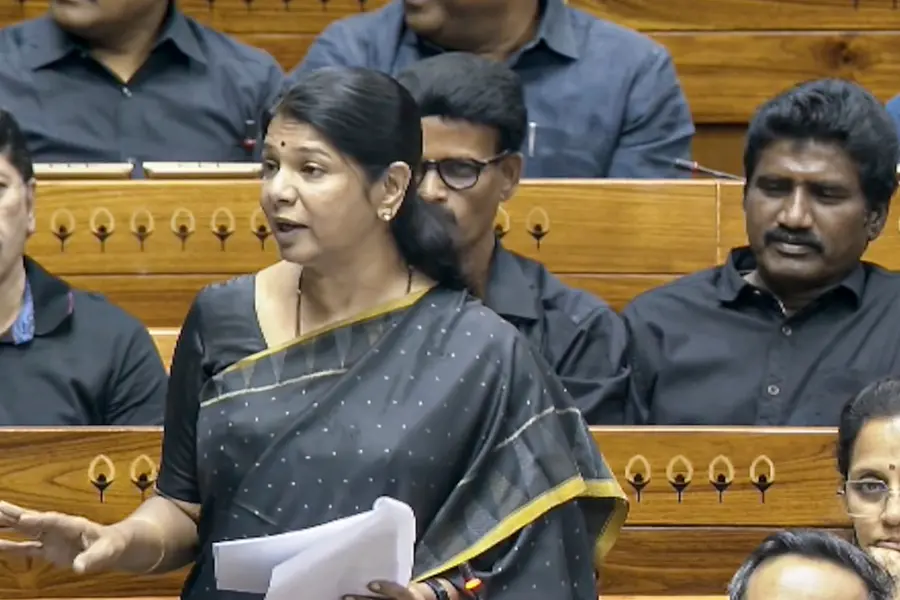
New Delhi: DMK MP Kanimozhi Karunanidhi on Friday launched a sharp attack on the Constitution (131st Amendment) Bill and the proposed delimitation exercise, calling it the “greatest assault on the federal structure” during a heated Lok Sabha debate on electoral reforms and women’s reservation.
Dressed in a black saree as part of a symbolic protest, she also criticised the Centre for notifying the Nari Shakti Vandan Adhiniyam, 2023 in the Gazette while Parliament was still debating the women’s reservation framework.
Kanimozhi questions timing, intent of electoral reforms
Kanimozhi said she represented both the DMK and “eight crore people” of Tamil Nadu, arguing that the proposed reforms would dilute the voice of southern states in Parliament.
She questioned the timing of the government’s notification, asking why key decisions were being formalised while the Bill was still under discussion in the House.
She further alleged that the three linked Bills on women’s reservation, delimitation and electoral restructuring were being presented under the guise of reform but could weaken India’s federal structure.
Also Read| Women’s groups urge MPs to delink quota from census, delimitation
Concerns over population-based delimitation
The DMK leader strongly opposed population-based seat redistribution, calling it unfair to states that have successfully implemented population control measures.
She highlighted that Tamil Nadu’s fertility rate has dropped to 1.6, marking what she described as a completed demographic transition.
Kanimozhi contrasted this with higher population growth in northern states, arguing that Tamil Nadu and other southern states had complied with national population control policies but could now face reduced political influence.
She also questioned the use of 2011 Census data for delimitation, warning that outdated figures could distort representation if used for redrawing constituencies.
Demand to separate Women’s reservation from delimitation
Kanimozhi reiterated DMK’s demand that the Women’s Reservation Act, providing 33 per cent reservation for women in Lok Sabha and state assemblies, should be implemented independently from the delimitation exercise and based on the existing 543-seat structure.
She warned that linking the two reforms could delay women’s representation and create an imbalance in parliamentary strength.
Sharp exchange over Southern states’ representation
Union Home Minister Amit Shah earlier assured Parliament that southern states would not lose representation, stating that seat distribution would remain proportionate even after expansion.
He cited projections showing that states such as Karnataka, Andhra Pradesh, Tamil Nadu and Kerala would see increases in the number of MPs while maintaining similar percentage shares.
However, Kanimozhi argued that the Bill’s wording leaves key decisions open-ended, including which census data will be used and how the Delimitation Commission will function.
Federalism debate intensifies in Parliament
The debate over delimitation and women’s reservation has intensified political tensions, with opposition parties alleging centralisation of power and the government insisting the reforms ensure equitable representation.
Kanimozhi also invoked Dravidian ideology, referencing reformer Periyar E V Ramasamy, stating that justice must account for regional disparities rather than apply uniform population-based formulas.
Also Read| ‘North, south, east or west—no discrimination’: PM Modi on delimitation bill
Broader political protest in Tamil Nadu
The issue has triggered parallel protests outside Parliament as well, with Tamil Nadu Chief Minister M K Stalin criticising the delimitation proposal as unfair to Tamil people and federal principles.
The controversy over delimitation, women’s reservation implementation, and census-based seat redistribution continues to dominate national political discourse ahead of future electoral cycles.
Inputs from Agencies
Published: 17 Apr 2026, 01:16 pm IST
Disclaimer: Kindly avoid objectionable, derogatory, unlawful and lewd comments, while responding to reports. Such comments are punishable under cyber laws. Please keep away from personal attacks. The opinions expressed here are the personal opinions of readers and not that of Mathrubhumi.
