
Supreme Court Justice Dipankar Datta used a cricket umpire analogy while examining the law governing the appointment of the CEC and election commissioners.
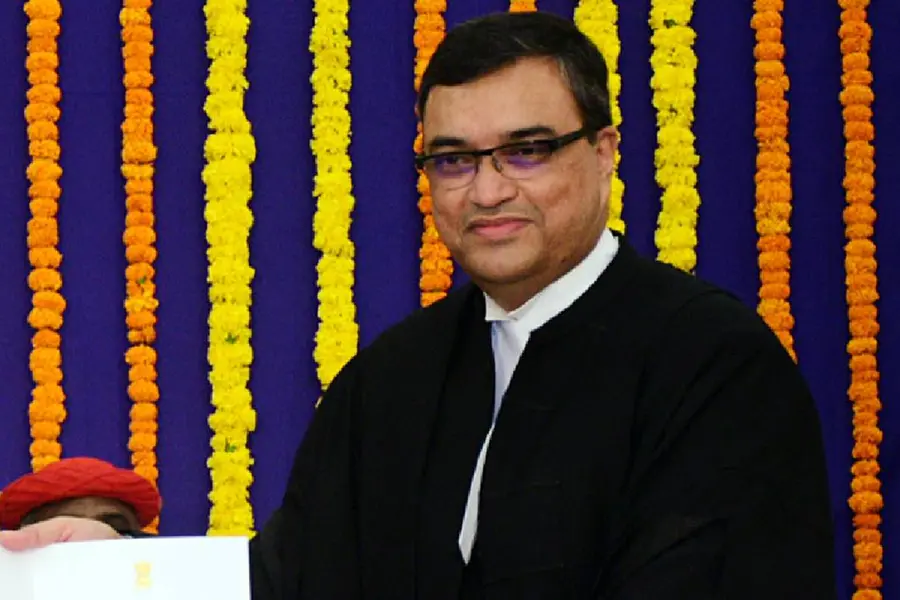
New Delhi: An umpire selected by the captain of a cricket team that eventually wins would always be suspected over his decisions even if they are correct, Supreme Court judge Dipankar Datta said on Wednesday to highlight that the Executive will have an "effective" veto in the selection of the Chief Election Commissioner and election commissioners.
Using this cricket metaphor, Justice Datta was extremely critical of the fact that a three-member panel, comprising the Prime Minister, the Leader of Opposition and a Union minister, selects the CEC and election commissioners.
Also read | SC verdict on CEC appointment law: Judges split, matter referred to Constitution Bench
If free and fair elections are to be ensured, it is axiomatic that the Election Commission (EC) must not only be an independent body but also be seen to act independently, he said.
Dealing with the issue of independence and neutrality, Justice Datta noted the submissions of petitioners that the inclusion of a minister in the panel denuded the selection committee of institutional neutrality.
"If the said Selection Committee were to function, the decision would invariably be 2:1, on paper, in favour of the executive and, in practice, of whoever is the ruling party. With two members from the executive being part of the Selection Committee, the executive has an effective veto," he said.
Referring to discussion during the hearing, he said it was quite unlikely that the minister would take a stand against the Prime Minister in case of a difference of opinion between the Prime Minister and the Leader of the Opposition.
"The presence of likelihood of a 'no' is striking enough to colour the perception of the Selection Committee; the probabilities and certainties of the 'no' matter little. Thus, the challengers of the law contend, even if the appointments are meritorious, the process does not pass the perception test.
"The bottom line of the argument runs thus: it would not be a fallacious metaphor if it is said that since the umpire is picked by the captain of one side in a cricket match and his team wins, even if the decisions taken by such umpire are correct, it has the patina of suspicion, for, at the end of the day, the umpire has effectively been chosen by the winning captain," he said.
Justice Datta headed a bench, also comprising Justice Satish Chandra Sharma, which gave split opinions on whether a batch of pleas challenging the validity of a 2023 law that excludes the CJI from the panel for selecting the chief election commissioner (CEC) and election commissioners should be referred to a larger constitutional bench.
Also read | ECI says all decisions, including SIR, were unanimous
Justice Sharma differed with the views of Justice Datta and batted for referring the pleas to a larger bench while terming the issue as important.
Justice Datta said, "If free and fair elections are to be ensured, it is axiomatic that the ECI must not only be an independent body but also be seen to act independently."
He said that though the 2023 Act may possibly survive the frontal challenge of not including the CJI in the selection committee but it has to succeed on the perception test, which this court has repeatedly said is essential.
Raising questions, Justice Datta said can it be argued with conviction that the selection committee (for selection of CEC and election commissioners), envisioned in section 7 of the 2023 Act, looks as independent as the pro-tem committee constituted by the apex court in 2023.
"Over seven decades, every dispensation resting power found it convenient to keep institutions which the Constitution envisioned to be independent under their control to enact along the lines empowered by Article 324(2) would have meant freeing the ECI from exclusive executive control and inviting trouble for the ruling regime.
"To the mind of this court, this has not been the failing of any one party or one period. A consistent trait of political power discernible over the decades has been to preserve leverage over the very body that is meant to judge its claim to power," he said.
On the enactment of the 2023 Act, Justice Datta said the question now is whether the appointment process contemplated by Sections 6, 7, and 82 evinces major executive control, passes the muster of Article 14 of the Constitution and whether Section 7 in particular meets the constitutional standard of independence required by Article 324 and the basic structure on the question of independence and neutrality.
He said the 2023 Act envisages a selection committee of three– prime minister, Union minister nominated by the PM and the leader of opposition (LoP) for the selection of CEC and election commissioners.
"There can be no gainsaying that free and fair elections, to a large extent, depend on a truly independent ECI. It is not enough for the ECI to be independent; it must also appear to be independent," he said.
Elaborating further on the panel sought to be constituted by the 2023 law, Justice Datta said the minister nominated by the prime minister to function as the third member of the selection committee, chaired by the prime minister, cannot be expected to defy his own nominator and risk his continuation as such nominated member on the committee for all practical purposes.
"Even otherwise, the collective responsibility doctrine would preclude the minister from opposing his Prime Minister, as observed in Manoj Narula case (2014 verdict) which reposes faith in the Prime Minister, and the entire nation has expectations of good governance being carried on by the ministers of his choice," he said.
Published: 23 Sept 2026, 08:31 pm IST
ABOUT THE AUTHOR

Disclaimer: Kindly avoid objectionable, derogatory, unlawful and lewd comments, while responding to reports. Such comments are punishable under cyber laws. Please keep away from personal attacks. The opinions expressed here are the personal opinions of readers and not that of Mathrubhumi.