
With no warning and exits blocked, soldiers fired 1,650 rounds, killing hundreds of men, women, and children.
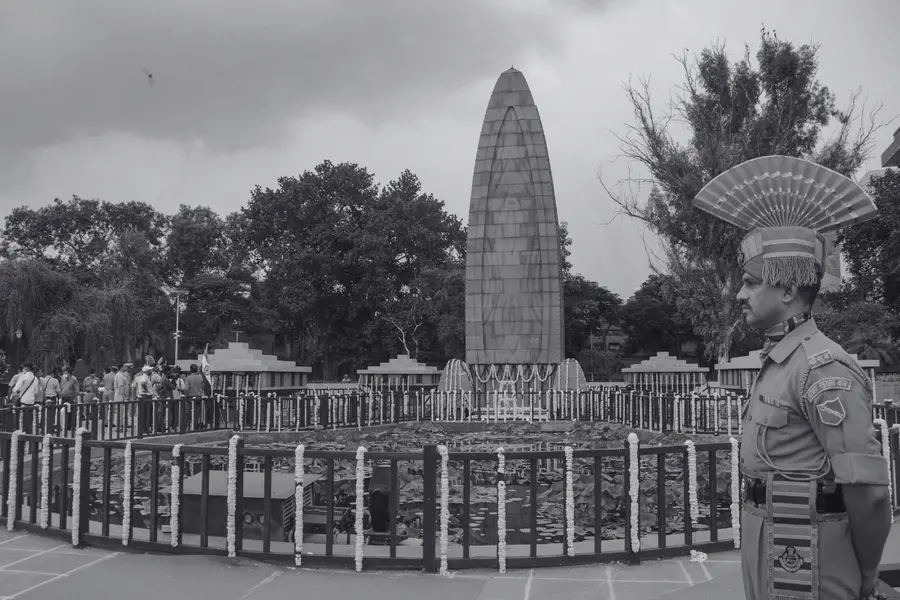
Amritsar: On the afternoon of April 13, 1919, a walled garden in the heart of Amritsar became the site of one of the darkest chapters in British colonial history. In a matter of ten minutes, British Indian Army troops opened fire on a peaceful, unarmed gathering, turning a festive spring day into a massacre that would permanently alter the trajectory of India's freedom struggle.
Here is the factual account of what transpired on that fateful day at Jallianwala Bagh, an event that shocked the world and galvanised the Indian independence movement.
The Brewing Storm: The Rowlatt Act
The massacre did not occur in a vacuum; it was the climax of mounting tensions between the British Raj and the Indian public. Following the end of World War I, a conflict to which India contributed over a million soldiers, Indians expected greater self-governance. Instead, the British imperial government passed the Anarchical and Revolutionary Crimes Act of 1919, widely known as the Rowlatt Act.
This draconian law allowed the colonial government to arrest any Indian without a warrant and imprison suspects without trial. In response, Mahatma Gandhi called for a nationwide hartal (general strike). Punjab became a major centre of these protests. By April 10, the secret arrest and deportation of two prominent local leaders, Dr Saifuddin Kitchlew and Dr Satyapal, sparked widespread, and eventually violent, protests in Amritsar, resulting in the deaths of both Indian civilians and European nationals.
April 13, 1919: The Massacre
April 13 marked Baisakhi, a major Sikh spring festival. An estimated 15,000 to 20,000 people, men, women, and children of all faiths, gathered inside Jallianwala Bagh. While some were local residents meeting to peacefully protest the Rowlatt Act and the arrest of their leaders, thousands of others were pilgrims from neighbouring villages, unaware that the newly appointed military commander, Brigadier-General Reginald E.H. Dyer, had hastily implemented martial law and banned all public gatherings.
Jallianwala Bagh was not a park but a dried-out, walled enclosure surrounded by tightly packed buildings. It had only one narrow entry and exit point.
At approximately 5:30 PM, Brigadier-General Dyer arrived with 90 Gurkha, Baloch, Rajput, and Sikh troops. The sequence of events that followed was swift and devastating:
- No Warning: Dyer ordered his troops to block the main exit. Without issuing any warning to the crowd to disperse, he commanded his men to open fire.
- Targeting the Densest Crowds: Dyer deliberately directed his soldiers to shoot where the crowd was thickest, including the exits where panicked civilians were attempting to flee.
- The Firing: The troops fired roughly 1,650 rounds of Lee-Enfield rifle ammunition over the course of about ten minutes, stopping only when their ammunition was virtually exhausted.
- The Martyr’s Well: In a desperate bid to escape the hail of bullets, many men, women, and children jumped into a deep well inside the compound, where scores tragically drowned or were crushed.
Once the firing ceased, Dyer and his troops immediately withdrew, leaving the dead and dying where they lay. Due to a strict curfew imposed by martial law, families were unable to retrieve their wounded loved ones until the following morning.
The Toll and the Aftermath
The exact number of casualties remains highly contested to this day:
- The Official British Estimate: The Hunter Commission, a British inquiry formed later to investigate the massacre, cited 379 dead and approximately 1,200 wounded.
- Indian Estimates: Investigations by the Indian National Congress and local testimonies estimated that over 1,000 innocent people were killed, with over 1,500 injured.
Brigadier-General Dyer later admitted to the Hunter Commission that he did not fire simply to disperse the crowd, but to "punish" them and produce a "moral effect" across the Punjab. While he was eventually censured and forced to resign from the military, he was notably hailed as a "Saviour of the Punjab" by some factions in the British House of Lords and members of the British public, who even raised a massive monetary fund in his honour.
A Turning Point for India
The brutality of Jallianwala Bagh shattered any remaining illusions of British benevolence in India. It served as a massive catalyst for the independence movement.
- Nobel laureate Rabindranath Tagore renounced his British knighthood in protest, stating that the "time has come when badges of honour make our shame glaring in the incongruous context of humiliation."
- Mahatma Gandhi lost all faith in the British justice system, leading him to launch his first large-scale, nationwide Non-Cooperation Movement in 1920.
Today, Jallianwala Bagh stands as a national memorial. The bullet holes preserved in its brick walls and the solemn presence of the Martyr's Well remain a stark, silent testament to the innocent lives lost and the heavy price paid for India's freedom.
Published: 13 Apr 2026, 10:58 am IST
Disclaimer: Kindly avoid objectionable, derogatory, unlawful and lewd comments, while responding to reports. Such comments are punishable under cyber laws. Please keep away from personal attacks. The opinions expressed here are the personal opinions of readers and not that of Mathrubhumi.
